


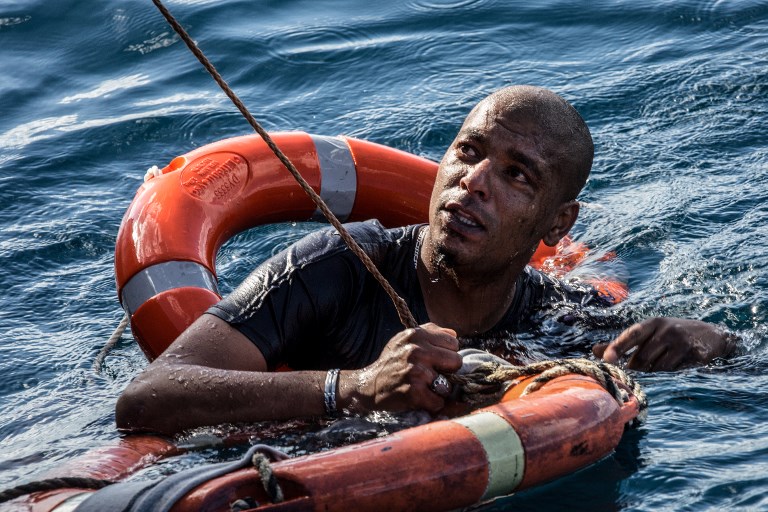
While the world’s political and economic elite were discussing and debating, not to mention wining and dining, in Davos, hundreds of human beings were drowning while making a desperate attempt to cross the Mediterranean. There was little discussion of this ongoing catastrophe at the annual World Economic Forum gathering in Switzerland. Obviously, there were other important issues of concern for the world’s most powerful movers and shakers. But for those refugees fleeing from both natural and man-made disasters, from economic deprivation and oppression, the discussions in Davos might as well have been taking place on another planet. For them, survival is all they seek, all that they can dream of. Many of them — women, men and children — won’t make it and will face a horrific end to their life; anonymous to most of the world, but not to their loved ones left behind.
This year has barely begun but, according to the Geneva-based International Organization for Migration, 204 deaths of migrants crossing the Mediterranean have already been recorded. This is similar to the figures recorded in January 2018 — a year that ended with 2,297 fatalities in a sea that has become a gigantic graveyard for some of the poorest and most-persecuted people in the world. Since this calamity has been taking place and reported on for years now, it would be reasonable to conclude that ending it is not high on the international community’s agenda, and that this fact demonstrates contempt for the lives and wellbeing of the least privileged on this planet. A more cynical view is that there are enough sinister forces out there that would like these tragedies not only to happen, but also to be publicized in order to deter others from even contemplating embarking on such a dangerous venture.
It would be wrong to single out any one country, group of countries or international organizations as responsible for the heartbreaking disasters that are occurring almost daily in the Mediterranean. It is an international collective failure that begins by not addressing the root causes that push so many people to leave their homes to undertake such a hazardous journey. It continues by abandoning those in flight to the unscrupulous and greedy smugglers who go unpunished, by not allocating enough resources for search and rescue operations at sea, and by vilifying migrants instead of providing them with shelter and an opportunity to restart their lives.
To be sure, what is currently happening in the Mediterranean basin is closely related to a general, increasing hostility to all migrants, including refugees and asylum seekers. It might be perceived as naive to expect that, in the current political, social and economic environment, countries will open their arms, or more importantly their borders, to those fleeing the horrors in their home countries. Yet such action is imperative for those who believe that we, as human beings, have a responsibility to save fellow humans whose lives, freedoms and fundamental rights are at acute and immediate risk. As well as being a moral obligation, it is also a legal one — of non-refoulement (i.e., not returning an asylum seeker to a country where they would be in danger of persecution) as enshrined in the 1951 Refugee Convention.
The most obvious way to reduce the number of people risking their lives trying to reach Europe is to embark on a concerted international effort to address the conditions that are forcing them to leave in the first place. It is one of the European myths, reinforced by nationalist movements and their opportunistic politicians, that most of these people are arrivals from the developing world who have come to exploit the West’s generous welfare systems. However, a quick glance at the origins of those who board tiny dinghies and other not-fit-for-purpose vessels in their attempts to cross the Mediterranean gives an instant and different explanation of why, in the last five years, nearly 2 million people have taken this deadly route, which has claimed the lives of nearly 18,000 of them.
It would be reasonable to conclude that ending the migration crisis is not high on the international community’s agenda
Yossi Mekelberg
Guinea, for instance, which topped the list of refugees’ countries of origin in 2018, is ranked among the most indebted and poorest countries in the world — almost the poorest of all 188 countries in the 2016 Human Development Index — and its security forces, notorious for using excessive force against its citizens, have a long history of human rights abuses and criminality. Other countries from which those crossing the Mediterranean are fleeing include war-ravaged Syria and Mali, and states notorious for their political instability such as Iraq, Afghanistan or Cote d’Ivoire. It is the intolerable conditions and deadly dangers back home that force so many to risk their lives and face the unknown, not the lure of Europe’s welfare systems.
Improving conditions in those countries is necessary and urgent, but it can’t and won’t happen overnight. In the meantime, it is vital for the international community to learn from history, and first and foremost react quickly whenever natural or man-made disasters, including civil wars or the collapse of law and order, create a large-scale refugee problem. Rapid responses, including creating safe havens as close as possible to home, can reduce the temptation to take more hazardous journeys such as crossing the Mediterranean.
And, since this approach has been neglected in most cases, the Mediterranean should be declared an area of international emergency and the countries that face the brunt of the refugee crisis — such as Greece, Italy, Malta and Spain — should be provided with financial and other necessary aid, such as search and rescue resources and support to enable them to absorb substantial numbers of refugees.
Moreover, many more lives can be saved by supporting nongovernmental organizations (NGOs) that conduct rescue operations in the Mediterranean. According to the Italian Coast Guard, NGOs saved more than 46,000 lives in 2016. Most important, however, is to bear in mind that these migrants are not a threat to Europe, but human beings in extreme distress who are asking those who are better off to show some humanity and compassion toward them. As long as we all understand this, practical solutions will follow.
• Yossi Mekelberg is professor of international relations at Regent’s University London, where he is head of the International Relations and Social Sciences Program. He is also an associate fellow of the MENA Program at Chatham House. He is a regular contributor to the international written and electronic media. Twitter: @YMekelberg


