


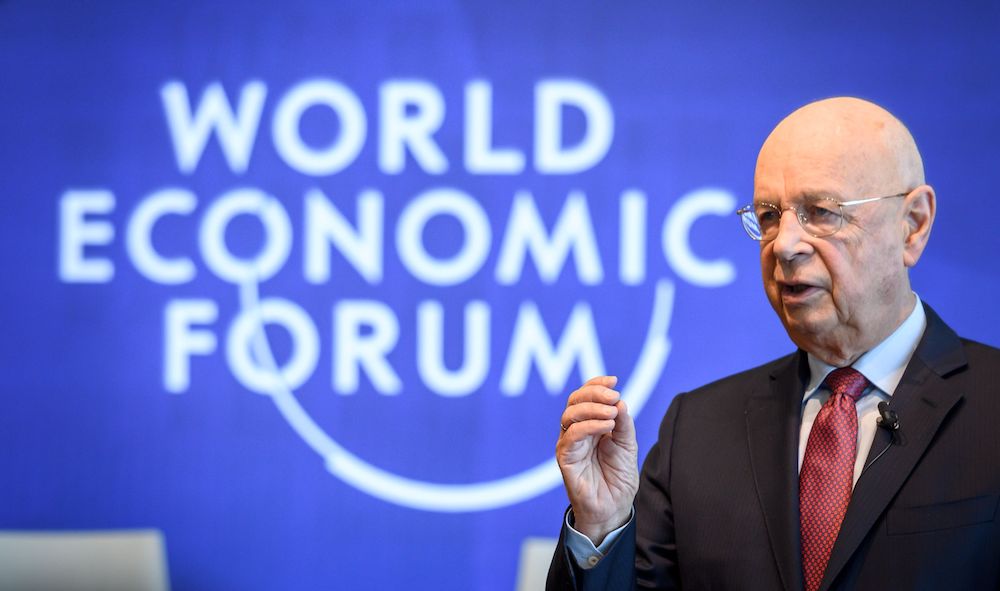
The 2019 World Economic Forum, which begins in Davos on Jan. 22, coincides with escalating geopolitical and geoeconomic risks. Serious though these are, what may be more alarming is what the WEF describes as the “crisis” resulting from the diminishing ability of the world to tackle major global challenges, especially on the environmental front.
This gloomy prognosis is the central message of the WEF’s 2019 Global Risks Report, which was published last week. It points to a clear deterioration in the global landscape, with a potentially toxic cocktail of trade disputes, environmental risks, cyber threats and geopolitical dangers. As the report makes clear, what this means is that at the very time when more coordinated, concerted action is needed to tackle these threats, there is less international will to do so.
Ironically, some of these issues — including Brexit and the US government shutdown — have caused leaders including US President Donald Trump, British Prime Minister Theresa May and French President Emmanuel Macron to pull out of Davos. Only three of the G7 leaders will be there: Japanese Prime Minister Shinzo Abe, German Chancellor Angela Merkel and Italian Prime Minister Giuseppe Conte. Russian President Vladimir Putin, Chinese President Xi Jinping and Indian Prime Minister Narendra Modi are also skipping this year’s event.
Abe, Merkel and Conte — along with 3,000 leaders and officials from the public and private sectors, including US Secretary of State Mike Pompeo, Brazilian President Jair Bolsonaro, Chinese Vice President Wang Qishan and US Treasury Secretary Steve Mnuchin — will discuss the challenges confronting the international order. According to the WEF, environmental risks such as the loss of biodiversity, extreme weather events, man-made disasters, natural disasters and the failure of climate-change mitigation and adaptation are the most urgent issues that must be tackled, with the “world most clearly sleepwalking into catastrophe.”
On the global-warming front, for instance, the alarm bells were most recently rung during last month’s UN climate-change summit, where the international consensus agreed by the 2015 Paris treaty for tackling this issue came under attack from key governments including the US, Brazil, Russia and Turkey. This threatens to slow the pace of global efforts to decarbonize, and it is clear that the views of climate skeptics such as Trump and Bolsonaro now need to be faced down.
The American and Brazilian presidents have lambasted the Paris agreement, arguing it is a grand hoax and/or an unwelcome distraction, despite overwhelming scientific evidence about the risks of global warming. Yet even if, remarkably, it turns out that the vast majority of scientists in the world are wrong about global warming, the Paris deal would still help to achieve a gradual move toward cleaner energies, making the world a less polluted and more sustainable place to live.
And given that scientists are much more likely to be correct in their conclusions than Trump and Bolsanaro, the consequences of failure to act now, as climate skeptics advocate, will be the growing probability of devastating environmental damage to the planet.
The Paris deal is potentially a very important stepping stone and what is now needed are well informed lawmakers from across the political spectrum to help ensure it is implemented effectively and hold governments to account so that it can truly deliver.
Andrew Hammond
On the geopolitical front, the WEF report highlights the growing risks of “political confrontations between major powers.” The array of challenges here include Russia’s annexation of Crimea and the fact that Washington’s relations with Moscow are perhaps now more strained than at any time since the collapse of the Soviet Union; the collapse of the Israeli-Palestinian peace process; US-China trade tensions; and the continuing instability in Syria and Afghanistan.
Yet while we might now be in a period of significantly higher political risk, the contemporary global landscape also contains many opportunities for greater stability. One example is the aforementioned 2015 global climate-change treaty. While the agreement is by no means perfect, it nonetheless represents a welcome shot in the arm for attempts to tackle global warming and, crucially, a new, post-Kyoto treaty framework has been put in place.
Moreover, the review framework means that countries can toughen their response to climate change in the future, especially if the political and public will to tackle the problem increases with time. So the Paris deal is potentially a very important stepping stone and what is now needed are well informed lawmakers from across the political spectrum to help ensure it is implemented effectively and hold governments to account so that it can truly deliver.
Meanwhile, the rise of China, which has surpassed the US as the world’s largest economy in purchasing-parity terms, has the potential to drive greater global stability in a fruitful G2 partnership, rather than being a growing source of tension with Washington, as is the case now.
During the Obama presidency relations remained generally cordial. Both nations recognized the importance of the relationship, and Washington pursued a strategy that promoted cooperation on softer issues, such as climate change, while seeking constructive engagement on vexed, harder issues such as tensions in the South China Sea.
Under the Trump presidency, however, there is the growing prospect of escalating rivalry rather than increased cooperation. This is likely not just on the economic front but also in the political realm if Beijing’s military power continues to grow rapidly and it embraces an increasingly assertive foreign-policy stance toward its neighbors in Asia.
Taken overall, while risks might be increasing significantly, there are also key opportunities, too. Perhaps the biggest uncertainty is over the direction of the US-China relationship. While this is currently tense, a collaborative partnership remains possible if both sides can resolve their economic and political disputes in a grand bargain that renews their relationship into the 2020s under Xi and Trump.
- Andrew Hammond is an Associate at LSE IDEAS at the London School of Economics


