- UAE tops Gallup’s 2026 Global Safety Report as the country where people feel safest walking alone at night, though the country was polled before start of the Iran war
- Bahrain and Kuwait also rank in the top 10; Gallup says the high rankings of the Gulf nations are ‘especially notable’ given the recent turmoil in the region
NEW YORK CITY: Saudi Arabia and neighboring Gulf countries continue to rank among the safest places in the world to walk alone at night, according to a major global survey, the results of which were published on Wednesday.
The feelings of personal safety and security in the Kingdom held firm even after months of Iranian missile and drone attacks across the region.
Gallup’s 2026 Global Safety Report, seen by Arab News, found that 95 percent of adults who were polled in Saudi Arabia during 2025 said they felt safe walking alone at night in the areas where they lived. This was the third-highest score among the 140 countries and territories surveyed.
Gallup surveyed the Kingdom again between May 12 and June 6 this year, after the war in the region began in late February. This time 96 percent of adults said they felt safe, matching the world-leading score for 2025.
In Bahrain, which Gallup also revisited this year, the updated figure was 93 percent. Gallup confirmed the 2026 results for both countries were little changed from 2025 “despite conflict and instability across the Middle East.”
The UAE ranked No. 1 in the world for perceived safety in 2025, with 96 percent. It was the first time the country had ranked first since 2020.
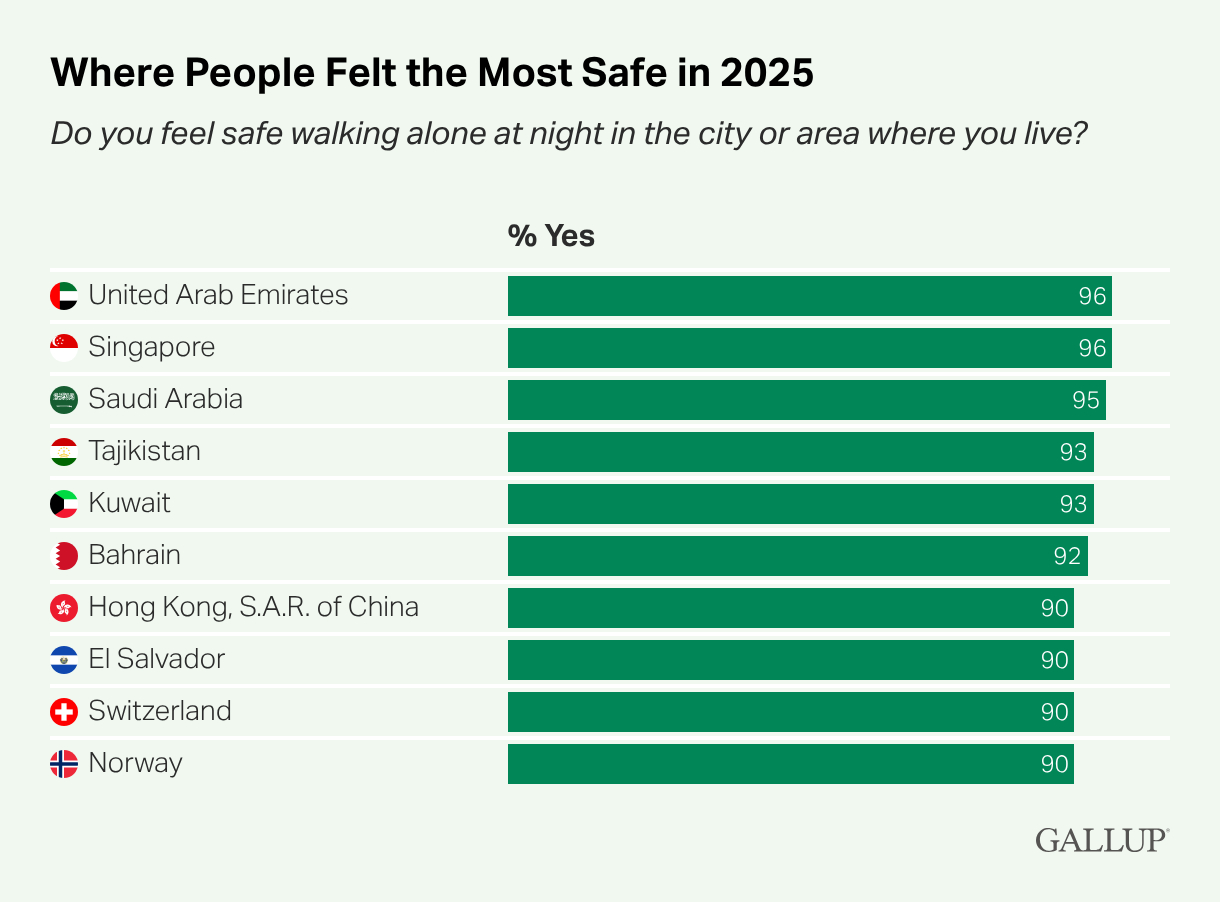
Singapore, which has topped the rankings 12 times since Gallup began tracking safety in 2006, also scored 96 percent and was statistically tied with the Emirates.
Four of the 10 highest-ranked countries in 2025 were members of the Gulf Cooperation Council: the UAE, Saudi Arabia, Kuwait (93 percent) and Bahrain (92 percent).
Gallup said the high rankings of Gulf nations were “especially notable” given the recent turmoil in the region.
The results in the UAE were strong across the entire population. The share of noncitizens who felt safe increased from 89 percent in 2024 to 96 percent in 2025, while the figure among Emirati nationals stood at 98 percent.
Among adults in the lowest income group, the figure climbed from 84 percent in 2024 to 95 percent, and women and men were equally likely to feel secure. Less than 1 percent of UAE residents listed crime, violence or public safety as the country’s most important problem, while 32 percent said the country faced no major problems at all.
Gallup noted that its figures for the UAE were collected before the start of the conflict with Iran, and it was gathering new data from the Emirates while the report was being prepared.
The war began on Feb. 28 when the US and Israel launched strikes on Iran. Tehran responded by launching waves of missiles and drones aimed at Gulf states that targeted energy facilities, airports and other civilian sites, and killed dozens of people.
In March, the UN Security Council adopted a resolution demanding an immediate end to Iranian attacks on the Gulf states and Jordan. A US-Iran ceasefire agreement came into effect on April 8. However, attacks on Kuwait and Bahrain were reported again in early June, so Gallup’s follow-up survey of Saudi Arabia was carried out during the fragile truce.
The Middle East and North Africa region as a whole scored 74 percent for safety in 2025, which placed it among the regions in which people said they felt safest, level with Western Europe and post-Soviet Eurasia. Only Northern America was higher, at 78 percent.
Gulf countries also fared well on Gallup’s broader Law and Order Index, which combines perceived levels of safety with confidence in local police and people’s own experiences of theft or assault.
The UAE scored 95 out of 100, tied with Singapore and second only to Tajikistan. Bahrain scored 93, and Kuwait and Saudi Arabia 92 each.
Elsewhere in the Arab world, Jordan scored 88, Egypt and Iraq 86, Algeria 85, Libya 83, Tunisia 81 and Morocco 80. Lebanon, at 75, and the State of Palestine, at 73, ranked lower.
The report offered an explanation for why so many people can feel safe at home even when their region was at war. Gallup examined 114 countries and found that national wealth and homicide rates track much more closely with how safe people feel than armed conflict does. In fact, once wealth and homicide rates were taken into account, the effect of armed conflict was no longer statistically significant.
Conflict did make a clear difference to how people viewed their country’s biggest problem, however. In Israel, 70 percent of adults said they felt safe walking alone at night in 2025, but 71 percent named safety and security as the most important problem their nation faced. In Ukraine, 64 percent felt safe, but 83 percent said security was the top concern.
Gallup’s upcoming fresh results from the UAE will reveal whether the residents of the country hit hardest by Iranian strikes still feel as safe as they did in 2025.