There is something spiritual about the West Bank; and I don’t mean in the sense of the often-controversial Jewish-Islamic-Christian relations present in the area. This kind of spirituality traverses border conflicts and even surpasses religion itself. It is not a thing or an action, but more so a feeling of falling in love with a place you’ve only just met — and under fairly unlikely circumstances, too, given the complexities of the region.
It’s a feeling associated with the energy of the market stalls in the early morning, the smell of charcoaled meat in the city by lunch time, the rough sensation on your fingertips as you run your hand along the overwhelmingly large Separation Wall, and the renewal one can sense at the first rain that marks the end of a scorching summer. Contrary to the dominant narrative adopted by Western media that often characterizes the area as an inaccessible, unwelcoming place, travelers are sure to have their expectations exceeded when they discover that the West Bank is actually an inviting, penetrable place, where this rewarding spirituality makes itself wholly available to all who simply make the effort to knock.
Ramallah
First on most wanderers’ West Bank travel itinerary is the city of Ramallah, which translates to ‘the hill of God’. It is considered to be the business, government and NGO capital of Palestine and maintains an interesting balance between modern development and traditional culture, while offering a great opportunity to ease into your travels in the area. Some notable sites include The Ramallah Cultural Palace, which boasts a large auditorium featuring regular music and dance shows, as well as the neighboring Mahmoud Darwish monument and museum, where you can learn about the great Palestinian poet and his literature that speaks of Palestinian exile, loss, dispossession and paradise.
Take some time to stroll down the central city streets and appreciate the bustling energy that exudes from Ramallah’s wide range of stores and eateries. Slow down a little and welcome the sweet smell as you pass by the men’s-only cafes, where many elderly Palestinians spend the day with a cup of strong Arabic coffee, a deck of cards and a fragrant argileh pipe. Move along toward the busy ‘Hisbeh’ produce market, where you can pick up some fresh fruit and vegetables, and perhaps some good conversational banter to help practice your Arabic, if needed. When your feet begin to get weary, it probably means its time to head to the famous Rukab’s ice-cream parlor. Known for its abundant flavors of ice-cream that are made out of the same resin used for chewing gum, this cold, gooey treat will give you a helpful sugar boost to get you to the end of a long day of touring in Ramallah.
Beyond the city itself, the towns surrounding Ramallah boast some incredible cultural festivals year-round, which usually celebrate the changing of the seasons that is reflected in the olive or fruit harvests. Check out the festivals that take place in Jifna and Beit Jala in May and June, respectively, which celebrate the Apricot harvest with many impressive carnivals. These events feature folklore or ‘Dabkeh’ dance, singing, and an array of booths selling hand-made olive wood gifts, embroideries and, of course, every kind of apricot product you can imagine! Similar festivals take place around ‘Heritage Day’ in June, and the olive harvest in October — keep your eyes peeled for the beautiful celebrations of all things ‘Palestinian’ during these annual celebrations in Birzeit and Bethlehem.
Jericho
Once you’ve experienced the hustle and bustle of Ramallah, you’ll appreciate some fresh air and open spaces. In this case, Jericho (“Ariha” in Arabic) should be next on your itinerary. Home to a plethora of architectural masterpieces, Jericho is the oldest inhabited city in the world, with evidence of the first settlements discovered as far back as 10,000 B.C.E.
One of the most majestic sites in Jericho is undoubtedly the Monastery of Temptation, which is carved into the stone valley walls high above the city. The Monastery, which is still in use today, is best accessed via the cable car (‘Téléphérique’, among locals) that runs regularly from Jericho town. The view from both the cable car and the monastery are breathtaking, and present an opportunity to take advantage of the cool air that flows in the caves above the sweltering township. If the inner carvings of the monastery particularly impress you, it’s worth taking a short taxi ride out to St. Georges Monastery located in Wadi Qelt, which was built in a similar fashion.
Once your feet are firmly back on the ground, head toward Hisham’s palace where you can view some seriously impressive early Islamic architecture that remains in the ruins of an old desert palace. This palace was one of the residences of the Umayyad Caliph Hisham during 700 C.E. and comprised a luxurious collection of baths, mosques, courts and other royal buildings. The incredible artwork that can be seen on the remaining palace floor is particularly astounding, depicting the ‘tree of life’ in a beautiful mosaic style.
Bethlehem
Believed by Christians to be the birthplace of Prophet Isa (peace be upon him), Bethlehem is a friendly Palestinian town that packs a punch. Famous for its beautiful churches and rolling hills, it’s the perfect place to rest for a few days in the middle of your West Bank trip. A good place to begin is Manger Square, where you can watch all kinds of people pass by and get a better understanding of the town’s heartbeat. Move toward the old city and venture down the cobbled limestone streets for some window-shopping with a freshly pressed orange and pomegranate juice in hand.
Be sure to check out the Mosque of Omar, which is the only mosque in Bethlehem’s old city, and is located right across from the Church of the Nativity. This site is important because it commemorates the decision made by Prophet Muhammad’s (peace be upon him) father-in-law to ensure that the Church of the Nativity would remain a protected Christian shrine where Christians would be free to practice their faith, even after his takeover of the area from the Byzantines in 637 C.E.
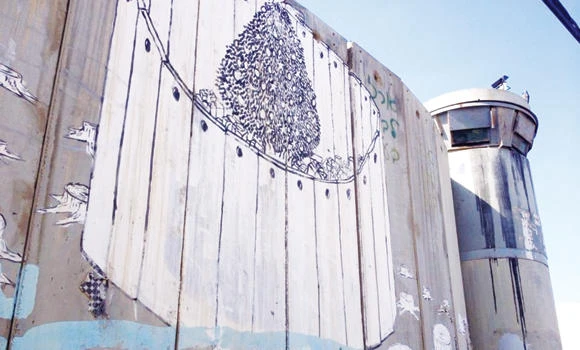
While touring, you wont be able to miss the 26-feet high concrete Separation Wall that enclaves parts of Bethlehem, and effortlessly cuts multiple villages into halves. Dotted with watchtowers in which Israeli soldiers look down upon their Palestinian subjects, and scattered with video cameras, electric fences and razor wire, this barrier often makes locals feel as though they are in a kind of prison. Yet their ongoing resistance is reflected in the colorful artwork that has been installed on the grey concrete blocks, and is a startling sight for those who truly wish to understand the impact of the occupation on West Bank Palestinians.
Nablus
Best known for its sweet ‘Kanafeh’ desert and its production of locally made olive soap, Nablus receives a lot less attention in the travel brochures than it is due. With a strong history of Palestinian activism against the Israeli occupation, Nablus maintains a unique mix of beauty and ferocity that tells every traveler a story about the West Bank’s ongoing struggle to breathe under a crushing colonization endeavor. Yet despite the often-cruel realities evident in the villages and refugee camps of Nablus, the town continues to retain a sense of vibrancy and determination, which make it well worth adding to your West Bank itinerary.
If you’re in need of some relaxation, there are two traditional Ottoman baths to choose from — Hammam ash-Shifa, and Hammam Al-Hana — both of which offer hot steam, relaxing scents, and a good full-body pulverization session for all who dare to enter. At ash-Shifa, you can wash away any burgeoning bruises afterwards with a cup of sweet tea, a few local pastries, and even an argileh session in the lounge area. To ensure that you don’t get caught with your pants down (literally) upon entry, verify the daily opening times for men and women by calling beforehand, as they run separate to one another.
If you’d prefer that your bathing remain a private endeavor, swing by the Mofthen Soap Factory in Martyrs Square and pick up some all-natural olive soap. While you’re there, don’t be too shy to ask the workers for a quick tour of the amazing facility. Afterwards, let your day soak in like syrup into pastry, as you sit and eat sweet Kanafeh in one of the many pastry stores in the city. This delectable dessert, with its cheesy base and crunchy top, will leave you with sticky fingers and an internal sugar rush, both of which are likely to stay with you for days!
Discovering Palestine
Rather than being indecipherable, as the complex political reality would normally lead us to believe, the West Bank emerges as an intimately knowable place for those who go the extra mile to visit with an open mind. Indeed, Palestine is about knowing that the seasons are about to change with the falling of the figs from the tree, and the slow arrival of olive buds. It’s knowing without even opening your eyes that it is morning because you can smell freshly baked bread wafting down the street. It’s knowing that no matter where you go, you’re likely to be welcomed with quintessential Palestinian hospitality into the corner of someone’s shopfront, or into their home, to take tea or coffee with them. It is these known aspects that often give new visitors to the West Bank a feeling of comfortable familiarity with a place that they have never even been before.
Long story short, don’t believe everything you hear about Palestine and Palestinians; go and discover your own unlikely love affair.
—
Email: [email protected]
Traversing the West Bank: An unlikely love affair