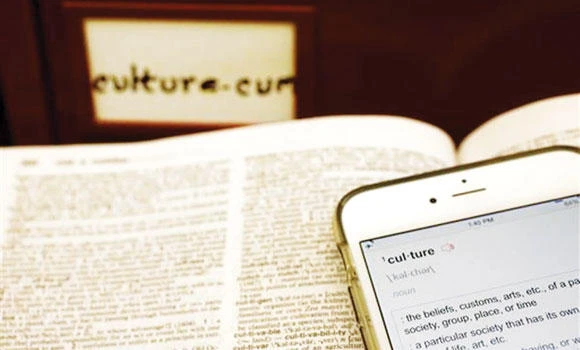
NEW YORK: A nation, a workplace, an ethnicity, a passion, an outsized personality. The people who comprise these things, who fawn or rail against them, are behind US dictionary Merriam-Webster’s 2014 word of the year: “culture.”
The word joins Oxford Dictionaries’ “vape,” a darling of the e-cigarette movement, and “exposure,” declared the year’s winner at Dictionary.com during a time of tragedy and fear because of Ebola.
Merriam-Webster based its pick and nine runners-up on significant increases in lookups in 2014 compared to 2013 on Merriam-Webster.com, along with interesting, often culture-driven — if you will — spikes of concentrated interest.
In the No. 2 spot is “nostalgia,” during a year of big 50th anniversaries pegged to 1964: the start of the free speech movement, the passage of the Civil Rights Act, the birth of the Ford Mustang and the British Invasion heralded by the landing of the Beatles on US soil for the first time.
Nostalgia was followed by insidious, legacy, feminism and a rare multiword phrase that can be looked up in total, in a foreign language at that: the French “je ne sais quoi,” or “a pleasant quality that is hard to describe.”
The Springfield, Massachusetts-based dictionary company filters out perennial favorites when picking word of the year, but does that formula leave them chasing language fads?
“We’re simply using the word ‘culture’ more frequently,” said Peter Sokolowski, editor at large for Merriam-Webster. “It may be a fad. It may not. It may simply be evolution.”
Sokolowski noted that the reasons words are looked up aren’t just about not knowing what they mean. Sometimes, he said, we seek inspiration or a way to check in on ourselves. Of an estimated 100 million lookups on the website each year and a similar number on the company’s app, culture enjoyed a 15 percent year-over-year increase.
Percentage-wise, it doesn’t sound like much, but the raw number in that stratosphere is large, Sokolowski said. He wouldn’t disclose actual numbers, though, citing the proprietary nature of that data for a company still privately held.
Sokolowski is a lexicographer, not a mind reader, so his observations about why any single word takes off in terms of lookups is well-informed but theoretical.
“The word ‘culture’ (has) got a cultural story. We have noticed for years that ‘culture’ has a cyclical spike every year at around Labor Day. That is to say back to school time during the month of September, so we’ve been watching this word spike at that time for years,” he said by telephone from Springfield. “In recent years, we’ve seen similar spikes at the end of semesters during finals.”
But traffic throughout the year indicates that the word “culture” is a “chameleon,” Sokolowski said. “When you put it next to another word it means something very different. For example, ‘consumer culture’ or ‘rape culture,’ which we’ve been reading about lately.”
There’s the “culture of transparency” in government and business, and “celebrity culture,” and the “culture of winning” in sports, he noted. “It’s a word that can be very specific, like ‘test prep culture,’ or it can be very, very broad, like ‘coffee culture.”
‘Culture’ is word of the year