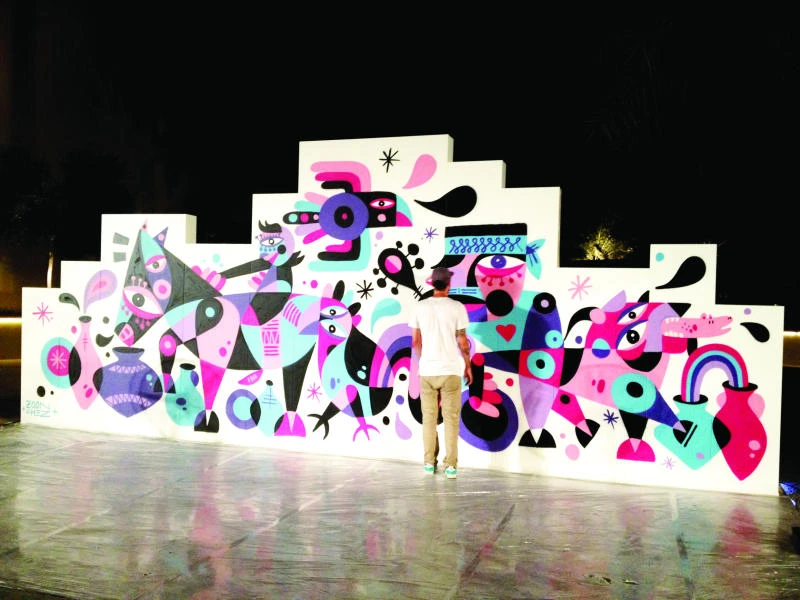
While high-end art in the Arab world is flourishing as locals begin to understand its significance pertaining to their lives, its other equally famous sibling “street art” (often referred to as a provocative art form) is also making a huge impact. Though other countries in the region were already familiar with its far-reaching effect, the walls across Dubai looked bare and lifeless. Thanks to Ruben Sanchez, a famous Spanish artist, it all changed when he dropped by and gave the city a unique chance to experience the magic of street art.
In an exclusive interview with Arab News, we sit down with him to find out about his fascination with street art and a whole lot more.
What attracted you to street art in the first place?
You know it’s the freedom of expressing your ideas onto an undefined canvas publicly. Not only that, you soon realize you have the diversity of choices available. Basically, it’s a free world where no rules apply. What matters the most is the high visibility factor.
Why did you choose Dubai to explore the world of this increasingly popular art as part of your artistic journey?
Dubai’s creative hub “Tashkeel” offered me to be part of their Guest Artist Program two years ago. The experience was so great that I’m still here as its resident artist.
Where do your inspirations come from?
They all come from the Mediterranean lifestyle, quotidian situations with a surrealistic twist. Sometimes you don’t know where inspiration might pop up from. Sometimes you just feel inspired by the things or experiences that surround you.
To what degree is street art popular in the UAE on the whole?
Street art barely exists in the UAE outside sponsored events. It’s good to see those small real actions in this city though.
What techniques and materials do you use while doing your paint work?
When working outdoors, I just use spray paint. While working in the studio I mix different materials and I mostly paint with acrylic paint.
How important is it for you to come up with new styles?
I think evolution should be a constant feature in any artist’s work. That means to experiment, to continuously develop your style, to fail, to find new materials, to study, etc...
What message does your art imply?
It depends on the location, the mood or if it’s part of a specific project or not, etc. Either way, I try to avoid doing just decorative pieces.
What colors do you generally prefer to use?
I like the Mediterranean color palette, reds, blues, and yellows...happy colors.
To what degree is your work influenced by your country of origin?
I think my work transmits where I come from. My work is colorful, mostly happy, and even romantic sometimes... I don’t do it on purpose though. It just comes out naturally.
What role can street art play in addressing serious issues that the Middle East is faced with at the moment?
It’s the voice of the people. It is our way to make propaganda and to let everybody know, governments included, what we think.
How eager are the UAE youths when it comes to learning about this art form?
They feel attracted by street art and they find it fun. However to assume the risk to take it seriously is a different thing for obvious reasons.
Which exhibitions of yours have been the most popular to date?
My solo show “The B Side” last year in Tashkeel, Dubai was quite a big deal for me. This exhibition showcased memories of my childhood in different amusing ways starting from skateboarding to getting awed by the splendor of graffiti culture. It’s great to have such a good response
after having worked really hard on a show like that.
What are your upcoming projects?
I will go back to work in refugee camps in North Jordan. And for the next year, I have projects like art direction for a performance arts show, murals, some commissions, and I am looking forward to see the public art projects in Dubai coming true all the way.
Which roles do you like the most, working as an illustrator or a graphic designer?
Each one has its own magic. Illustration might get a lot arty but I like the work of composition, color and type combination in graphic design. Yet, you can always mix both, right!
Dubai gets its first taste of street art