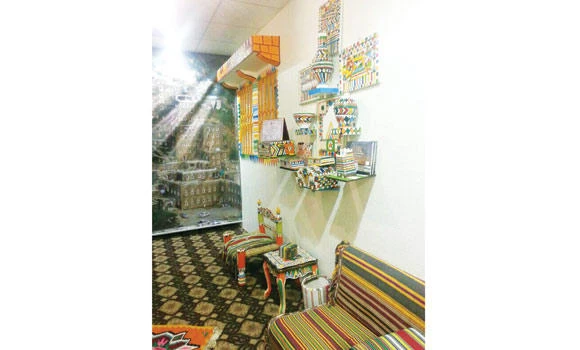
Fatima Faye Al-Almaai, a famous artist in the field of Asiri art engraving, is set to open a small museum featuring traditional clothing depicting ancient inscriptions which she has been working on for the past 10 years in an attempt to collect a cultural legacy for the pattern in the Asir region.
Al-Almaai said that the idea was born as a result of her passion for this art.
The Al-Almaai (cat) inscription is a number of lines, inscriptions and aesthetic formations done by female professionals in the area.
This folk art is not taught in art schools or specialized institutes but handed down the generations. Each color represents a certain sensory organ and every form symbolizes a human touch which has settled deep into the recesses of our being.
She described the idea of preserving the heritage of the region from extinction as a lifelong dream.
The museum will feature more than 300 pieces of clothing and silver jewelry, Asiri carvings engraved on walls, crockery, chairs “Altakhtat,” paintings, shutters and boxes.
Al-Almaai pointed out that many people in Asir have opened up museums in their homes that depict the heritage and civilization of the region.
The art is reflected in the culture and heritage of the Asir region and it must be preserved through providing training courses to women and artists on the secrets of this art, according to Al-Almaai.
Al-Almaai said: “I learned this art from a great artist in the region, Fatima Abu Qahas who has played a big role in immortalizing it through teaching it to a number of ladies.”
The art comprises a set of names symbolized by the inscriptions such as Al-Khatmah, Al-Batrah, Al-Hadheyah, Al-Bansalah, Al-Amri, Al-Sakrooni, Aryash, Banat and Omri. Each inscription has certain characteristics of color and form.
She added that the Al-Almaai inscription derives its raw materials from nature, and is used to decorate houses, walls, and household items.
She first started to form these inscriptions on household items and antiques to give them a distinct look, she said, stressing that this art does not use forms of animate beings.
The most important characteristic of Al-Almaai engraving is the use of natural hues and colors such as blue, orange, green, white and black.
Women in earlier times used to extract the colorful materials from nature to adorn their houses reflecting their aesthetic sense and value of natural products.
“I am currently using the older version of different types of paints for my carvings,” Al-Almaai said, adding that the work can take up to a fortnight to complete depending on the nature of the inscription and the size of the engraved painting.
She said that this art form represents the region’s identity and her passion. “I wouldn’t be able to achieve what I have without the support of my husband,” she added. Ali Mgaoi is a writer and has supported his wife in her work with the hope that they will be able to pass on this unique heritage to their daughters one day.
“I am afraid that the art may die out with the old women who have mastered it and therefore it is all the more important for the younger generation to learn it from them,” Al-Almaai said, noting that there are very few women who are able to provide training in the art form. They include Zahra Faye, Sharifa Muhammad Mahdi and Fawzia Barazik, she said.
Al-Almaai is an accredited trainer herself having been trained by Al-Fikr Al-Najih Center. “I am now planning to set up an institute to train women in this art form,” she said, adding that she had already enrolled 150 trainees in Rijal Almaa in collaboration with the Society of Arts and Culture and the Association of Parents.
In the past, the paintings were engraved only on the inner walls of houses but now they are being developed to be marketed on canvas.
The themes are mainly from Asir’s everyday life and do not contain images of animals or humans.
“Al-Almaai uses natural colors from the environment to work on these inscriptions,” Ali Mgaoi said explaining his wife’s techniques for the art form. Black which is one of the main hues is drawn from coal, ground to a powder and mixed with glue to give it a glaze. The red paints (Al-Hosan) are extracted from the red stones in the area added with some Murr and roasted rice to give them the deep rich texture. The yellows, blues and greens are bought from traders who bring them to Rijal Almaa.
Mgaoi said that Fatima Ali Abu Qahas is considered a pioneer in Al-Almaai engraving and has won one of the Abha awards.
He added that this art which takes inspiration from geometric designs is an extension of Islamic art and handed down the generations. “It is mainly the domain of women who have mastered it and there is no old home in Asiri without it,” Mgaoi said.
“You will find beautiful murals decorated with forms and colors that combine skill, artistic sense and accuracy in their design, and with tools produced from the environment itself, which highlights the artistic and geometric sense Asiri women have.
In order to preserve this ancient art from dying out, it is of the utmost importance for young women to receive training in it,” he concluded.
—
Email: [email protected]
Inside Fatima Al-Almaai’s dream project