One of the greatest landscape photographers, Ansel Adams, once said: “You don’t make a photograph just with a camera. You bring to the act of photography all the pictures you have seen, the books you have read, the music you have heard, the people you have loved.”
One look at award-winning Saudi photographer Najla Al-Khalifa’s stunning shots of nature photography, and you know her photos are an amalgamation of all that and much more. And it was perhaps this feature of her work that won her this August a gold medal in the French (Px3) competition 2015, a highly regarded European photography competition. It doesn’t end there. She also won three medals of merits for the travel and tourism class.
“The French (Px3) competition is one of the largest competitions in Europe, which seeks to encourage and appreciate photography and thousands of photographers from around the world participate in it annually,” said Najla.
The “Prix de la Photography, Paris” (Px3) strives to promote the appreciation of photography, to discover emerging talent, and introduce photographers from around the world to the artistic community of Paris. Paris Photography Prize (Px3) was founded in 2007 and since then Px3 has become an annual event that photographers all over look forward to.
In an interview with Arab News, Najla gives us a peep into her amazing world of photography and her recent international success.
Tell us about your latest achievement — the French (Px3) competition.
My achievements include:
• Won a gold medal book proposals/Nature category for the “Tail of Bamboo Series” which was a study depicting the delicacy and resilience of the Bamboo Trees in Sagano bamboo forest.
• The Riyadh Water Tower Series, Honorable Mention (Digitally Enhanced).
• A Day in London, Honorable Mention (Travel and Tourism Category).
• Wa’aba Crater, Honorable Mention (Travel and Tourism Category).
Where can we see the winning photos and your other work?
An exhibition of the winning works is held currently in Paris, and then it will be traveling around the world. On the other hand, you can see my winning works as well as other works on my Instagram account @Naj_alkhalifa.
How does it feel to be internationally recognized for a talent and skill that is still in its infancy among many Saudi women?
It is equally important to be recognized inside and outside one’s country, and I think I’m on the right path. On a personal level, it is very gratifying to see the name of my country in the international art scene, and I am very proud to be a part of that. I don’t know if we can call it in its infancy stage, we have great pioneering photographers like Suzan Ba’Ageel and Madeeha Al-Ajroosh, just to name a few. In addition, during the past seven to ten years we have seen a lot of extremely talented and creative female photographers who took the right steps and accomplished internationally, as well as domestically.
Tell us about the experience of shooting the Wahba Crater and the Riyadh Water Tower.
Wa’aba Crater: I had been dreaming of visiting this natural wonder located 254 km from Taif for years. I was lucky to visit it in February 2015. It is breathtaking, worth all the wait and research.
The Riyadh Water Tower series was initially a project for the Art Quake Kyoto Biennale, in which I ventured with architect, and social culture to create a contemporary vision of the oldest monument in the Saudi capital, through the medium of photography and digital art.
What are some of the other exotic locations that you have shot?
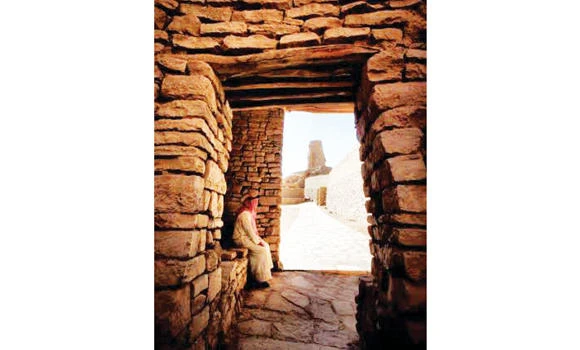
I challenge myself sometimes to bring a new perspective on ordinary scenes or places that were photographed by hundreds of millions of people, and make the people feel that it is the first time they saw it. For example, Al-Amara Palace in Najran. I have seen a lot of beautiful photos of this extraordinary urban heritage building. I visited the palace several times with keenness to produce a photo that retains its authenticity, yet stands out among the other shots.
Among the interesting places I photographed were Qara Mountains in Al-Hasa, Mount Fuji, Madain Saleh in Al-Ula, Tea Farms in Cameron Heights and Marid Castel in Al-Jouf.
What are your future projects?
My dream project is to photograph all the regions of the Kingdom and publish it in a book.
What is your dream location to shoot?
Too many to mention, the Kaaba and the Holy Mosque, sunflower and lavender fields, the Milky Way, The Yellowstone National Park, The Arura and others. I’m also hoping that one day I can have aerial shots of some of the sites in Saudi Arabia.
Apart from photography, what are your other interests?
I am interested in experiencing new things in life. Reading, traveling art and enjoying my family with two kids Saud and Jude.
What do you think should be done to promote photography among young Saudis, especially women?
I hope that one-day photography is added to school curriculums. It’s very rewarding to have a hobby or interest that grows with you, and nurtures you inside out. I’ve been giving photography training courses to kids, and you can’t imagine the keen eye, talent I found. The enthusiasm and pride they have while showing to me their photos is very touching.
What are the challenges you faced in your endeavor?
I truly believe that overcoming the challenges within a person gives that person the courage to overcome
anything. I always focus on what I want, and work on achieving them.
What is your message to aspiring photographers?
To believe in themselves, and never stop learning no matter what level or achievements they have attained.
What has been your inspiration?
I love photography, I feel happy and full of life when I am holding the camera. My calling as a photographer is presenting my country to the world. By doing so I help in altering the stereotypical perception of Saudi Arabia “one image at a time” as the famous phrase says.
I believe that photography is man’s collective conscious, a universal language spoken by people from all walks of life. An advocate of understanding, of truth, of communication and connection, of joy, of peace, and utter beauty.