We live in a modern world that is losing traces of its past bit by bit, it’s inevitable since it’s the normal evolutionary way of life. The world is progressing at a fast pace and we are engrossed in daily activities that can get us all wrapped up with the future of our endeavors and so the past is simply an illusion or a story being told by an elder of the family. We are who we are because of our past, family history and our culture that was molded by years of evolutional traditions. Saudi Arabia is a very diverse country with so many traditions and so many different cultures that make Saudi Arabia what it is today. As a society that is very keen on holding on to familial ties and is also keen on keeping traditions alive, we tend to forget sometimes what it really is like for our parents or grandparents to have lived in the old days, days before technology took over. Thankfully, our elders do love to tell stories from the past either to entertain the younger generation or to simply send us a message or lesson of some sort to remind us of our traditions, wake us up from the technology based lifestyle and routine world of today. We are consumed by the stories they tell us and the details of the story as they describe a living room, the house garden, the kitchen, school and so on so forth. Our imagination takes us to that place in time where everything was beautiful in its intricate details, and what better way to place that image in our mind than on a canvas for everyone to appreciate.
They say a picture speaks a thousand words, a painting is a form of picture as well and it tells many stories, depending on one’s preference. There is nothing more beautiful than finding images from our ancestral past, they tell a thousand stories and our imagination goes wild. Our heritage is rich, beautiful and simple and it’s a rarity to find an artist that is able to put all those past images on paper, Abbas Al-Roqai is one such artist. His paintings are all conjured up from his past, his homeland — Qatif in the Eastern Province — one of the oldest settlements in the Kingdom. The paintings are full of vivid colors, details and reflect the simplicity in those days. Al-Roqai is an elementary school teacher and still remembers the simple days where he would spend time in his family home, surrounded by oasis, vast lands rich with vegetation and palm trees.
“Times were simpler then and I found myself engrossed with painting from a very young age, sketching and painting everything that surrounded me which mostly included farm land, historic buildings and traditional stone houses that were surely simple looking from the outside but beautiful from the inside. I choose this method and this path in my paintings because I simply love my heritage and the way I was brought up in my area. It was a simpler time and it has changed immensely since then, but that stirs up more emotion and passion in me to keep it alive through my paintings.”
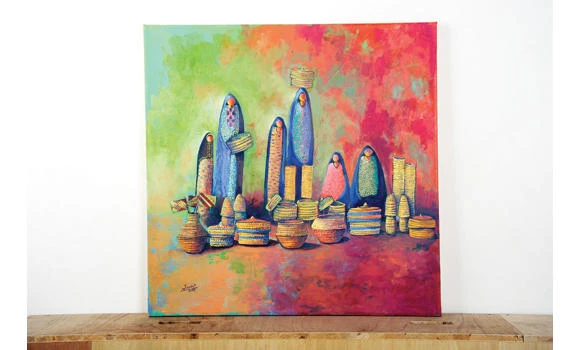
Al-Roqai’s paintings are all of female figures in different settings of life then and areas all adorning colorful jalabiyas and bokhnogs (head scarves) known to that area specifically. His choice of showing only female figures is because he emphasizes on the importance of women in the household then and now. “Women were playing an equal role then just as men, you see female farmers and traders as well as housewives. They took equal responsibility for the stability of the household as men did and I wanted to show their importance in my paintings. You see the women in farms carrying baskets as they walk amongst the farms or in Souq Al-Khamis, helping out in the household chores surrounded by their sisters as they help their mothers and so on so forth. They play a vital role and I do it because I loved how life was back then, my daughters also have a lot of influence on my work, I do this so they know their heritage and appreciative the family bond. My paintings are lessons in history.”
Al-Roqai is even influenced by past structures such as his father’s home, which as he explains was a beautiful place to live in. After a harsh day under the sun playing outside or helping out his father, he says that the interior infrastructure was so well-designed that it was always cool inside as if there was a central cooling system. “It’s the precision with which homes were built that I have to also emphasize in my paintings to show the real picture of how times were then. I still remember how I was always in awe of the old Qatif Castle, it’s been demolished in the mid 80’s, every time my friends and I go play inside. It’s these places that I wish would be preserved for historical purposes as well as to serve its purpose in any painter’s backdrop or main attraction. They’re sights to behold and appreciate, alas the old is being replaced by the new and through my paintings I am trying to resurrect them again.”
The painter not only conjures up images from his past but also confirms his choice of colors through educating himself on the different patterns and fabric colors of each region as each differs slightly from the other. It’s simply not just a mix of colors on a canvas; it’s all in the details as well. “It’s important to keep these images true to their original form to use it as a source of inspiration and a lesson in history for the next generation; it’s something to keep alive as we are nothing without our ancestral past.”
Al-Roqai still goes out to the palm tree farms for sources of inspiration and the beaches of the Eastern Province to witness some of the decaying old fishing ships of the old days, they may be old and covered in barnacles but they still hold many stories and serve as a backdrop for the fish market that disappeared years ago. Each painting holds a story behind it, his wish is to be able to find the words that tell these stories, by himself or by an author that will write the words just as the paintings describe.
Abbas Al-Roqai’s work was being displayed in Sketchat Group Exhibition at the Desert Design Gallery in the city of Alkhobar from the 10th of May until the 24th. To see more of Al-Roqai’s work, please do visit his page on Instagram — Abbasahmad888.
— [email protected]
Taking a step back in time through canvas