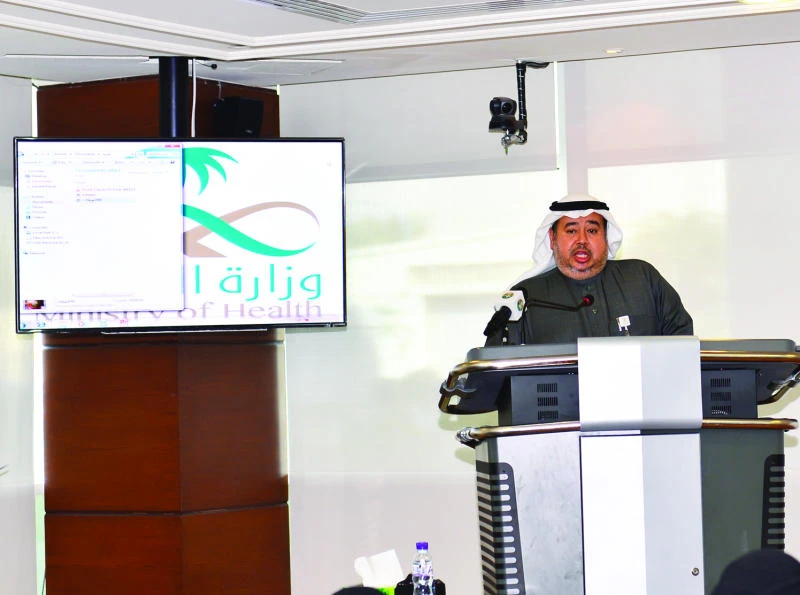
A medical symposium on breast cancer ended Wednesday with a warning that women over 40 should have regular checkups for the disease.
Abdullah Al-Othman, rector of King Saud University (KSU), inaugurated the two-day Saudi-Australian symposium with 700 delegates and more than 800 visitors.
The event, which was preceded by a three-day exhibition on breast cancer, was organized by KSU in cooperation with the University of Sydney.
In an address at the end of the symposium, Abdulaziz Al-Saif, the symposium director, said: “My only message to the ladies is to have a timely checkup for breast cancer when they feel some abnormality in their bodies.”
He said early detection could help doctors cure the disease, while negligence could be fatal. He advised women to have mammograms every year over the age of 40.
He said the discussions included oncology, radiological sciences, rehabilitation, patient safety and pharmacology. He said a team of doctors from the two universities also discussed ways to cooperate, exchange experiences, transfer technology and have joint training projects. He said plans are under way to conduct research in breast cancer.
The term “breast cancer” refers to a malignant tumor that has developed in cells of the breast. Breast cancer usually either begins in the cells of the lobules, which are the milk-producing glands, or the ducts, the passages that drain milk from the lobules to the nipple. Less commonly, breast cancer can begin in the stromal tissues, which include the fatty and fibrous connective tissues of the breast.
Initially, breast cancer may not cause any symptoms. A lump may be too small to feel or cause any unusual changes. Often, an abnormal area turns up on a mammogram, or X-ray of the breast, which leads to further testing.
In some cases, however, the first sign of breast cancer is a new lump or mass in the breast that a woman or doctor can feel. A lump that is painless, hard and has uneven edges is more likely to be cancer. However, sometimes cancer lumps can be tender, soft and round.
According to the American Cancer Society, any of the following unusual changes in the breast can be a symptom of breast cancer, including swelling of all or part of the breast, skin irritation or dimpling, breast pain, nipple pain or the nipple turning inward, redness, scaliness, thickening of the nipple or breast skin, a nipple discharge other than breast milk, or a lump in the underarm area.
These changes can also be signs of less serious conditions that are not cancerous, such as an infection or a cyst.
Regular checkup for breast cancer advised