A SPLIT-SECOND is all it takes. Just a momentary lapse in concentration can result in a terrifying collision. It needn’t be your fault, as no one can predict it, yet you need to ensure that all steps are taken to protect you, your family, and all passengers within your vehicle. It is not about how skilled a driver you are but, rather, whether you are a responsible driver.
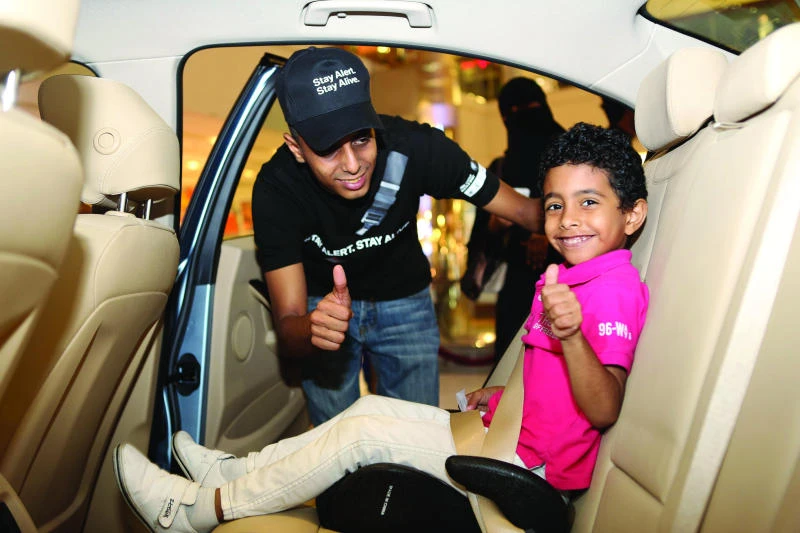
BMW Group Middle East’s ‘Stay Alert. Stay Alive’ road safety campaign aims to raise awareness.
BMW Group urges drivers to ask themselves the following questions:
Do you buckle up as soon as you get in the car?
Do you insist that your passengers wear a seatbelt?
Do your children have the right safety restraints for their weight and age?
If you have answered no, even just once, you need to read the following 5 reasons to buckle up…
Seatbelts Save Lives
It’s been proven time and again. Seatbelts save lives and reduce injuries in a road traffic accident. According to the World Health Organization (WHO), wearing a seatbelt reduces the risk of a fatality among front seat passengers by 40-50 percent and among rear seat car occupants by 25-75 percent.
It’s the Law
Wearing a seatbelt while driving or as a front seat passenger is Bahraini law and any person not to be buckled up will face a considerable fine. Children less than 10 years old must be restrained using the correct type of child seat. Adults found to be traveling with children not correctly restrained will face a monetary fine, and worse, if they are involved in a road traffic accident.
Seatbelts = Life
According to the laws of physics, if a vehicle is traveling at 120 km per hour, its contents and passengers are also moving at 120 km per hour. A sudden stop or head-on collision at 120 km per hour can mean the difference of life or death to the passengers wearing seatbelts.
In a road traffic accident, passengers who are not buckled up will fly toward the point of impact, colliding with anything in their path such as dashboards, windshield or steering wheels with several pounds of moving force.
Seatbelts are designed to stop the uncontrolled movement of people within a vehicle and
therefore one of the most important tools to prevent serious injury or death in a road traffic accident.
Even the best drivers have accidents
Your driving experience and confidence levels will not account for the often unpredictable actions of other drivers. Even the most skilled drivers cannot be 100 percent certain of the ability to prevent an accident when another driver is at fault. It is therefore essential that every driver and passenger wears a seatbelt any time they are in a moving vehicle. If you respect life you must take the necessary steps to protect it.
Seatbelts Reduce Child Fatalities
Children are not small adults – they need specialized protection in a moving vehicle. Until the age of seven, children’s bones are still forming, which means they must be protected from the force of an accident. Babies’ skulls are extremely flexible and even a small impact can result in significant deformation of the head and brain. Also, an infant’s rib cage is still elastic, and any impact to the chest can damage the heart, lungs and other internal organs. At this age, the pelvis is unstable and cannot withstand the forces from the use of regular seat-belts featured in your car. Therefore, appropriate child restraints are essential to reduce the risk of injury.
It is essential for you as a parent to make sure that you use the right restraint for your child’s age and size. There are different seats available and the selection of the appropriate one is crucial in ensuring that your child is effectively protected:
Rear-facing Infant Car Seat
Designed for infants under the age of 1 year, they provide the best protection until the infant is both one year of age and weighs at least 13 kg. At BMW, this is known as BMW Baby Seat 0+.
Child Safety Seat
Targeting toddlers aged 1-4 years, they secure your child and spread the crash forces over a wide area. This seat should last until either the child’s weight exceeds 18 kg or it grows too tall for the seat. At BMW, this is known as BMW Junior Seat I-II.
Booster Seat
Made for small children aged 4-6 years, it works by raising the child to the correct height for the car’s adult seat-belt to work properly. It has a seat back that can provide additional protection in the event of a side impact. The booster seat should be used until the child is approximately 145 cm tall. At BMW, this is known as BMW Junior Seat II-III.
Booster Cushion
The final option before your child transitions to the three-point lap and diagonal seat-belt featured in your car and is designed for children aged 6-11 years that weigh from 22 to 36 kg. Some manufacturers are now producing backs that cover the full 15 to 36 kg range. At BMW, these are known as BMW Booster Cushions.
Established in 1990, Mohamed Yousuf Naghi Motors has been the exclusive and official importer of BMW Group brands - BMW, MINI and Rolls-Royce - for almost two decades in the Kingdom of Saudi Arabia. Their representation of the brand spreads across the country, with showrooms and service centers in the holy cities of
Makkah and Madinah, Riyadh, Jeddah and Alkhobar.
5 Reasons to Buckle Up!