


Every year, as an entertaining and useful thought experiment, my firm internally awards a “Great Power Strategist of the Year” prize; sort of a mini-Oscars for the geopolitically-minded. It is a disarming way to look at which great power statesman has most improved their country’s geopolitical position by any means (moral or otherwise) over the past 12 months. This year, perpetually under-rated Russian President Vladimir Putin won the award, almost unanimously.
Before getting into the strategic details of why Putin did so well, let’s take a closer look at what is so often unsaid and irretrievably clear about Russia: It is surely a country in structural decline. Gone are the days of great power status; the Kremlin (by its own acknowledgment) is merely a regional power now, not playing in the same league as either the US or a rising China.
The country has a gross domestic product (GDP) only the size of the state of Texas. Nor is the economy particularly dynamic — Russian GDP is expected to have increased only 1 percent in 2019. Despite talking for a decade about diversifying its one-crop economy, Russian economic power remains wholly dependent on the spot price of oil and natural gas.
As a whole, Russia remains an endemically corrupt place, as demographically stalled as it is riven by nationalist tensions on its gigantic periphery. Even a declining EU has 10 times the economic strength of the place and three times its population. Russian military spending is now only a tenth of that of the US. These facts make it clear that Russia is not now, nor will it be in the future, a country once again vying to become the dominant power in the world.
And yet, if all that is true, what is also a fact is that Putin plays the poor cards he has been dealt geostrategically so very well. Unlike a fractured Europe, Putin can act decisively and quickly, as he reigns more like a Romanov czar than a modern European head of government.
Beyond this, the Russian president’s approval rating, even after being in charge for all these years, remains an eye-popping 61 percent as of December 2019 — a level most Western leaders can only dream about. This peculiar mix of semi-autocratic power and personal popularity means Putin need have no fear of putting his troops in harm’s way.
In a general sense, Putin is just your standard, garden-variety Gaullist, determined above all to restore Russian national pride and global status after a perceived period of humiliation following Moscow’s defeat in the Cold War. There is a reason he has a giant picture of Peter the Great in his personal study; in line with centuries of Russian political culture, the president sees himself as the tough, reformist “good czar,” restoring order and dignity to his country after one of its disastrous bouts of chaos under the weak previous leader, the shambolic Boris Yeltsin.
A quick tour of the world illustrates the Russian president’s tactical success. Following their victory in Syria (even before the Qassem Soleimani assassination), Russia and fellow anti-establishment Iran have become ever firmer allies. Putin has utterly divided Europe, luring Turkey away from its traditional Kemalist, pro-Western stance, while — through the Nord Stream 2 pipeline — it has made increasingly pacifist Germany its energy mendicant. Even Emmanuel Macron’s France has called for Europe to turn the page on the heretofore united anti-Western front against the Kremlin.
While there are real limits to the burgeoning Sino-Russian alliance (primarily centered on the fact that a nationalistic Putin loathes playing the junior role to Beijing, as he would have to in a deeper entente), there is also little doubt Chinese President Xi Jinping and Putin have grown ever closer.
Moscow continues to cause mischief even in America’s backyard. The Kremlin has somehow managed to just about prop up the thuggish and incompetent Nicolas Maduro regime in Venezuela, despite US maneuverings to the contrary. Further, with America mired in domestic (impeachment) and foreign (Iran and North Korea) crises, the Kremlin now has great latitude to build on these significant geostrategic accomplishments.
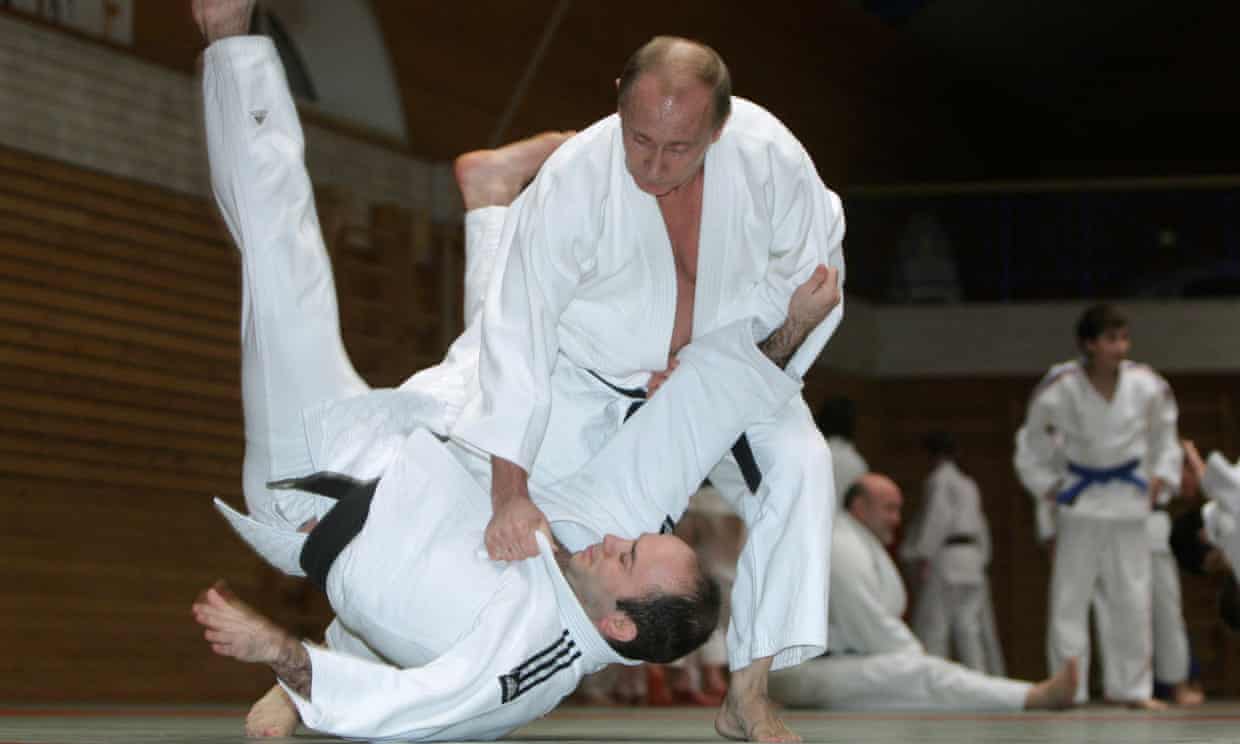
The president sees himself as the tough, reformist ‘good czar,’ restoring order and dignity to his country.
Dr. John C. Hulsman
However, as was true for Charles de Gaulle, it is important not to make too much of what Putin has concretely achieved. Bashar Assad’s Syria is presently the only Middle Eastern country where Russia has bases (though it is working hard to secure influence in Libya).
As was true earlier with Ukraine, Syria matters strategically to Russia ever so much more than to the West, precisely because these two shattered countries are about all that remains of the Kremlin’s former global posture. Putin has run rings tactically around the West in both cases, but never forget that the Kremlin’s desperation in coming to its allies’ rescue in Ukraine and Syria belies a Moscow acutely aware that it is scrambling to remain relevant.
Yet, for all that, Putin wins our award as he has shored up Russia’s pretensions to remaining a great power — if no longer a superpower — despite daunting odds.
- Dr. John C. Hulsman is the president and managing partner of John C. Hulsman Enterprises, a prominent global political risk consulting firm. He is also senior columnist for City AM, the newspaper of the City of London. He can be contacted via www.chartwellspeakers.com.


