



QUETTA: Prime Minister Shehbaz Sharif left on an official visit to Balochistan on Thursday to express solidarity with the people of the province, a day after the military announced it had conducted a successful operation against separatists who hijacked a passenger train, rescuing hostages and killing 33 militants.
The Pakistan military spokesperson, Lt. Gen. Ahmad Sharif Chaudhry, told a private news channel on Wednesday night that security forces had killed militant suicide bombers sitting among the hostages before swiftly executing the rescue operation and securing the Quetta-Peshawar-bound Jaffar Express.
The separatist Balochistan Liberation Army (BLA) had bombed part of a railway track and stormed the train on Tuesday afternoon in Mushkaaf, a rugged area in the mountainous Bolan range of Balochistan.
The province, Pakistan’s biggest in terms of the landmass, has long been the site of a low-level insurgency, with separatist groups accusing the government of exploiting the province’s natural resources while leaving its people in poverty. Government officials deny the allegation and say they are developing the province through multibillion-dollar projects, including those backed by China.
Sharif praised the security forces for their swift action and reiterated Pakistan’s commitment to eliminating militancy from the country in an official statement.
“Prime Minister Shehbaz Sharif has departed for Quetta on a one-day visit,” a handout circulated by his office said on Thursday.
Plain clothes security force perosnnel, who were rescued from a train after it was attacked by separatist militants, leave Mach railway station in Mach, Balochistan, Pakistan, March 12, 2025. (Reuters)
On Tuesday night, hours after attacking the train, the BLA said it was holding 214 people hostage, including military, police and intelligence personnel who were traveling home on holiday to meet their families.
The military reported that militants killed 21 hostages soon after seizing control of the train, but there were no further casualties among the passengers during the rescue operation.
Sharif commended the security forces for their handling of the crisis, saying their professionalism ensured the operation was completed without major losses.
“The operation was executed with extraordinary skill,” he said in an earlier statement released on Wednesday. “We are committed to defeating those who attack innocent civilians on every front.”

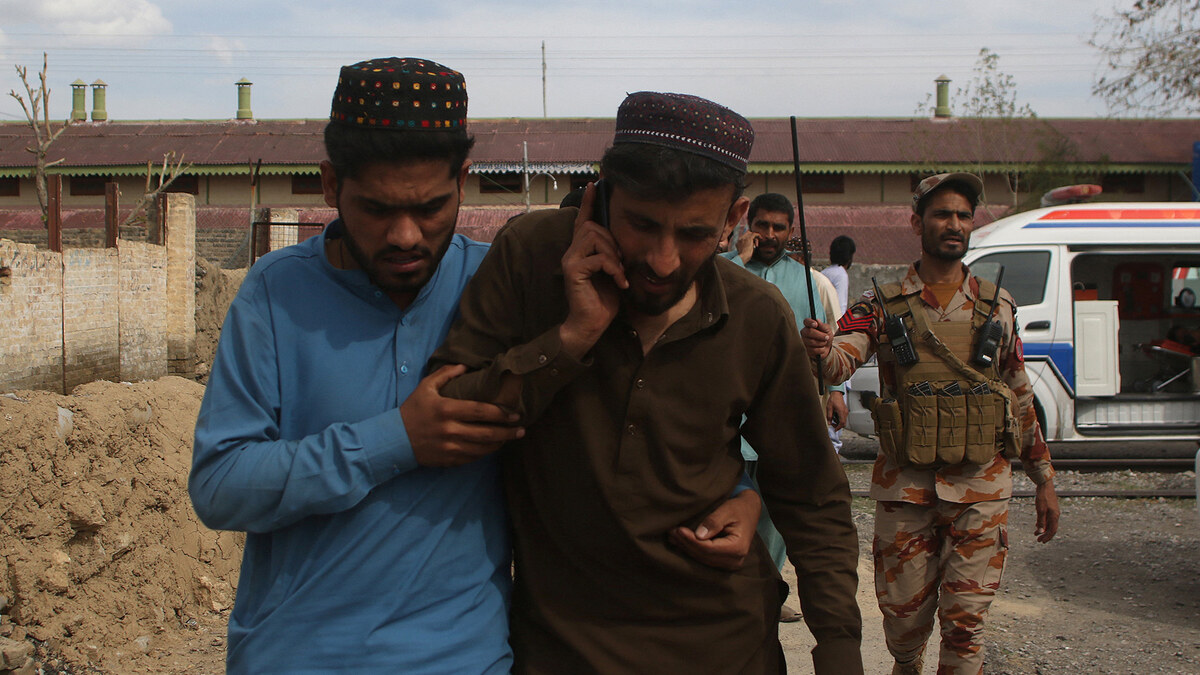
Security personnel and volunteers help to transport an injured train passenger following an operation against armed militants in southwestern Balochistan province on March 12, 2025. (AFP)
According to Lt. Gen. Chaudhry, security forces launched their response shortly after the attack began on Tuesday afternoon. He disclosed that the army, air force, paramilitary Frontier Corps (FC) and Special Services Group (SSG) personnel participated in the operation.
Four FC soldiers were killed during the mission, while no army personnel sustained casualties, he added.
Chaudhry noted that passengers who had fled to surrounding areas during the operation were being accounted for.
He also reiterated the militants were in contact with their “handlers” in Afghanistan, a claim frequently made by Pakistani officials who attribute a recent rise in militancy to cross-border influences. The Taliban rulers in Kabul have repeatedly denied providing insurgents a base to plan or execute attacks in Pakistan.
“This changes the rules of the game,” Chaudhry said during his interview while referring to the hostage crisis, without elaborating on his statement.




