Aoun calls on French envoy to pressure Israel

Special Aoun calls on French envoy to pressure Israel
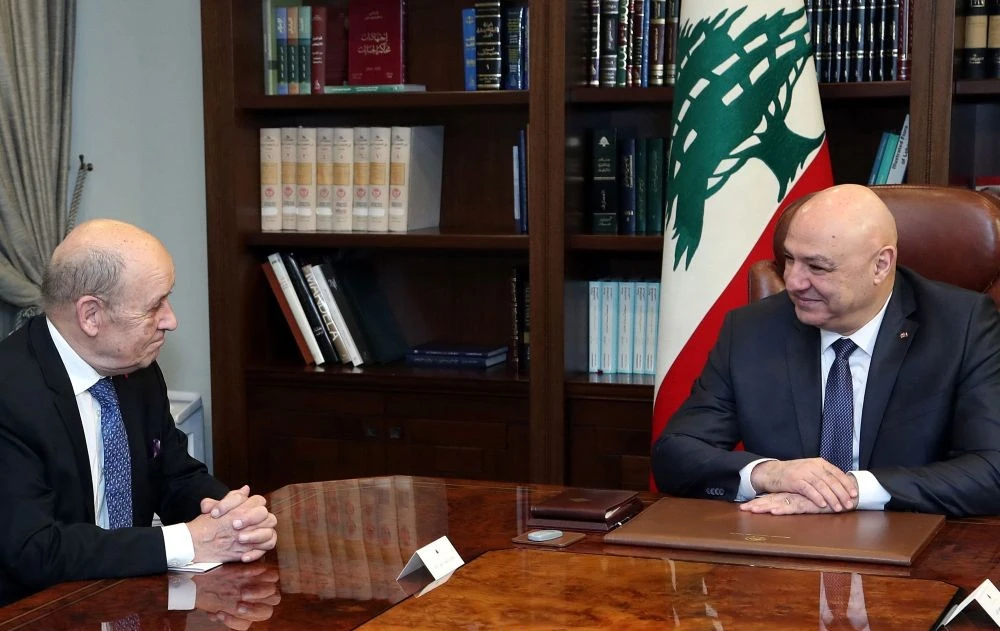
Lebanon’s President Joseph Aoun, right, meets with France’s envoy to Lebanon Jean-Yves Le Drian at the Presidential Palace in Baabda, Mar. 26, 2025. (AFP)
Short Url
Updated 26 March 2025
Follow

Aoun calls on French envoy to pressure Israel

Aoun calls on French envoy to pressure Israel
  • PM Salam warns no one in Lebanon wants normalization with southern neighbor
  • Israeli military activity continues in the south of the country

BEIRUT: Lebanese President Joseph Aoun has called on the sponsors of the ceasefire agreement between Israel and Hezbollah to “pressure Israel to abide by it in order to maintain their credibility and ensure the implementation of what was agreed upon to restore stability.”

Aoun met France’s presidential envoy, Jean-Yves Le Drian, on Wednesday. Le Drian is visiting Lebanon as part of preparations for the French-Lebanese summit set to be held next Friday at the Elysee Palace.

According to the presidential media office, Aoun assured the French envoy that he is “determined, along with the government, to overcome the difficulties that may hinder Lebanon’s reform process in the economic, banking, financial, and judicial sectors, and to find appropriate solutions in cooperation with the relevant parties.”

Aoun said: “The administrative measures that will be taken will send a positive message both domestically and internationally.”

The president also clarified that he will raise during the Paris summit “topics of mutual interest and ways to strengthen and develop Lebanese-French relations.”

Le Drian also met with Prime Minister Nawaf Salam, parliament speaker Nabih Berri, and Foreign Minister Youssef Rajji.

In a statement, he reaffirmed “France’s continuous support for Lebanon and its stability.”

He praised “the inaugural speech of the president and the vision it presented for Lebanon, as well as the seriousness of the Lebanese government's work,” highlighting “the importance of maintaining the international momentum that accompanied the new presidency and the formation of the government by implementing the necessary reforms and preserving Lebanese unity to enhance the confidence of the international and Arab communities in Lebanon and attract investments to the country.”

Salam said that “the purpose of the French envoy’s visit is to discuss reconstruction,” but warned that “no one in Lebanon wants normalization with Israel.”

He said the “international and Arab diplomatic pressure on Israel to cease its aggressions has not been exhausted,” but expressed concern over the situation in the south “in light of the ongoing Israeli attacks, especially following the rocket launch that occurred last week.”

Salam said the “five hills that Israel insists on retaining hold no military or security value, except for maintaining pressure on Lebanon.”

He rejected “all Israeli talk regarding the displacement of residents from Gaza and the West Bank, as well as the establishment of a Palestinian state outside of historical Palestine,” emphasizing the “importance of rallying Arab and international support to confront this project.”

The premier received a call last Monday from Morgan Ortagus, deputy special envoy of the US to the Middle East, following the escalation in the south due to unidentified rockets being fired from southern Lebanon toward the Metula settlement in Israel.

A source in Salam’s office told Arab News: “Ortagus assured Salam that she is closely monitoring the situation in Lebanon and will be making a visit to the country soon, but no specific date has been provided.”

Meanwhile, the visit scheduled for Wednesday by Lebanese Defense Minister Michel Mounir to Damascus to meet with his Syrian counterpart, Murhaf Abu Qasra, has been canceled.

The source from Salam’s office said that “the PM’s office was informed on Tuesday night that the visit had been postponed.”

It added that “this is attributed to the delayed announcement of the new Syrian government, which will lead to changes in the distribution of responsibilities, particularly the official in charge of the security file with Lebanon.”

On the ground, an Israeli drone carried out two strikes on Al-Shaara, near the eastern mountain range between Lebanon and Syria.

Israeli media outlets stated that “the Israeli Air Defense bombed two targets east of Lebanon.”

Reconnaissance planes continue to violate Lebanon’s airspace, reaching Baalbek and Bekaa.

The Israeli military started on Tuesday a field maneuver in western Galilee and the Lebanese border area, which will last until Thursday.

Israeli Army spokesperson Avichay Adraee said that the military exercise will include “training on different scenarios, namely protecting the area and responding to immediate threats in the field with multifaceted cooperation.”

He added that “the exercise has been planned under the 2025 annual deposition plan,” noting that “there is no fear of security incidents.”
Gaza authorities ‘levy fees on some privately imported goods’

Palestinians sell fish during a ceasefire between Israel and Hamas, at the seaport of Gaza City, November 12, 2025. (REUTERS)
Updated 4 sec ago
Follow

Gaza authorities ‘levy fees on some privately imported goods’

Palestinians sell fish during a ceasefire between Israel and Hamas, at the seaport of Gaza City, November 12, 2025. (REUTERS)
  • Ghaith Al-Omari, a senior fellow at the Washington Institute think tank, said Hamas’ actions aimed to show Gazans and foreign powers alike that it cannot be bypassed

CAIRO: From regulating the price of chicken to levying fees on cigarettes, Hamas is seeking to widen control over Gaza as US plans for its future slowly take shape, Gazans say, adding to rivals’ doubts over whether it will cede authority as promised.
After a ceasefire began last month, Hamas swiftly reestablished its hold over areas from which Israel withdrew, killing dozens of Palestinians it accused of collaborating with Israel, theft, or other crimes. Foreign powers demand that the group disarm and leave the government, but have yet to agree on who will replace them.
Now, a dozen Gazans say they are increasingly feeling Hamas’ control in other ways. 

The prices are high. There’s no income, circumstances are difficult, life is hard, and winter is coming.

Mohammed Khalifa, Shopper in Nuseirat area

Authorities monitor everything entering areas of Gaza held by Hamas, levying fees on some privately imported goods, including fuel and cigarettes, and fining merchants seen as overcharging for goods, according to 10 Gazans, three of them merchants with direct knowledge.
Ismail Al-Thawabta, head of the media office of the Gaza government, said accounts of authorities taxing cigarettes and fuel were inaccurate, denying that the government was raising any taxes.
The authorities were only carrying out urgent humanitarian and administrative tasks whilst making “strenuous efforts” to control prices, Al-Thawabta said. 
He reiterated Hamas’ readiness to hand over to a new technocratic administration, saying it aimed to avoid chaos in Gaza: “Our goal is for the transition to proceed smoothly.”
Hatem Abu Dalal, owner of a Gaza mall, said prices were high because not enough goods were coming into Gaza. Government representatives were trying to bring order to the economy — touring around, checking goods and setting prices, he said.
Mohammed Khalifa, shopping in central Gaza’s Nuseirat area, said prices were constantly changing despite attempts to regulate them. “It’s like a stock exchange,” he said.
“The prices are high. There’s no income, circumstances are difficult, life is hard, and winter is coming,” he said.
Reuters, citing multiple sources, reported this week that Gaza’s de facto partition appeared increasingly likely, with Israeli forces still deployed in more than half the territory and efforts to advance the plan faltering.
Nearly all of Gaza’s 2 million people live in areas controlled by Hamas.
Ghaith Al-Omari, a senior fellow at the Washington Institute think tank, said Hamas’ actions aimed to show Gazans and foreign powers alike that it cannot be bypassed.
“The longer that the international community waits, the more entrenched Hamas becomes,” Omari said.
Asked for comment on Gazans’ accounts of Hamas levying fees on some goods, among other reported activities, a US State Department spokesperson said: “This is why Hamas cannot and will not govern in Gaza.”
The PA is pressing for a say in Gaza’s new government, though Israel rejects the idea of it running Gaza again.
Munther Al-Hayek, a Fatah spokesperson in Gaza, said Hamas’ actions “give a clear indication that Hamas wants to continue to govern.”
In the areas held by Israel, small Palestinian groups that oppose Hamas have a foothold, a lingering challenge to it.
Gazans continue to endure dire conditions, though more aid has entered since the ceasefire.
A senior Gazan food importer said Hamas hadn’t returned to a full taxation policy, but they “see and record everything.”
They monitor everything that enters, with checkpoints along routes, and stop trucks and question drivers, he said, declining to be identified. 
Price manipulators are fined, which helps reduce some prices, but they are still much higher than before the war began, and people complain they have no money.
The Gaza government employed up to 50,000 people, including policemen, before the war. 
Al-Thawabta said that thousands of them were killed, and those remaining were ready to continue working under a new administration.
Gaza authorities continued paying them salaries during the war, though it cut the highest, standardizing wages to 1,500 shekels ($470) a month, Hamas sources and economists familiar with the matter said. 
It is believed that Hamas drew on stockpiled cash to pay the wages, a diplomat said.
The Gaza government replaced four regional governors who were killed, sources close to Hamas said. 
A Hamas official said the group also replaced 11 members of its Gaza politburo who died.
Gaza City activist and commentator Mustafa Ibrahim said Hamas was exploiting delays in the US plan “to bolster its rule.”
“Will it be allowed to continue doing so? I think it will continue until an alternative government is in place,” he said.