- A deadly sequence of major earthquakes in Colombia, Venezuela and Japan has revived global anxiety about seismic risk, including along the Arabian tectonic plate
- Scientists say the Arabian plate is remarkably stable, but its edges — from Turkiye to the Gulf of Aqaba — remain capable of producing powerful, destructive quakes
LONDON: It was no more than a faint whisper, appearing to come from beneath the ruins of one of the many buildings devastated by the earthquake that struck Colombia on Monday.
After two days, hope of finding anyone still alive was running out. But by sheer luck, Brian Zuluaga, walking home from work, did just that.
Clambering on to the rubble of the five-story building, he stopped to listen, and heard it again — a man’s voice, faint and hoarse but audible.
“I’m here,” it said. “I’m with a baby.”
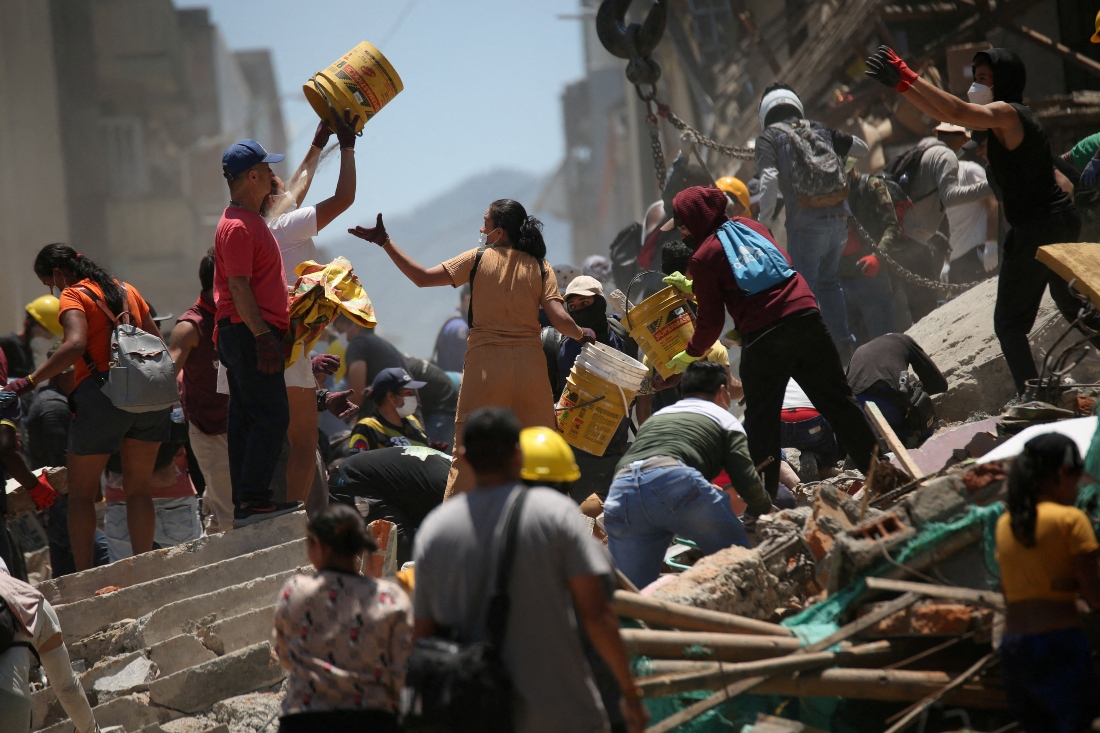
Rescue workers rushed to the scene, carefully moved great chunks of concrete with their hands and freed the bloodied man and the child he had been cradling in his arms for the previous 48 hours.
The rescue of the six-month-old baby boy was a brief moment of joy for a country mourning the deaths of more than 220 people, victims of an earthquake that injured thousands more and devastated innumerable buildings in the west of the country.
The Colombia earthquake is the latest in a series that has dominated global headlines in the past weeks.
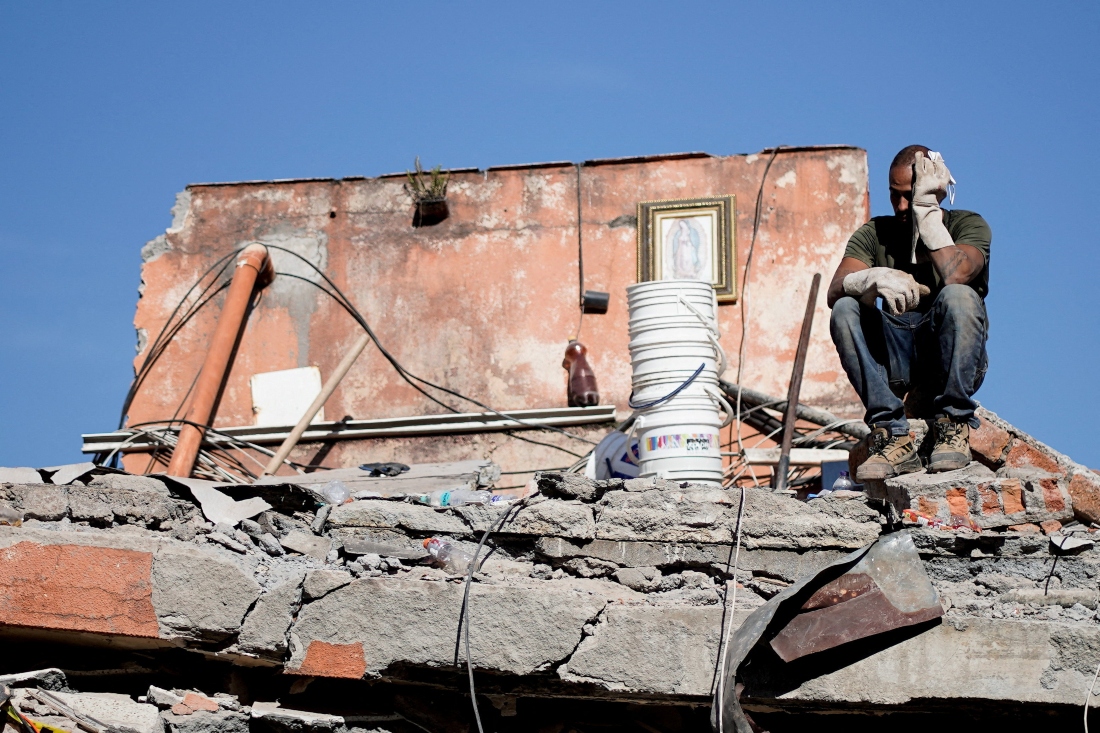
The 7.4 magnitude shock was felt as far away as Venezuela, which was still struggling to recover from two powerful earthquakes, of 7.2 and 7.5 magnitude, which struck on June 24.
More than 6,500 people were killed and hundreds of buildings in the state of La Guaira were destroyed or badly damaged.
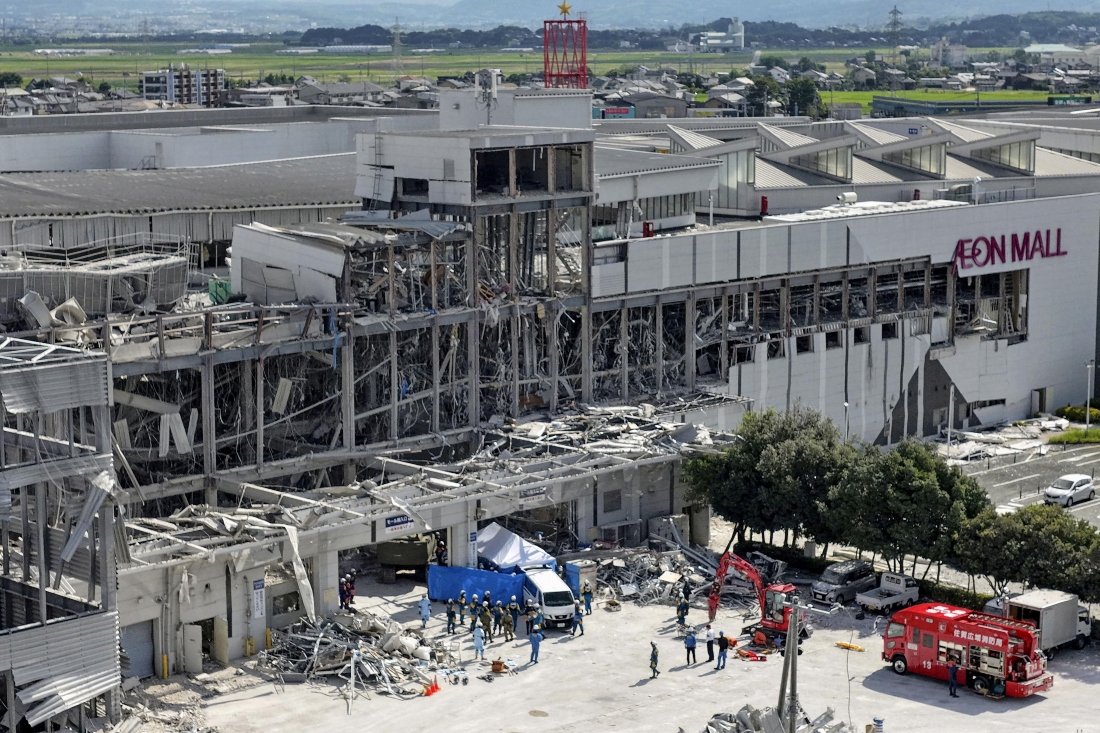
On July 28, Japan’s Kyushu Island was hit by a 6.8 magnitude earthquake, which killed 34 people and caused widespread damage to buildings and power lines.
Earthquakes are common events. According to the US Geological Survey, which monitors daily earthquake activity around the world, on average there are about 20,000 earthquakes every year — about 55 a day.
On Wednesday, for example, 51 earthquakes were recorded, the most powerful a 6 magnitude shock in the region of the remote South Sandwich Islands in the South Atlantic Ocean.
Very few of the world’s daily earthquakes qualify as “major” events.
“We expect on average about 16 major earthquakes a year,” said Dara Goldberg, a research geophysicist with the US Geological Survey’s National Earthquake Information Center.
“Generally, that’s 15 earthquakes bigger than magnitude 7 and one bigger than magnitude 8.
“In the past 12 months, we’ve had 17 earthquakes bigger than magnitude 7, and none of those have been bigger than magnitude 8, so we’re really not that far from a so-called average year.”
The NEIC operates a network of more than 2,500 seismometers around the world that are recording and sending data to its headquarters in Colorado in real time, and “we are able to locate and characterize every earthquake bigger than magnitude 4.5 anywhere around the globe.
“Obviously, most of those are not societally impactful, but they are impactful to researchers and our understanding of where earthquakes are common and what hazards to expect in different parts of the world.”
The number of major earthquakes each year can vary enormously, and unpredictably. In 1989 there were only six major earthquakes, defined as equal to or greater than magnitude 7.0. But in 2010 — the year with the largest number on record to date — there were 23.
It is the relative rarity of high-magnitude earthquakes that that has drawn public attention around the world to this recent sequence of major events in a short period of time, prompting anxious questions.
Are earthquakes occurring more frequently, and are they becoming more powerful?
These, say seismologists, are reasonable questions, especially for anyone who lives in one of the world’s earthquake hotspots — and some of those hotspots are to be found along the edges of the Arabian tectonic plate, a huge section of the Earth’s crust roughly the size and shape of the Arabian Peninsula.
But the answer is “no.”
The USGS says there has been an increasing number of earthquakes in recent years, but “not because there are more earthquakes, but because there are more seismic instruments and they are able to record more earthquakes.
“What’s been unique about this latest sequence of earthquakes in those three countries is the direct human impact,” said Goldberg.
“Sometimes we have magnitude 7 earthquakes that are, you know, 400 km deep in in the earth and barely felt at the surface, or earthquakes in the middle of the ocean where there are no inhabited islands nearby.”
There are two factors that affect the impact of an earthquake. One is the magnitude, which is a calculation based on the length of the part of the fault that has moved, and the distance it has moved.
The other is the intensity, a measure of how much the earthquake shakes the surface, which in turn is dependent upon the depth of its hypocenter — the point in the earth where the earthquake originates.
“You might have a magnitude 7 earthquake that is very close to the surface, and right under a large city, and it’s felt by a really enormous population,” said Goldberg.
“Depending on what the infrastructure is in that location, you could have either really severe damage, or it could be a place that’s very used to having larger quakes and has really great seismic-resilient infrastructure, so it doesn’t have that much of an impact.
“Compare that to an earthquake of the exact same magnitude that is maybe 200 or 300 km deep in the Earth. By the time it reaches the surface, the shaking is really weak, and so the societal impact will be much less.”
The surface of the planet — the Earth’s crust — consists of seven major tectonic plates and about 10 minor ones, one of which is the Arabian.
More than 80 percent of earthquakes happen around the edge of the Pacific plate, the largest and most seismically and volcanically active zone in the world, known as the Ring of Fire.
Each of the Earth’s tectonic plates is constantly on the move, sliding over the semi-molten layer of hot rock beneath the crust.
They do not go fast or far — at most, no more than a few centimeters a year.
But they do interact, pushing into each other, pulling apart or sliding past, and the forces involved in these movements are massive.
Occasionally, the pressure that builds up along the boundaries, or “faultlines” between plates, is released suddenly, and it is this burst of energy that radiates outward as “seismic waves,” causing earthquakes.
The Arabian plate has more neighbors than most — it is bordered by and interacting with eight major tectonic plates, which means it is surrounded by faultlines capable of generating earthquakes.
In 2022, in a bid to better understand the earthquake threat to the Arabian Peninsula, scientists at King Abdullah University of Science and Technology in Thuwal analyzed GPS readings taken at 168 stations across the Arabian plate over 17 years — the largest such study ever undertaken.
They concluded that, despite jostling for its place with so many competitors, “the Arabian plate is remarkably tectonically stable.”
KAUST geophysicist Renier Viltres, in the paper “Present-day motion of the Arabian plate,” published in the journal Tectonics, said: “We were surprised at the remarkable stability of the Arabian plate, despite the push and pull forces associated with continental collision in the northeast and plate breakup in the south.
“The plate moves as a single block, and the motion of the plate relative to its major neighboring plates has likely remained unchanged for the last 13 million years.”
Which is not to say that the faultlines that encircle the Arabian plate have not produced their share of earthquakes.
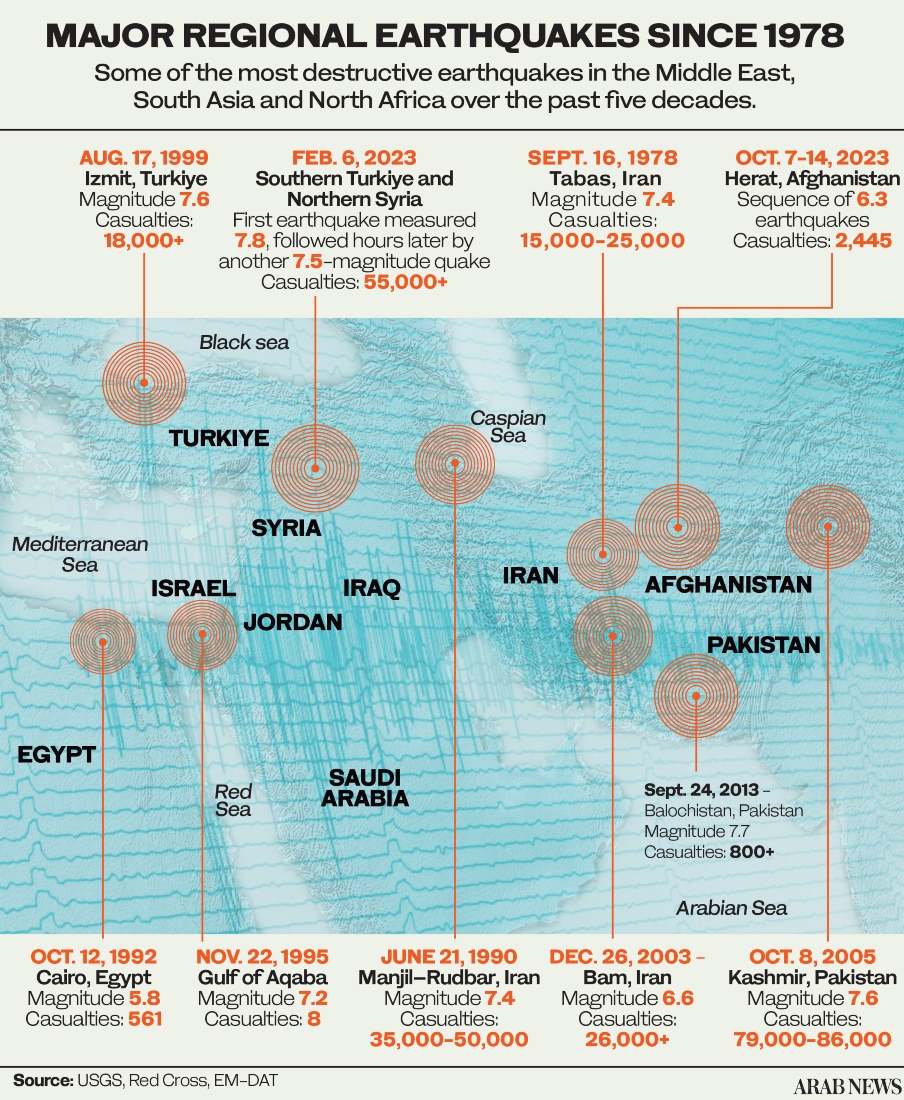
A search of the database of the NEIC, whose records go back to 1907, reveals that since 1978 there have been more than 18,000 earthquakes on or around the Arabian plate.
Of these, however, only 11 have measured in excess of 7 magnitude.
The worst of these was the 7.8 magnitude earthquake that struck southern Turkiye near the border with Syria on Feb. 6, 2023, followed by a large aftershock.
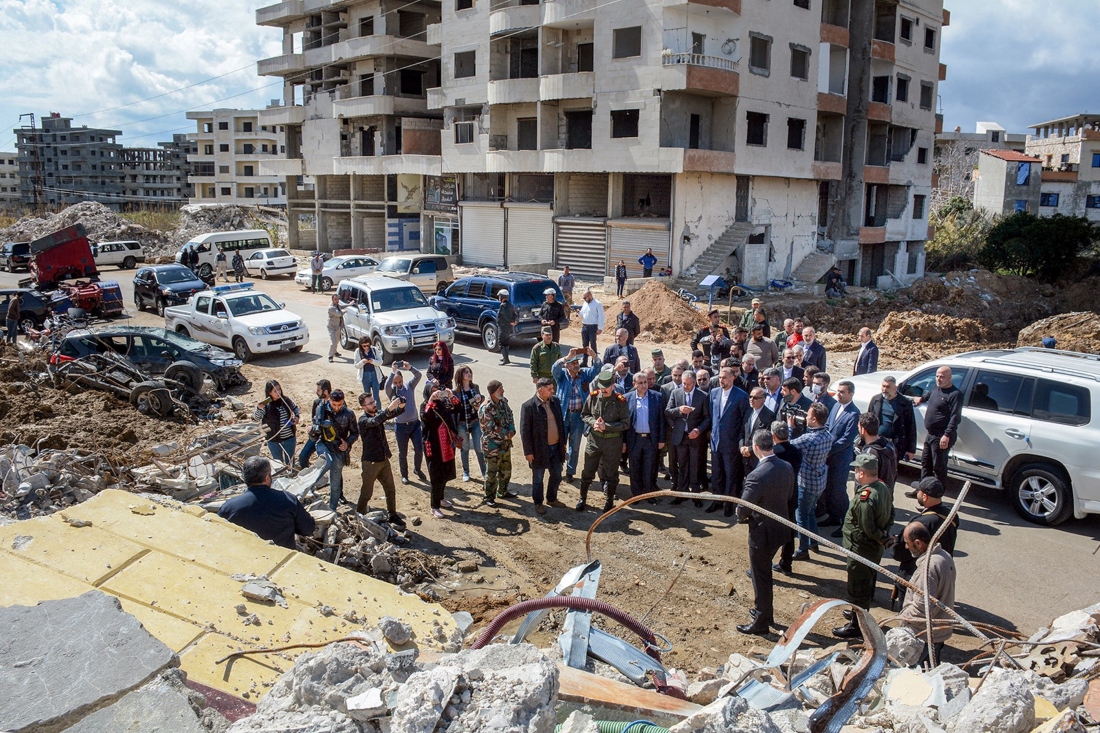
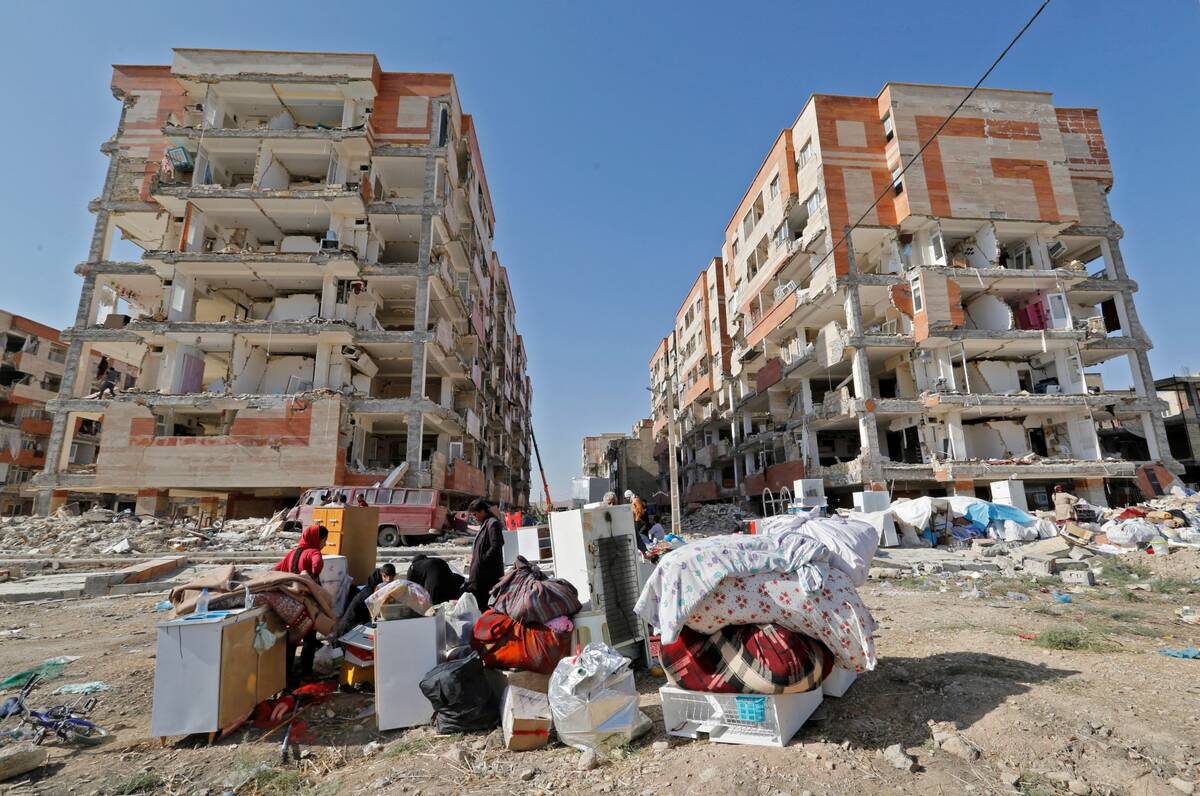
More than 50,000 people died, 1.5 million were left homeless and in excess of 350,000 buildings were destroyed or severely damaged.
The epicenter of the earthquake was in a notoriously active zone — in the vicinity of a junction between the Anatolia, Arabia and Africa plates.
But historically, relatively few earthquakes have taken place in Saudi Arabia itself.
Over the past 50 years, there has been a cluster around the Gulf of Aqaba, through which the edge of the Arabian plate runs, but most of these have been in Jordan or Egypt.
Only five in that region have been recorded in Saudi Arabia, in the vicinity of Tabuk, but none has exceeded 4.7 magnitude.
In fact, in the past half-century there have been only about 25 relatively minor earthquakes in the whole of the Kingdom.
The biggest concentration has been in the region of the western Umluj governate in Tabuk province, where, since 1978, 11 distinct earthquakes have been recorded, including the largest ever experienced in Saudi Arabia — a 5.7 magnitude shock centered 56 km northeast of the Red Sea city of Umluj, on May 19, 2009.
It came as a surprise to seismologists.
The 5.7 magnitude shock was the largest of a highly unusual “seismic swarm” of more than 30,000 mainly “mini” earthquakes that erupted between April and June 2009 in Harratt Lunayyir, a lava field east of Umluj and a region long thought to be geologically quiet.
Most were of a low magnitude — only 19 reached 4 or slightly greater — but out of caution more than 40,000 residents were temporarily evacuated.
Although no one was killed, seven people were injured, several large ground cracks and landslides were seen, and shocks were felt as far away as Madinah, AlUla and Yanbu, 130 km down the coast.
This is the reassuring note on the USGS file for this and the vast majority of earthquakes recorded in Saudi Arabia: “No people dead or missing; no people injured; no buildings damaged or destroyed.”
One of the most common questions seismologists at the USGS are asked is — can we one day expect a “megaquake”?
In short, no. There is a mathematical relationship between the magnitude of an earthquake and the length of the fault along which it occurs, and there is a physical limit to the potential force of an earthquake.
The longer the fault, the larger the earthquake but, says the USGS, “no fault long enough to generate a magnitude 10 earthquake is known to exist, and if it did, it would extend around most of the planet.”
On May 22, 1960, the largest-ever recorded earthquake, produced by a fault more than 1,600 km long and with a magnitude of between 9.5 and 9.6, struck Chile.
The earthquake originated in the Peru-Chile Trench — the faultline between the Nazca plate, on the eastern flank of the Pacific Plate, and the South American Plate, which runs down the entire west coast of South America.
The epicenter was in the Valdivia-Puerto Montt area on the coast. It lasted about 10 minutes, but the effects were as devastating as they were wide-ranging.
In addition to widespread destruction in Valdiva and the surrounding areas, as many as 6,000 people died, and tsunamis claimed victims as far away as Hawaii, Japan, Australia and New Zealand.