Yemen’s Houthi-run Foreign Ministry says UN should not shield espionage activities
Yemen’s Houthi-run Foreign Ministry says UN should not shield espionage activities
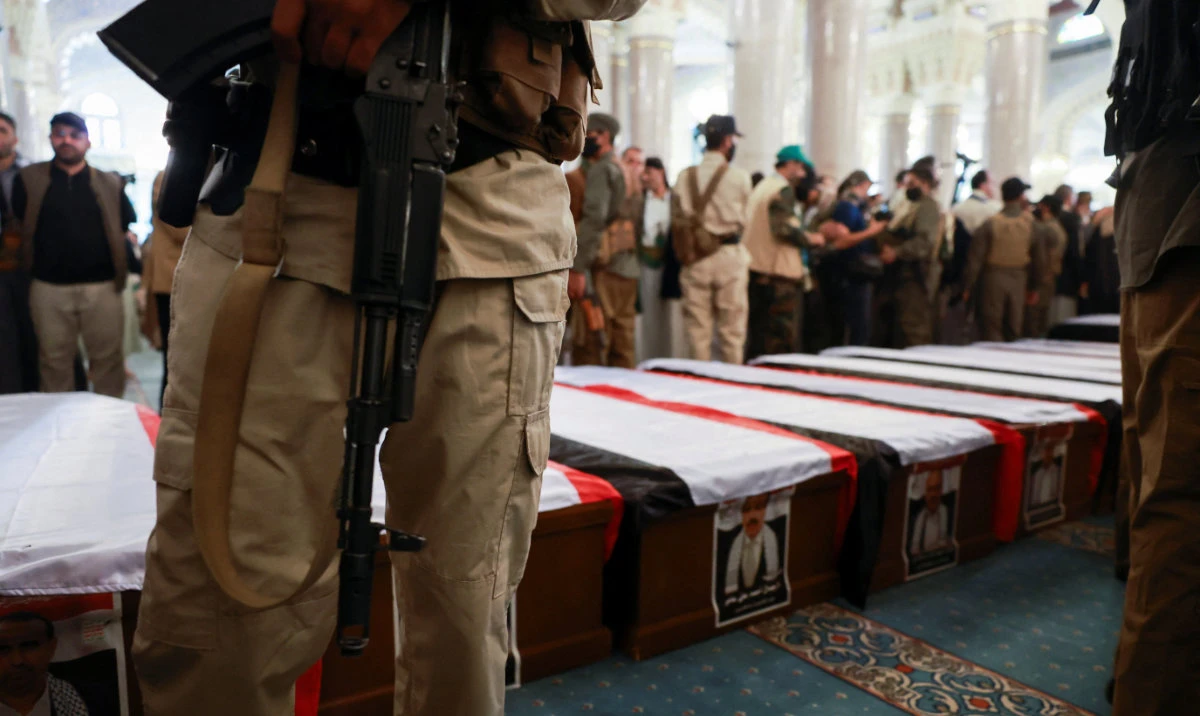
A member of the Houthi stands guard next to the coffins of Houthi government officials killed in an Israeli strike, during the funeral procession in Sanaa, Yemen September 1, 2025. (Reuters)
Short Url
Updated 04 September 2025
Follow

Yemen’s Houthi-run Foreign Ministry says UN should not shield espionage activities
Yemen’s Houthi-run Foreign Ministry says UN should not shield espionage activities

Yemen’s Houthi-run Foreign Ministry said United Nations officials’ legal immunities should not shield espionage activities, days after at least 11 UN personnel were arrested in the capital Sanaa. The UN said on Sunday that Houthi rebels raided its premises in Sanaa and arrested UN staff following an Israeli strike that killed the prime minister of the Houthi-run government and several other ministers.
The ministry also accused the UN of bias, saying it condemned “legal measures taken by the government against spy cells involved in crimes,” but failed to denounce the Israeli attack, the Houthi-run news agency Saba reported on Wednesday.
Yemen has been split between a Houthi administration in Sanaa and a Saudi-backed government in Aden since the Iran-aligned Houthis seized Sanaa in late 2014, triggering a decade-long conflict.
The ministry added that Yemen respected “the 1946 Convention on the Privileges and Immunities of the United Nations ... while emphasizing that these immunities do not protect espionage activities or those who engage in them, nor provide them with legal cover,” it added.
On Sunday, UN Secretary-General Antonio Guterres said the Houthis forcibly entered World Food Programme premises, seized UN property, and attempted to enter other UN offices in the capital.


Survivors from Sudan’s El-Fasher recount escape

Survivors from Sudan’s El-Fasher recount escape
Updated 6 sec ago
Follow

Survivors from Sudan’s El-Fasher recount escape

Survivors from Sudan’s El-Fasher recount escape
  • As many as 200,000 people may still be trapped inside the city, according to estimates of the city’s population toward the end of the siege

TAWILA, Sudan: At a clinic in Sudan’s North Darfur where dozens of bony children lie on cots and men with bandaged wounds await surgery, patients described a desperate escape from the city of El-Fasher as it was captured last week by a paramilitary force.

They are among up to 10,000 people who arrived in the town of Tawila after fleeing the capture of nearby El-Fasher by the Rapid Support Forces, and are now being treated at the clinic run by international aid agency Medecins Sans Frontieres.

In addition to those who reached Tawila, more than 60,000 others are believed to have escaped El-Fasher, according to the International Organization for Migration, though their whereabouts are unclear. As many as 200,000 people may still be trapped inside the city, according to estimates of the city’s population toward the end of the siege. 

The dire conditions inside El-Fasher were described by two patients at the MSF clinic, in accounts obtained by a local journalist who has previously provided verified material for Reuters.

One, who gave her name as Fatuma, said she was entrusted with the care of three children orphaned when their parents and brother had been killed by a drone strike as they fetched a meal.

Fatuma took the children out of the city on a donkey cart with other injured people just before El-Fasher fell, but came across RSF soldiers on the road. 

“They made us lay the baby on the ground and made all of us get down on the ground, and took everything we had,” she said. She was eventually able to bring the baby to the MSF clinic.

A second patient, Abdallah, said he had escaped El-Fasher amidst intense shelling and gunfire on the day of the takeover.

“People left in chaos, carrying children, some in wheelbarrows, some on donkey carts, some on their feet,” he said. “No one walking around was untouched, everyone was injured.” Abdallah, awaiting surgery in the MSF clinic after being shot multiple times, said he saw what he estimated to be more than 1,000 bodies on the road.