Putin to visit Central Asia as Russian influence wanes

Putin to visit Central Asia as Russian influence wanes
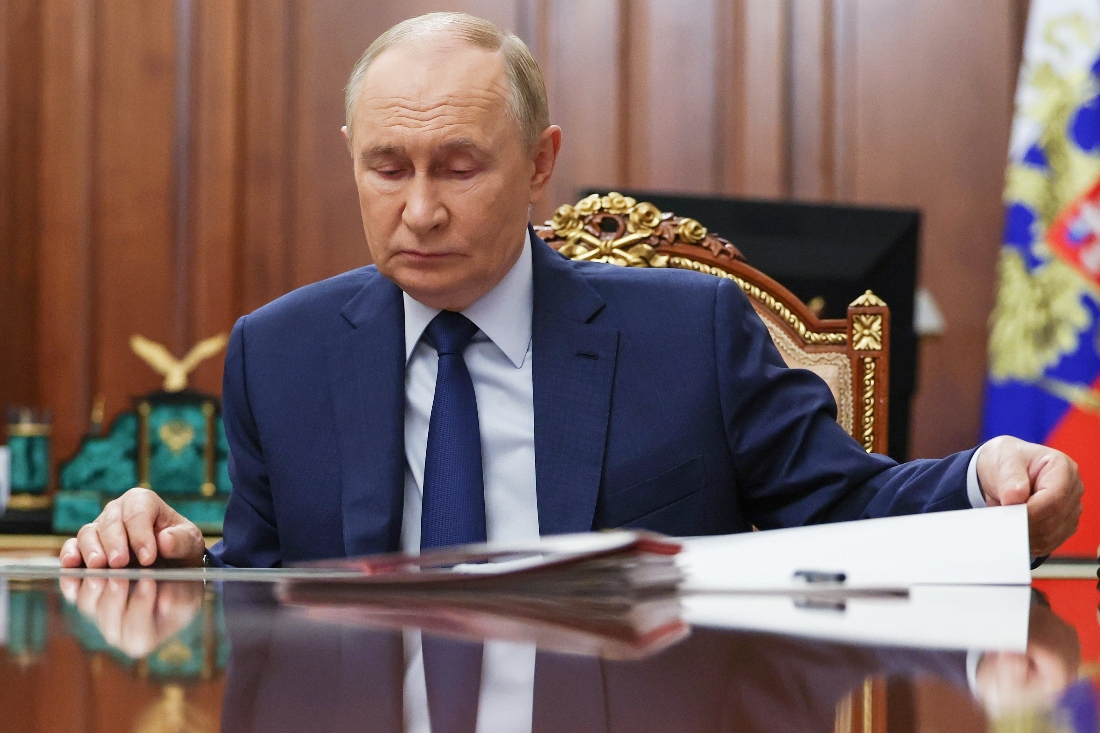
Russian President Vladimir Putin attends a meeting at the Kremlin in Moscow, Russia. (AP)
Short Url
Updated 08 October 2025
Follow

Putin to visit Central Asia as Russian influence wanes

Putin to visit Central Asia as Russian influence wanes
  • The region is home to millions of Russian speakers, while millions of Central Asian migrants have moved across the border to work in some of Russia’s most labor intensive industries
  • All five Central Asian states maintain close cultural and economic links with Russia

DUSHANBE: Russian President Vladimir Putin will meet Central Asian leaders in Tajikistan on Thursday, for only the second such summit since the fall of the Soviet Union, as Moscow jostles with China and Europe for influence.
Weakened by the war in Ukraine, Russia’s historic grip over the region has waned in recent years.
At the first summit with Central Asia’s five leaders in 2022, Putin got a tongue-lashing from the president of Tajikistan, who accused Moscow of neglecting the post-Soviet states and of showing them little respect.
China and Europe have meanwhile rushed to fill the power vacuum. Both have held high-level summits in Central Asia this year and are hoping to expand their access to the region’s vast natural resources.
Putin is expected to arrive in Tajikistan on Wednesday.
The leaders of Kazakhstan, Kyrgyzstan, Uzbekistan, Tajikistan and Turkmenistan are set to attend Thursday’s meeting, which will take place in the Tajik capital Dushanbe.
Central Asian countries will use the summit to “advance their positions,” as well as to build trust with Russia and develop trade ties, Kazakhstan’s foreign ministry told AFP.
Russia said it expected “significant and interesting results from the talks.”

- ‘We want to be respected’ -

All five Central Asian states maintain close cultural and economic links with Russia.
The region is home to millions of Russian speakers, while millions of Central Asian migrants have moved across the border to work in some of Russia’s most labor-intensive industries.
Russia is set to build Kazakhstan’s first nuclear plant and its relations with its neighbors are largely friendly.
But after more than a century of Russian domination, Central Asia’s five republics are increasingly looking beyond Moscow — their former imperial ruler — for trade and security.
The region is increasingly looking to China and Turkiye for arms supplies, while the European Union announced a $14 billion investment package in the region following its summit in April.
Neighbouring China has already established a strong presence there through its Belt and Road Initiative, a colossal infrastructure project that aims to boost trade between Beijing and the rest of the world.
Russia has said it is not competing with Beijing for influence in Central Asia but the rivalry with other powers — including Europe — is “hard to ignore,” Kyrgyz-based analyst Ilya Lomakin told AFP.
“One could say that this is the latest iteration of the so-called New Great Game,” he said, referring to a 19th-century power struggle between the British and Russian empires in the region.
“Whether Russia will be able to maintain its position in this area, let alone expand it, remains to be seen,” he added.
At the last Central Asia-Russia summit in October 2022, Tajik leader Emomali Rakhmon demanded Russia show “respect” in a seven-minute tirade that left Putin squirming.
“Yes, we’re small nations, not 100 million or 200 million people... But we have history, culture. We want to be respected,” he added.
In response, Putin said he “largely agreed” and called for them to focus on “concrete matters.”
Germany’s Merz calls for repatriation of Syrians as far-right surges

Updated 6 sec ago
Follow

Germany’s Merz calls for repatriation of Syrians as far-right surges

Germany’s Merz calls for repatriation of Syrians as far-right surges
“There are now no longer any grounds for asylum in Germany, and therefore we can also begin with repatriations,” Merz said
The party has campaigned on an anti-migrant platform and argues that Islam is incompatible with German society

BERLIN: Syrians no longer have grounds for asylum in Germany now the civil war in their country is over, German Chancellor Friedrich Merz said, as his conservatives seek to fend off a surging far-right ahead of a slew of state elections next year.
Germany was the EU country that took in the largest number of refugees from the 14-year-long Syrian civil war due to former Chancellor Angela Merkel’s open-door policy, with around one million Syrians living in the country today.
But Merz and several fellow conservatives in his coalition cabinet say the situation has changed following the fall last December of Bashar Assad’s government and end of the war — despite the fact Syria remains in a deep humanitarian crisis and forcible returns would face steep legal challenges.

COUNTERING THE AfD
“There are now no longer any grounds for asylum in Germany, and therefore we can also begin with repatriations,” Merz said late on Monday, adding that he expected many Syrians to return of their own accord to rebuild the country.
“Without these people, rebuilding will not be possible. Those in Germany who then refuse to return to the country can, of course, also be deported in the near future.”
The far-right Alternative for Germany has surged ahead of Merz’s conservatives in opinion polls ahead of five state elections next year that could give the AfD its first state premier.
The party has campaigned on an anti-migrant platform and argues that Islam is incompatible with German society.
Migration has consistently topped polls about Germans’ top concerns in recent years, and some mainstream conservative strategists believe only a hard-line asylum policy can counter the AfD. Others advocate challenging the AfD more robustly.
The United Nations has warned that conditions in Syria currently do not allow for large-scale repatriations, with some 70 percent of the population still relying on humanitarian aid — a sentiment echoed by German Foreign Minister Johann Wadephul during his trip to the country last week.
AfD co-leader Alice Weidel called that “a slap in the face to the victims of Islamist violence,” referring to the arrest of a 22-year-old Syrian in Berlin on Sunday accused of preparing a “jihadi” attack in the latest of a series of high-profile incidents that have fueled public concerns over security and migration.

VOLUNTARY RETURNS
Germany has been examining the possibility of deporting Syrians with criminal records for several months, and Merz said on Monday he had invited Syrian President Ahmed Al-Sharaa to Germany to discuss the issue.
Now a policy of broader repatriations — preferably voluntary — is being discussed.
Chancellery chief Thorsten Frei said on Monday that young Sunni Muslim men were “certainly not subject to any danger or risk of destitution in Syria” anymore.
“Germany will only be able to help people in such situations on a lasting basis if, once the country has been pacified, a large proportion of these people then return to their homeland,” said Frei.
Hundreds of thousands of Bosnians were repatriated from Germany in the late 1990s after the end of the war there, largely via voluntary returns in part prompted by the knowledge their residence permits would not be extended.
Bosnia had a clearer peace architecture, with international monitoring, than Syria has today — and Germany would likely face legal challenges if it sought to forcibly return Syrians.
Only around 1,000 Syrians returned to Syria with German federal assistance in the first half of this year. Hundreds of thousands of Syrians in Germany still hold only temporary residence permits.