Pakistan army says 30 militants killed in raids after attack left 11 soldiers dead

Pakistan army says 30 militants killed in raids after attack left 11 soldiers dead
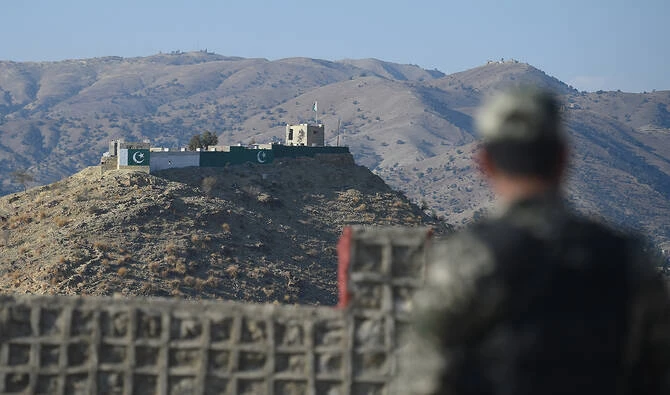
A Pakistani army soldier stands guard on a border terminal in Ghulam Khan, a town in North Waziristan, on the border between Pakistan and Afghanistan, on January 27, 2019. (AFP/File)
Short Url
Updated 10 October 2025
Follow

Pakistan army says 30 militants killed in raids after attack left 11 soldiers dead

Pakistan army says 30 militants killed in raids after attack left 11 soldiers dead
  • Pakistan is struggling to contain a surging militancy in its northwestern Khyber Pakhtunkhwa province that borders Afghanistan
  • Islamabad accuses Afghanistan and India of backing militant groups for attacks against Pakistan, Kabul and New Delhi deny this

ISLAMABAD: Pakistan’s security forces have killed 30 militants involved in an ambush that killed 11 soldiers this week near the Afghan border, the Pakistani army said on Friday.

The soldiers were killed in an overnight gunbattle in Orakzai district, which also killed 19 militants, according to the Inter-Services Public Relations (ISPR), the army’s media wing.

It said security forces have been conducting a series of “retribution operations” against the Pakistani Taliban militants involved in heinous incident that occurred in the Orakzai district.

During the conduct of an operation in Orakzai’s Jamal Maya area, 30 Pakistani Taliban militants involved in the Oct. 7 incident were killed after intense fire exchange.

“These successful operations have avenged the heinous act and have brought the main perpetrators to justice,” the ISPR said. “Sanitization operations are being conducted to hunt and eliminate any other Indian-sponsored kharji (militant) found in the area.”

The Pakistani Taliban, or the Tehreek-e-Taliban Pakistan (TTP), and other militant groups have frequently targeted security forces convoys and check-posts, besides targeted killings and kidnappings of law enforcers and government officials in recent months.

Islamabad has frequently accused Afghanistan of allowing the use of its soil and India of backing militant groups for attacks against Pakistan. Kabul and New Delhi both deny the allegation.

On Thursday, another Pakistan army major and seven militants were killed in a gunbattle in Dera Ismail Khan in northwest Pakistan, according to the ISPR.

Pakistan’s northwestern tribal regions turned into militant hotspots after the US invasion of Afghanistan in the wake of the September 11, 2001, attacks. Islamabad launched multiple military operations over the last two decades to push away militants but they have managed to regroup and the threat has persisted in the rugged, mountainous region.

Italian fruit detective racing to save forgotten varieties

Italian fruit detective racing to save forgotten varieties
Updated 14 November 2025
Follow

Italian fruit detective racing to save forgotten varieties

Italian fruit detective racing to save forgotten varieties
  • The Italian agronomist-turned-detective seeks descriptions of bygone local fruits in centuries-old diaries or farming documents, and sets out to find them

CITTA DI CASTELLO: Isabella Dalla Ragione hunts in abandoned gardens and orchards for forgotten fruits, preserving Italy’s agricultural heritage and saving varieties which could help farmers withstand the vagaries of a changing climate.
The 68-year-old’s collection of apples, pears, cherries, plums, peaches and almonds, grown using methods of old, are more resilient to the climate shifts and extremes seen increasingly frequently in the southern Mediterranean.
The Italian agronomist-turned-detective seeks descriptions of bygone local fruits in centuries-old diaries or farming documents, and sets out to find them.
Others she identifies by matching them to fruits in Renaissance paintings, where they often appear in depictions of the Madonna and Child.
Of the 150 or so varieties collected from Tuscany, Umbria, Emilia-Romagna and Marche and grown by her non-profit Archaeologia Arborea foundation, the small, round Florentine pear is among Dalla Ragione’s favorites.
“I’d found it described in documents from the 1500s, but I’d never seen it and believed it lost,” she told AFP.
“Then 15 years ago, in the mountains between Umbria and Marche, I found a tree almost in the middle of the woods,” thanks to an elderly local woman who told her about it by chance.
While old varieties are flavoursome, most disappeared from markets and tables after the Second World War as Italy’s agricultural system modernized.

- ‘Urgent’ -

Italy is a large fruit producer. Its pear production ranks first in Europe and third globally, but just five modern varieties — none of which are Italian — account for over 80 percent of its output.
“There used to be hundreds, even thousands, of varieties because each region, each valley, each place had its own,” Dalla Ragione said as she showed off wicker baskets full of fruit, stored in a little church near the orchard.
Modern markets instead demand large crops of fruits that can be harvested quickly, easily stored and last a long time.
But as global warming makes for an increasingly challenging climate, experts say a broader range of plant genetic diversity is key.
“Heirloom varieties... are able to adapt to climate change, to more severe water shortages, to extremes of cold and heat,” said Mario Marino, from the climate change division of the UN’s Food and Agriculture Organization.
“However, a much more severe disease arrives, one that improved varieties are normally more resistant to... and the local varieties perish, or perhaps don’t produce fruit,” he told AFP.
The answer lies in creating new varieties by crossing modern and old-fashioned ones, he said.
Marino, who advises Dalla Ragione’s foundation, said her work was “urgent” because “preserving one’s heritage means preserving the land, preserving biodiversity... and (allowing) us to use that DNA for new genetic resources.”

- Oral testimonies -

Researchers can access the collection, while Dalla Ragione also recreates historical gardens which can host recovered varieties as part of an EU-funded project.
“We don’t do all this research and conservation work out of nostalgia, out of romanticism,” she said as she harvested pink apples from her trees in the hilly hamlet of San Lorenzo di Lerchi in Umbria.
“We do it because when we lose variety, we lose food security, we lose diversity and the system’s ability to respond to various changes, and we also lose a lot in cultural terms.”
Dalla Ragione has sought answers to fruit mysteries in monastery orchards, the gardens of nobility and common allotments. She has pored over local texts from the 16th and 17th centuries.
She once traced a pear to a village in southern Umbria after reading about it in the diary of a musical band director.
But one of her richest sources on how best to cultivate such varieties has been oral testimonies — and as the last generation of farmers that grew the crops die, much local knowledge is lost.
That has made it difficult to know how to divide her time between researching and looking for a new variety, though she has learnt the hard way that the urgency “is always to save it.”
“In the past if I’ve delayed, thinking ‘I’ll do it next year’, I’ve found the plant has since gone.”