



Katmandu: Grieving relatives and well-wishers gathered in Katmandu as the bodies of three Nepali mountaineers killed in a deadly avalanche on Pakistan’s Broad Peak returned home, days after rescuers recovered them from the slopes of the world’s 12th-highest mountain.
The three — Kili Pemba Sherpa, Gyalu Sherpa and Nima Sherpa — were among 10 elite climbers killed when an avalanche struck their expedition at an altitude of about 6,600 meters (21,650 feet) on July 30.
The disaster also killed renowned British-Nepali mountaineer Nirmal Purja, dealing a major blow to a country whose high-altitude guides are at the heart of global mountaineering.
“The country should look after the families of those who died because they are gone now,” Lakpa Gyaljen Sherpa, chairperson of the Nepal Sherpa Association, said as the bodies arrived at Katmandu’s Tribhuvan International Airport.
“Who will look after their children? The children have lost their parents. Now, the government should create an environment that is safer for mountaineers.”
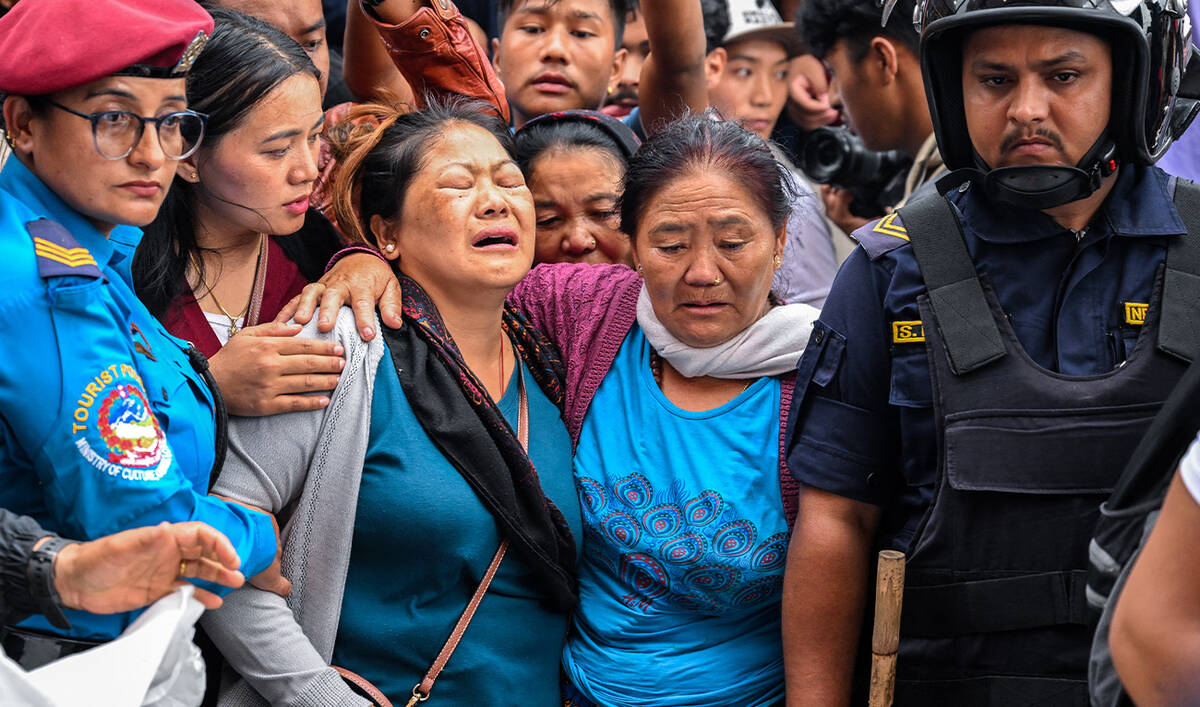
Family and relatives break down as the coffin of Nepalese mountaineer Pur Bahadur Gurung, who was killed in an avalanche in Pakistan, arrives at Tribhuvan International Airport in Kathmandu on August 6, 2026. (AFP)
The arrival of the bodies came as mourners in Pakistan’s capital Islamabad held a candlelight vigil on Tuesday for the climbers, whose deaths and the difficult effort to recover their bodies have drawn attention in recent weeks to the dangers faced by mountaineers on some of the world’s highest peaks.
Broad Peak rises 8,051 meters (26,414 feet) in Pakistan’s Karakoram range near K2, the world’s second-highest mountain. Avalanches, falling ice, extreme altitude and rapidly changing weather make rescue and recovery operations particularly difficult in the region.
Purja, 43, who led the expedition, was one of the world’s best-known high-altitude mountaineers. The 10-member team included climbers from Nepal, Pakistan, Oman, China, Britain and the United States.
Gambu Sherpa, chairperson of Khijidemba Village Municipality, home to Gyalu Sherpa, described the deaths as the biggest loss Nepal’s mountaineering sector had suffered.
“This is the biggest loss in Nepal’s mountaineering sector,” he said. “Gyalu Sherpa, who lost his life, was also a Guinness World Record holder. He climbed Mt. Kanchenjunga three times in just 15 days.”
“He made the impossible possible and became a record holder. He climbed numerous 8,000-meter peaks and contributed greatly to Nepal’s tourism sector. His entire village, Khijidemba, is in great shock, as is the country.”
At the vigil at the Pakistan Sports Complex in Islamabad, mountaineers, diplomats and members of civil society lit candles and offered prayers for those killed.
“We have all gathered here today to pay tribute to the world’s ten best climbers who lost their precious lives during the avalanche on 30th of July, which was very unfortunate,” Nepal’s Ambassador to Pakistan Rita Dhital said.
“The world lost ten of its best climbers and Nepal lost six in a single day. They were the best leading climbers from Nepal and the whole nation is mourning their loss at the moment.”
The recovery operation was repeatedly hampered by adverse weather that prevented helicopters from reaching the avalanche site, forcing rescuers to undertake much of the operation on foot in difficult high-altitude conditions.
Dhital praised Pakistani climber Sirbaz Khan and his team for their role in the difficult recovery effort, saying they had shown “extra courage and resilience and strength” in bringing fellow climbers down from the mountain.





