


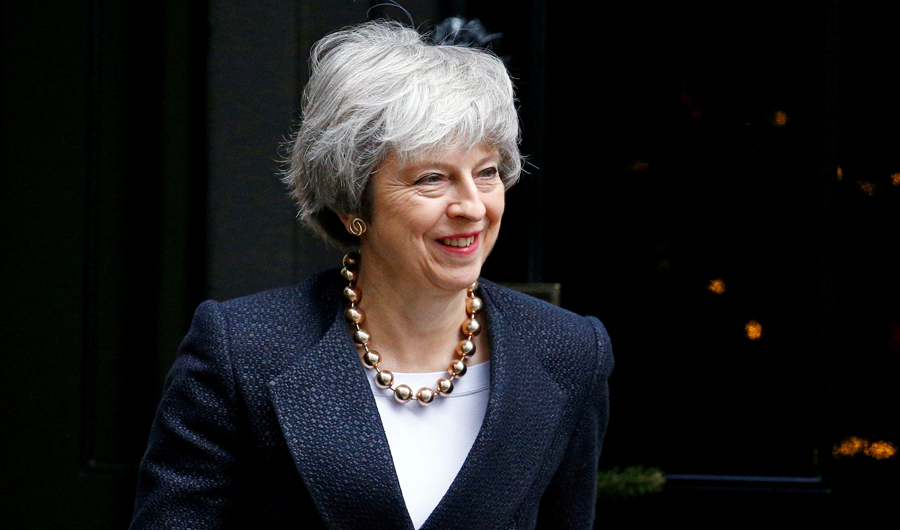
No one doubts that UK Prime Minister Theresa May means well and hopes to deliver on what the British electorate voted for in 2016: To leave the EU. Her efforts, compared to those who campaigned for Brexit and then disappeared, are commendable. She has clearly demonstrated a capacity to uphold the democratic choice of those who participated in the referendum, putting aside her preference to stay in the EU.
But a true leader is capable of making a U-turn if that is in the national interest. The indications are that it is futile to go through with a Brexit deal that keeps the UK tied to the EU with less say in the union’s rules and regulations. There are also indications that the country will be poorer for decades to come, regardless of whether there is a Brexit deal.
So, to avoid further economic uncertainty, and to put an end to the political paralysis witnessed in the UK for more than two years, May must take charge and call for compromises from outside the box. She should no longer hide the fact that the majority of the public was misled and voted to leave the EU for half-baked reasons. As leader, she must try to find a way out that preserves the UK’s integrity, stability and growth.
In the last 20 to 30 months, Britain has been yo-yoing from one failed negotiation to another. It is cruising to stagnation in an age of uncertainty. The UK’s leadership must try to break the deadlock. Conservative MPs are divided, while Labour under Jeremy Corbyn is being elusive on Europe — the party’s leader is pro-Brexit, while members and the majority of MPs back remaining through a new referendum.
In a divided country and Parliament, compromises are needed to achieve unity and thus some certainty. Parliament is divided between four distinct views on Brexit: That May’s deal is better than none at all; that the deal is poor but there is room for further concessions from the EU; that the UK is better off outside the bloc even without a deal; and that another referendum is necessary.
Clearly the Christmas and New Year break did nothing to change the dynamic among MPs or the political leadership, which is sticking to its guns despite new polls showing an electorate clearly leaning toward backing a vote on any final deal or a referendum that delays or cancels Brexit all together.
Conservative MPs are continuing their destructive intra-party civil war, with some supporting May’s latest negotiated deal, others wanting further negotiations with the EU for an improved deal, and some wanting to renege on Brexit all together for the time being.
New polls of Labour Party members show a further shift to put pressure on Corbyn to back a fresh referendum to solve the impasse. One survey of Labour members showed that 72 percent of card-carrying party loyalists want the leader to throw his weight behind a “final say” public vote about any deal approved by Parliament. In the same poll, 88 percent would back remaining in the EU if a new referendum took place.
In a divided country and Parliament, compromises are needed to achieve unity and thus some certainty.
Mohamed Chebaro
Along the same lines, calls continue from all political, social and economic sectors indicating that paralysis is hurting the UK’s outlook on all fronts. The latest is economists warning that Brexit could only be “bad or awful” for Britain. A poll of 80 prominent economists published by the Financial Times newspaper indicates that “uncertainty will hobble UK business investment and depress consumer spending in 2019.” However, many said that forecasting for the year ahead was impossible given the “comprehensive and chronic uncertainty that has become a way of life in Britain,” as the choices left on the table are either a no-deal exit from the EU or no Brexit at all.
This poll is clearly in line with the Governor of the Bank of England Mark Carney’s warning in September that a no-deal Brexit has the potential to be “as catastrophic as the financial crisis of 2008.” In a brief to May’s Cabinet, Carney stated that house prices may decline by 35 percent over three years, driven by falling employment, as Brexit would depress economic growth and business confidence. These views are not new and his previous assessments during the referendum campaign of 2016 were rejected by hard-core pro-Brexit Conservative MPs, who nicknamed the governor “the high priest of Project Fear.”
The new year has started in the UK with the probability of a deal being agreed that is acceptable to the EU 27, UK MPs and the British electorate being very slim. The general feeling in cities and towns across the UK is gloomy. Households are struggling due to economic uncertainty and anxiety about the continuing deadlock between politicians and the government. Such deadlock has seen general discord intensifying between those who are pro-Brexit and those who would prefer to remain.
The images on British highstreets are not encouraging either. End-of-year festivities, known for increasing business activity across all retail sectors, did not dissipate the fears and feeling of paralysis enveloping the country. The festivities did not mask the scale of the looming crisis. Empty shops and signs advertising discounted office spaces stood alongside Christmas lights and decorations in cities throughout Britain, serving as a reminder of the harder times ahead. That is unless policy-makers across the ideological and party divide stop and review their positions and call for a national consensus regarding the way forward. A consensus that will align British interests in the short, medium and long term in a way that cancels out the paralysis and uncertainty and puts country, not party, first — whether outside or inside the EU.
• Mohamed Chebaro is a British-Lebanese journalist with more than 25 years’ experience covering war, terrorism, defense, current affairs and diplomacy. He is also a media consultant and trainer.


