
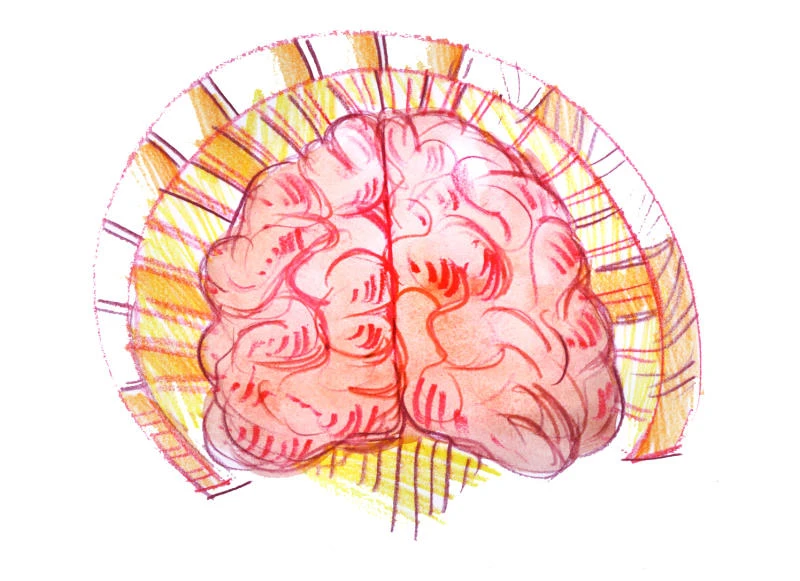

A topic that has always fascinated me is the nature of the Mind. The dictionary gives two separate definitions. The first defines it as the element of a person that enables them to be aware of the world and their experiences. The second merely states that the mind is a person’s ability to think and reason, i.e. the intellect. To a superficial observation they seem very similar, almost the same, but I believe them to be somehow different. A brief investigation might be an interesting “intellectual” exercise.
If we take into consideration the famous statement (in Latin) “Cogito, ergo sum” (= I think, therefore I am”) by 17th century French philosopher Rene Descartes, we are brought to accept the second definition as the best. It says that the fact that we think proves that we exist. Try, in fact, to imagine yourself without the capability of using your brain, or reasoning, or judging, of making comparisons, etc. You cannot.
The simple fact that you are trying to “imagine” something means that you are making use of your brain, i.e. your mind. By the way, is the brain the same as the mind? When you tell someone who seems to have done something foolish, “You have no brain(s)”, what do you intend? You mean that they lack the physical organ called brain, or the faculty that such part of the body puts into practice? Evidently you mean the latter. Therefore the word brain is often used to indicate the mind, while it is only the physical tool, the container of something that can be neither seen nor perceived with our senses. If you endeavor to explain to yourself how you are able to “see” or “hear” or “feel” with your mind, for example, you will be totally baffled. You have the experience but you cannot explain how it happens.
But it has been suggested that, instead of saying: “I think, therefore I am” (= exist), we could switch it into: “I am, therefore I think”. From what we previously said, it might seem that the fact that we can use our brain, i.e. the fact that we can think, gives us the awareness that we are alive, that we exist, that “we are”.
Without such faculty we would not have the experience of living — considering “living” as the capacity of being aware of what is happening around us, not only experiencing it in a physical way. Here we get the idea of something on a totally human level, although the mind might be considered as transcending the physicality of the human body. Yet, the brain is a real, material organ that can be touched, examined, studied.
The affirmation “I am, therefore I think”, though, is — I dare say — the opposite. We start from the word “existence” seen from a metaphysical (= beyond the physical) point of view. When you think of who you are, who is doing the thinking? The thought is not you, because you are thinking it. So? Don’t panic, please! I do not intend to start a philosophical disquisition. I am only trying to clarify an interesting concept that can help us understand ourselves a little better. Considering our “essence” as “thought” is quite reductive, isn’t it? Therefore there must be something that is outside, beyond the physical nature of a human being.
Therefore there must be something outside, beyond the brain (the tool for thinking) that actually “creates” the thought itself. You can call it in as many ways as you like: spirit, soul, awareness, consciousness… Therefore, with all due respect to the great philosopher Descartes, we prefer to lean toward the second definition: “I am, therefore I think.” A deep, indescribable awareness comes first and then…all the rest!
E-mail: [email protected]
Blog: recreateyourlifetoday.blogspot.com


