
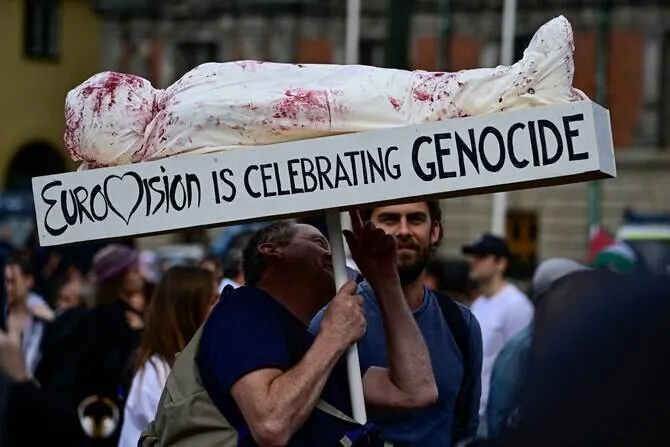

A Dutch broadcaster announced last week that it will boycott the Eurovision Song Contest for a second year, describing the competition as a “platform for division.” Other nations, including Iceland, Ireland, Slovenia and Spain, have also refused to take part recently because of Israel’s participation.
Meanwhile, the Olympics and FIFA World Cup suspended Russia and Belarus from competing following Russia’s invasion of Ukraine.
Boycotting a country or imposing sanctions on its economic and political system is perhaps understandable as a weapon of last resort. But in the conflictive world of today, extending sanctions or boycotts to arts festivals and sporting events might be pushing it too far, since those international competitions and events are designed to bring people together, keeping human relationships alive even when all other bridges have been severed.
The Dutch broadcaster was of the understandable view that, with a participating country involved in a large-scale military conflict, Eurovision could no longer be considered neutral. While I generally oppose boycotts, the double standard in the case of the Eurovision Song Contest is all too obvious in the wake of the Hamas attack on Oct. 7, 2023, and Israel’s subsequent bombardment of Gaza.
Critics accuse the European Broadcasting Union, the contest’s organizer, of double standards, since Russia was barred from Eurovision in the aftermath of its full-scale invasion of Ukraine, while Israel has faced no such sanction over Gaza. But perhaps the cases are different, as many defenders of the union maintain.
Eurovision is a complex case but there is a long tradition of nations being banned from key international festivals or competitions.
When flags and freedom of expression become tools to taunt, the world faces even more trouble.
Mohamed Chebaro
Russia was barred from the 2022 World Cup by FIFA following its invasion of Ukraine, a suspension that continued through to the 2026 competition. Germany, Japan, South Africa and Afghanistan have also faced Olympic Games bans at different times.
But do we not risk losing more as a result of boycotts since many cultural and sporting events are and ought to be celebrations of our humanity separate from national government behavior? The Eurovision Song Contest, for example, was created to bring people together. It is undeniable that international conflicts are increasingly affecting this and other events, undermining their neutral character.
World circumstances since Russia’s invasion of Ukraine point to a more polarized public sphere driven and powered by the digital realm and its many tools and algorithmic biases. Flags and freedom of expression must surely be upheld, but when these become tools to taunt and mark division, the world faces even more trouble.
In the minds of many, events designed to celebrate diversity and community, such as Eurovision, no longer cut it, especially when a participating country continues to be involved in a large-scale military conflict. Humanitarian suffering in Gaza and the restrictions on press freedom have contributed to increasing divisions surrounding Israel’s participation in the contest.
Sadly, our descent into intolerance can be seen everywhere. The world has changed, many might say. But we should remember that opinion polls invariably reveal that the majority of the global public wants international cooperation, respect for human rights and to protect the planet.
We cannot stop or eliminate all wars but international arts and sporting events should try to remain inclusive — a reminder of the need to keep the conversation alive and the interaction flowing through a song or sporting contest.
- Mohamed Chebaro is a British-Lebanese journalist with more than 25 years of experience covering war, terrorism, defense, current affairs, and diplomacy.


