


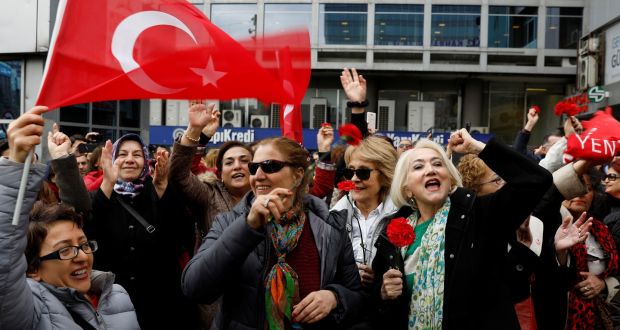
Turkey’s local elections, held on March 31, delivered unmistakable messages to President Recep Tayyip Erdogan and his Justice and Development Party (AKP). According to press reports, the AKP lost nine provinces, leaving it in control of only 39 out of 81 — a 19 percent decrease. By contrast, the main opposition party gained seven new provinces for a total of 21, a 50 percent increase, while Kurdish parties also registered significant gains. Conspicuously, the opposition gained control of Turkey’s largest cities, Istanbul and Ankara, in addition to Izmir.
The voters appeared to be calling for a reassessment, if not a reset, of government policies. They made a clear statement on the need to set limits on the power of the country’s leaders.
In particular, the polls were an object lesson in the close relationship between politics and economics. Although by definition local elections are driven by economic issues, Turkey’s economic performance has been greatly influenced, negatively, by security crackdowns at home and a combative foreign policy. The costly ventures of going after Kurdish nationalists with no holds barred in Syria and elsewhere, and uncompromising positions toward the Kurds at home have left a clear impression on investors. To them, they are indicators that unrest may continue on Turkey’s southern border and in Kurdish majority areas within Turkey.
There is considerable uncertainty among investors due to the crackadown on political opposition ever since the failed coup of 2016, including the detention and dismissal of thousands from the civil service, the judiciary and security forces. The state of press freedom has also scared away outside investors. According to the Committee to Protect Journalists, Turkey continues to “jail more journalists than any other country on the planet,” with at least 68 in prison for their work at the end of last year. In addition, the government has closed down scores of news outlets and detained writers and peaceful activists.
Accusations of nepotism, corruption and shady deals have also affected the business climate. Reports in the US about sanctions being busted by entities close to Turkey’s leadership have had negative consequences. Announcements in Turkey that it would not abide by American sanctions against Iran have made international businesses nervous, lest they become targeted by the US for violating those sanctions.
Diplomatic spats with NATO allies, such as Germany and the Netherlands, make foreign investors hesitate about expanding their exposure in Turkey. Ankara’s growing relations with Iran and Russia are also causes for concern for those investors, especially in light of US fears should Turkey go ahead and install advanced Russian missiles.
Although by definition local elections are driven by economic issues, Turkey’s economic performance has been greatly influenced, negatively, by security crackdowns at home and a combative foreign policy.
Abdel Aziz Aluwaisheg
These changes in the business climate have made a clear impact on Turkey’s economic performance. While the decline predated the failed coup in 2016, it has accelerated since. Gross domestic product (GDP), the overall measure of economic activity, has fallen sharply and the per capita income of average citizens has declined by about 25 percent over the past five years. Inflation and unemployment are in the double digits. Last summer, the Turkish lira lost 40 percent of its value against the US dollar, thus increasing the cost of imports and, consequently, domestic prices. Although the devalued currency should have benefited exports, Turkey’s trade deficit is widening, not shrinking. International reserves have also fallen about 25 percent in five years.
Much of this damage to the economy and Turkey’s regional and international standing is self-inflicted: Picking fights with close allies, weakening Turkey’s military alliance with NATO and the US, helping Iran evade sanctions, and turning a blind eye to Tehran’s malign activities in Syria. The economic consequences of these apparently impulsive steps have ruffled the international business community, which is traditionally hypersensitive to uncertainty and political risk expectations.
It was almost inevitable with these changes that Turkey entered into recession last month, experiencing its worst performance since 2008 with an overall GDP decline of 3 percent (annualized), and Turkish industry suffering a fifth straight monthly decline. An International Monetary Fund (IMF) official warned that “there is a significant slowdown in the Turkish economy and the government needs to respond immediately and accurately to this problem.”
During the week following the local elections, the Turkish press reported that there were high fluctuations in exchange rates, interest rates and on the stock market, particularly after the Central Bank limited the Turkish lira supply to overseas markets to thwart another de facto depreciation in the currency in overseas swap markets.
Alarmed by these jitters, Turkey’s Treasury and Finance Minister Berat Albayrak sought to reassure, declaring that the country was going to “enter a normalization process” following the March 31 municipal elections.
Turkey will probably need that normalization process, but it may need outside help. Although Turkey has in the past ruled out intervention by the IMF, any prospective bailout may not be forthcoming without support from key countries, such as the US and Germany. Turkey’s allies may want to see a moderation in its foreign policy before making the necessary efforts to help it out of the economic recession it has just plunged into.
- Abdel Aziz Aluwaisheg is the Gulf Cooperation Council (GCC) assistant secretary-general for political affairs and negotiation, and a columnist for Arab News. The views expressed in this piece are personal, and do not necessarily represent those of the GCC. Twitter: @abuhamad1


