

US House of Representatives Speaker Nancy Pelosi’s controversial trip to Taiwan this week shows, yet again, how much America’s actions in the Asia-Pacific have the capacity to capture headlines. However, the significantly growing attention that Europe is devoting to the world’s fastest-growing economic region often goes under the radar.
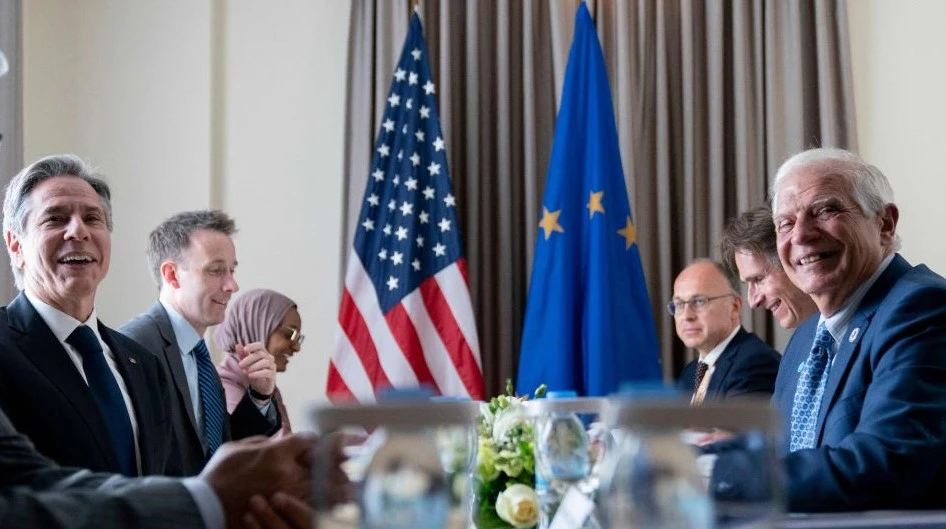
The latest signal of European intent comes in the second half of this week at the Association of Southeast Asian Nations’ summit of foreign ministers. This is one of the first regional meetings of foreign ministers to have been held in person since 2019, so Europe sees it as a key opportunity to demonstrate support for ASEAN’s regional prosperity and security.
EU and UK foreign ministers will be in attendance in Phnom Penh, Cambodia, alongside a growing array of nations also wanting to enhance their partnerships with ASEAN, including India, Japan, South Korea, Turkey, Qatar, the UAE, Oman, Australia, New Zealand and Canada. Within this growing club of admirers, Europe stands out to many given its collective economic size.
This is a landmark year that marks 45 years of partnership between the EU and ASEAN, with bilateral relations having been elevated to a strategic partnership in 2020. In 2021, the EU recognized the centrality of ASEAN — whose members are Brunei, Cambodia, Indonesia, Laos, Malaysia, Myanmar, Philippines, Singapore, Thailand and Vietnam — in its new Strategy for Cooperation in the Indo-Pacific.
One of the EU’s recent initiatives with ASEAN is a green partnership backed by an initial €30 million ($30.5 million) grant from the EU budget to strengthen cooperation in areas including climate action, the clean energy transition and air pollution.
Another example of the two blocs’ cooperation is the Smart Green ASEAN Cities initiative, under which the EU is providing some €5.1 million in support from now to 2024 to assist ASEAN member states in meeting the substantial pressure from high urbanization rates by focusing on green and smart solutions through digitalization and the use of technologies.
The post-Brexit UK is also on a charm offensive. Only last year, it signed a dialogue partnership agreement with ASEAN, the first the bloc has signed in about a quarter of a century.
To help kick this initiative off, London has signed a number of sustainability deals, including: A £15 million ($18.2 million) ASEAN Low Carbon Energy program, a cross-sectoral project on green finance and energy efficiency led by the Friends of Indonesia Renewable Energy Dialogue; a £4.2 million fund for UK-ASEAN science partnerships that research the impact of climate change and the transition to clean energy; and a £6 million joint research program with Singapore on marine debris in Southeast Asia.
The underlying goal of Europe’s engagement with ASEAN, and Asia-Pacific more generally, is to build competitive advantage vis-a-vis other world powers. Collectively, the two regions represent about 60 percent of global gross domestic product, population and trade, with significant potential still to be realized.
The approach and engagement of the EU and the UK are designed to foster an increasingly rules-based international order, a level playing field and an open and fair environment for trade and investment, reciprocity, the strengthening of resilience, attempts to tackle climate change, promoting prosperity, and sustainable development, in line with the principles of democracy, the rule of law, human rights and international law.
Outside of economics, free and open maritime supply routes in full compliance with international law are also key. And Europe intends to work increasingly closely with partners in security and defense, not just addressing maritime security, but also malicious cyber activities, terrorism and organized crime.
This agenda broadly dovetails with that of American approach to ASEAN. In May, President Joe Biden hosted the bloc’s leaders at the White House for its first summit in Washington.
As well as this week’s ASEAN foreign ministers’ summit, another manifestation of Europe’s intent toward the Asia-Pacific is the annual conferences Brussels (and increasingly London too) has with key emerging market giants like India, plus major industrialized nations like Japan. This is also already paying dividends.
Take the example of India, with which Europe is keen to forge stronger ties. The EU is already India’s largest single trade and investment partner, hence why the new bilateral trade deal that is under discussion would be a key prize for both parties. There are wider reasons behind their converging interests, including a growing need to develop shared defense forums, such as maritime security in the Indian Ocean, where 40 percent of bilateral trade passes.
As important as Europe’s relations with emerging markets are, industrialized nations are important too. With Japan, for instance, the EU enjoys a burgeoning bilateral agenda. The two powers have in recent years stepped up their leadership on international trade and the rules-based economic order.
Japan remains the world’s third-largest economy and is one of Europe’s top export markets in Asia. In the EU, it is estimated that some 600,000 jobs are now tied to bilateral trade, with about 74,000 European firms exporting to Japan.
The underlying goal of Europe’s engagement with ASEAN, and Asia-Pacific more generally, is to build competitive advantage vis-a-vis other world powers.
Andrew Hammond
This core economic agenda was given a fillip in 2019, when the EU-Japan free trade agreement entered into force, covering about a third of global GDP and almost 650 million people. The accord took years to agree, with the headlines captured by the scrapping of almost all duties on imports. Beyond the numbers, however, both sides have stressed that the trade treaty is also important because it rests on values and principles. In part, this relates to the fact that the agreement was the first to be struck by the EU that includes language upholding the Paris climate agreement.
Specifically, there is a commitment to supporting the Paris treaty by making a “positive contribution” to reducing global warming by cutting greenhouse gas emissions. This follows a move by the European Commission to try to ensure that all future EU trade agreements make reference to meeting Paris goals.
These diverse examples showcase why Europe perceives such a massive opportunity in the Asia-Pacific, ASEAN and beyond. From its emerging markets to its industrialized economies, the region is a growing priority in a bid to drive economic and political competitive advantage in the post-pandemic era.
- Andrew Hammond is an Associate at LSE IDEAS at the London School of Economics.


