


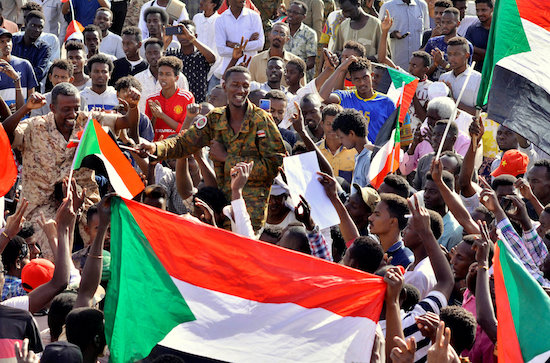
It all began with bread; specifically, the cost of a loaf in Atbara, a city in the River Nile State of Sudan — a most unlikely set of circumstances to end the 30-year regime of Omar Al-Bashir.
A group of high school students took to the streets to protest, and the demonstrations swelled. The regime responded with tear gas, rubber bullets and live ammunition, and even restricted access to social media platforms in true authoritarian fashion. This failed to quash unrest and protests quickly spread throughout Sudan, reaching Khartoum, the capital.
Sudan’s moves to devalue its currency and retract subsidies on wheat and electricity have sent the economy into a tailspin. Ever since oil-rich South Sudan seceded in 2011, Sudan has not been able to recover without the South’s oil revenues, which brought in precious foreign currency. The devaluation led to cash shortages, long queues for basic commodities and an inflation rate second only to Venezuela’s. More to the point, a cash-strapped economy unraveled Bashir’s carefully crafted “coup-proof” regime, which drained public coffers in exchange for the loyalty of senior military and state security officials.
It worked for 30 years as repeated protests were quickly and ruthlessly squashed by the military, state security groups such as the National Intelligence & Security Service, and Rapid Support Forces. This created fractures in a system meant to keep Bashir in power. After all, coup-proofing a regime also required ways to protect Bashir from the same structures he himself empowered to repress insurrection. Such paranoia and quick resort to violence when suppressing dissent meant low-ranking security forces were constantly set upon defenseless citizens, which clearly took its toll.
Sudan’s constitution has been suspended and the government dissolved. The seemingly untouchable Bashir was deposed by his own top general, the defense minister, who then himself stepped down after only a day in charge.
Sudan is one of the few success stories where widespread dissent culminated in massive changes in the upper echelons of power in this part of the world. Even more, this was achieved by the increasingly evident power of youth and women in shaping public discourse.
Hafed Al-Ghwell
The world at large is collectively sighing with relief after weeks of worry that Sudan could go the same way as Syria, Yemen or Libya. Bashir loyalists could have escalated violence at the expense of citizens who simply wanted relief — whether food, fuel, better wages, or just a better life.
There are worrying parallels here with the so-called “Arab Spring” revolts of 2011. In Egypt, when Hosni Mubarak was ousted from power, the country entered a tumultuous period, which eventually forced citizens back out on to the streets to reclaim their revolution from a resurgent extremist Muslim Brotherhood.
In Tunisia, while protests actually achieved a state as close as possible to a true democracy, entrenched interests and lack of compromise severely crippled the momentum in the country where it all started. Other Arab governments successfully managed, to some extent, the precarious balance between initiating much-needed reforms without fomenting protests that oust incumbents and abandon countries to unknown fates — fertile ground for extremists and misguided populism.
Fortunately, the lessons from 2011 are still fresh, and in some cases battles from that time rage on to this day. Sudan avoided the grisly fate of yet another horrifying civil war as evidenced from Darfur’s 300,000 dead and up to 3 million displaced. It remains to be seen whether Lt. Gen. Abdel Fattah Abdelrahman Burhan — now the top official in Sudan—will cede authority to a civilian, democratic government. Sudan could go the way of Algeria, where a military-backed shadow government controls the levers of power. Alternatively, Burhan could retain power by remaking himself into a statesman backed by a loyal military, like Egypt’s Abel Fattah El-Sisi — or he could become yet another Bashir himself. The former is more likely, while the latter would simply foment more mass protests.
In the end, Sudan is one of the few success stories where widespread dissent culminated in massive changes in the upper echelons of power in this part of the world. Even more, this was achieved by the increasingly evident power of youth and women in shaping public discourse. In Sudan, the now iconic image of Alaa Salah in her traditional white dress standing on top of a vehicle will join an exclusive club of other female symbols of protests. She will be hailed alongside other such brave women from Libya,Syria, and Palestine. Aside from forgotten youths, disaffected state civil servants, embattled civil societies and the unemployed, women are increasingly becoming the drivers of change.
Sadly, the Arab world has shown so far that it does not do “revolutions” very well. Will Sudan and Algeria be the exceptions? Only time will tell.
- Hafed Al-Ghwell is a non-resident senior fellow with the Foreign Policy Institute at the John Hopkins University School of Advanced International Studies. He is also senior adviser at the international economic consultancy Maxwell Stamp and at the geopolitical risk advisory firm Oxford Analytica, a member of the Strategic Advisory Solutions International Group in Washington DC and a former adviser to the board of the World Bank Group. Twitter: @HafedAlGhwell


