
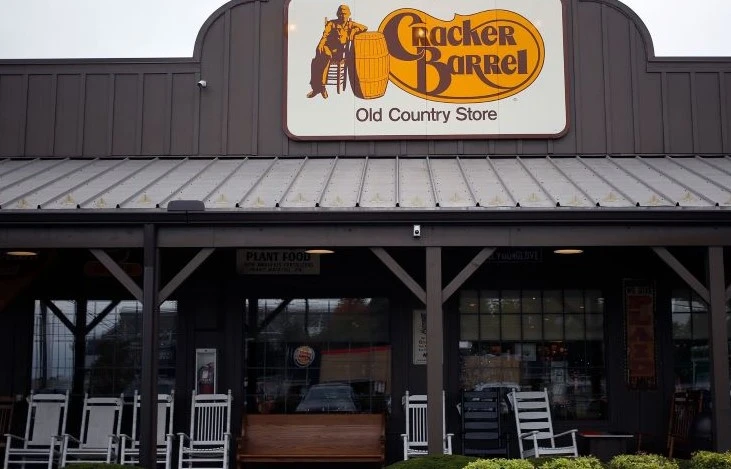

New fuel was recently added to the fire of American online outrage when the restaurant chain Cracker Barrel put a vegan sausage option on its menu.
Known for its southern cooking and gift shops, the company has long been associated with a traditional ambience and convenient locations. However, some customers viewed the vegan offering as too woke and catering to liberal interests, and others even vowed to boycott the restaurant.
The uproar — which mostly played out on social media — has rightly been lampooned as ridiculous. Cracker Barrel continues to offer plenty of regular meat options, and no one is forced to partake of the vegan sausage.
The reaction highlighted the reputational risks for businesses in a polarized political environment as well as the ease with which many Americans engage in outrage — particularly online but increasingly in real life too.
Much of this is silly. As US pop star Taylor Swift wrote, “You need to calm down.” Many people — not just Americans — have become far too wrapped up in the emotional manipulation of social media combat.
At the same time, some of the controversies over apparently petty things symbolize much deeper and more serious trends in US politics. Many people on the right and left ends of the political spectrum feel that their anger is triggered by something that leaves moderates looking on in bemusement.
Conservatives on the right end of the political spectrum are particularly primed to react with outrage. There are multiple reasons for this, including the nature of right-wing media.
Fundamentally, American conservatives believe that liberals are stealing their country. As US sociologist Theda Skocpol recently noted to The Atlantic, Stop the Steal — the movement that claims that former American President Donald Trump won the last presidential election — “is a metaphor for the country being taken away from the people who think they should rightfully be setting the tone.”
Conservatives deeply believe that traditional cultural values, rituals, traditions, symbols, and norms are under siege by a vaguely defined group of liberal elites. This lens shapes their reaction to things that many other Americans consider unimportant.
Conservatives are especially sensitive to anything that appears to roll back traditional culture. For example, some conservative commentators picked up on toy company Hasbro’s decision last year to remove Mr. from the Mr. Potato Head brand name. The company was not removing the Mr. Potato Head toy; it was only broadening its brand, as it makes female and tot toys too. However, conservative commentators — often not bothering to check the facts — portrayed the move as an example of liberal attacks on traditional gender identities.
Conservatives have expressed fury over entertainment and school policies that embrace non-traditional gender identities. For many Americans, this feels like much ado about nothing. However, conservatives view traditional gender roles as a fundamental building block of society, so anything that undermines those roles is treated as an existential threat.
More broadly, conservatives often react with derision or anger toward anything that they see as belonging to liberal culture. Conservative commentators have denigrated electric vehicles, paper straws, face masks, and more as signs of wokeness taking over the culture. It feels personal to them, because they see liberals as snidely judging conservatives’ personal, political, and cultural preferences.
On the left end of the political spectrum, liberals like many of the social changes that conservatives dislike. Liberals are aware of the conservative backlash, which also feels fundamentally threatening to liberal values, ideals, and lifestyles.
Liberals and conservatives vehemently oppose each other over some things that many more moderate Americans see as minor.
For example, conservatives bemoan the so-called war on Christmas. Many Americans happily celebrate Christmas as a religious or cultural holiday and do not perceive there to be a war against it. The American conception of a separation of church and state means that there are limitations on government agencies celebrating the holiday, which many Americans readily accept but which conservatives see as threatening traditional culture and Christianity.
A small group of people on the far left see a cultural emphasis on Christmas as undermining inclusion of all faiths or the separation of religion and state; some of them attempt to tamp down public recognition of the holiday.
Something that appears petty and silly to one person might symbolize deeply held beliefs to another person.
Kerry Boyd Anderson
The debate about Christmas is a good example of how people on the left and right of the political spectrum perceive a threat to their cherished values, while most Americans are left to shrug their shoulders and move on with however they want to spend the time around Christmas.
Issues related to race and gender are very activating to Americans on the right and left of the political spectrum, so anything that relates to those two areas can very quickly feed into a political outrage machine. More moderate Americans have a range of opinions and often take issues about gender and race seriously but also are less likely to take uncompromising positions.
People who engage in outrage politics should pause, breathe, think, and question before reacting — whether online, on TV, or in person. When people pause to calm down and consider a situation, they can respond in a wiser way.
People will disagree about what really matters. Something that appears petty and silly to one person might symbolize deeply held beliefs to another person. Stopping to consider why an issue provokes emotions can help everyone navigate the modern interaction of media, feelings, and politics.
- Kerry Boyd Anderson is a writer and political risk consultant with more than 18 years of experience as a professional analyst of international security issues and Middle East political and business risk. Her previous positions include deputy director for advisory with Oxford Analytica. Twitter: @KBAresearch


