
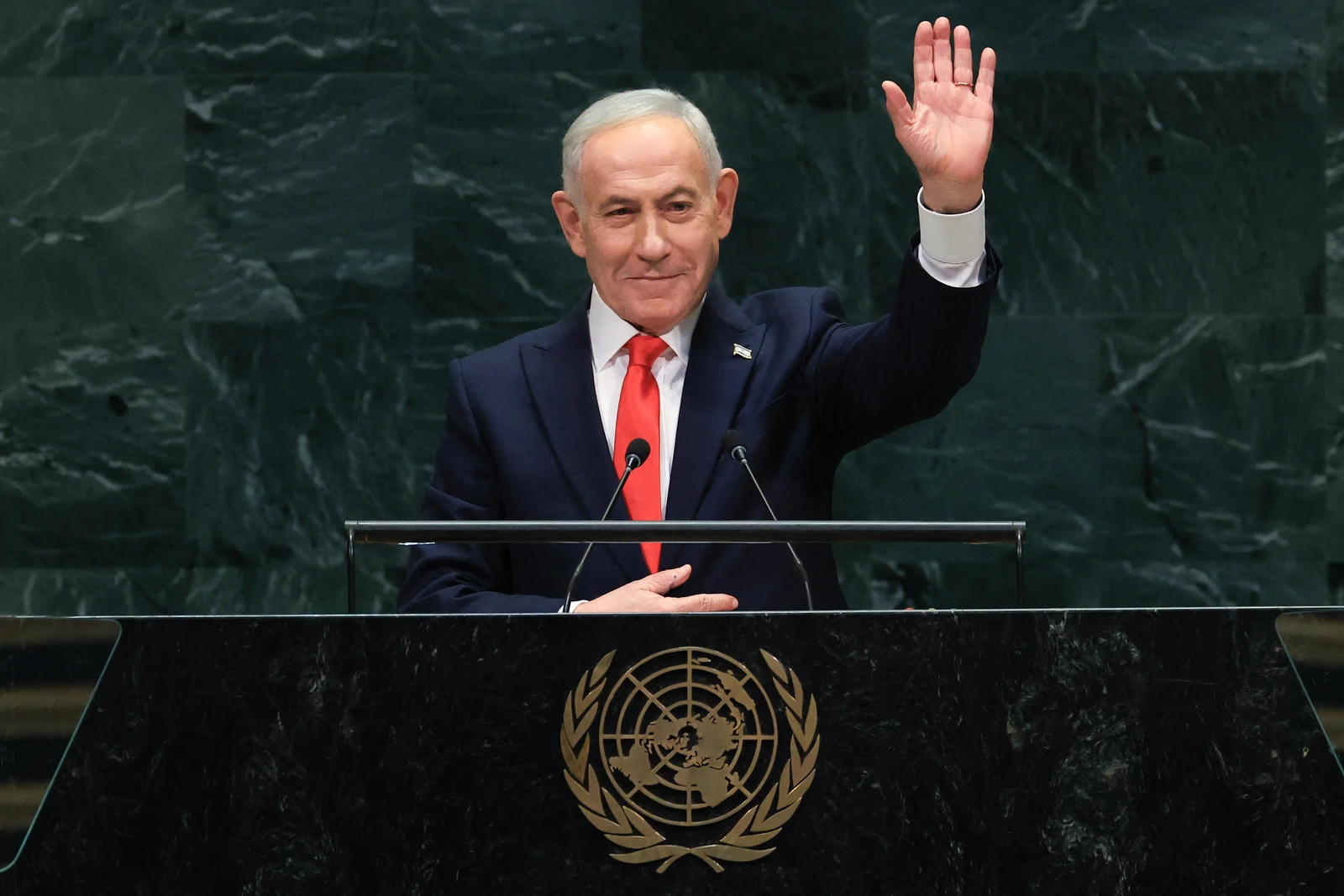

From an Arab perspective, there is something profoundly disturbing about listening to Benjamin Netanyahu speak about peace and security while watching the policies of his government systematically undermine both.
After decades of occupation, settlement expansion and failed negotiations, Netanyahu and the extremist forces surrounding him appear to be operating on the assumption that Israel’s military superiority gives it the right to determine the political and territorial future of an entire region. Their greatest illusion is that power can permanently replace politics, that occupation can somehow become peace and that Palestinian rights can be pushed aside indefinitely without eventually producing consequences.
So, in what world does Netanyahu live?
Certainly not in the world experienced by Palestinians in Gaza and the West Bank. Not in the world of families who have watched their homes and communities destroyed, their land fragmented and their political future repeatedly postponed. And not in the world that is increasingly confronting the reality that Israel’s current government is pursuing policies that make a negotiated settlement progressively harder to achieve.
Netanyahu’s address to the UN last week was another striking example of this disconnect. He vigorously defended Israel’s military conduct, rejected allegations against his government and presented Israel as a country surrounded by enemies and subjected to unfair international hostility. Yet, outside Netanyahu’s political narrative, a very different picture is emerging: growing international concern over Gaza, accelerating settlement expansion and increasing alarm that the Israeli government is deliberately creating facts on the ground that could make a viable Palestinian state impossible.
The language changes — security, deterrence, temporary measures and strategic necessity — but the geography keeps moving in one direction. More settlements. More roads. More land under Israeli control. More restrictions on Palestinians. Less territorial continuity. Less space for a viable Palestinian state.
This extremist Israeli government seems increasingly determined to make an honest discussion impossible.
Hani Hazaimeh
The E1 settlement project is perhaps the clearest expression of this mentality. Israel’s decision to advance construction tenders for E1 has triggered unusually broad international opposition because the project would drive a wedge through the West Bank and threaten its territorial continuity. The UK and 11 other countries have explicitly said Israeli actions in the West Bank, including E1, are undermining the possibility of a two-state solution.
This is not simply an Arab complaint. It is the assessment of governments that continue to recognize Israel’s security concerns and condemn the Hamas attacks of Oct. 7, 2023. Their message is straightforward: Israeli security cannot be ensured by destroying the political possibility of Palestinian statehood.
Yet Netanyahu’s government appears determined to test precisely how far it can go.
This is why Arabs see the present Israeli government not merely as another government pursuing another policy but as the clearest expression yet of an expansionist mentality that has been developing for generations. Its most extreme elements have increasingly treated Palestinian territory not as land whose final status should be negotiated but as territory to be gradually absorbed, controlled and reshaped until the question of Palestinian sovereignty becomes practically impossible.
The strategy is brutally simple: create facts on the ground and leave diplomacy to deal with them afterward.
But there is an enormous flaw in that strategy. Facts created through force do not automatically become legitimate political realities. A settlement does not become lawful because concrete has been poured. Occupation does not become permanent sovereignty because enough time has passed. And Palestinian national aspirations do not disappear because Israeli governments refuse to recognize them.
Netanyahu’s political illusion is particularly dangerous. He appears to believe that Israel can demand recognition of its security concerns while denying Palestinians comparable security; insist upon its historical claims while dismissing Palestinian claims; expand settlements while speaking of two states; and wage devastating military campaigns while presenting Israel as the sole victim in a conflict that has produced suffering on an enormous scale.
From an Arab perspective, recognizing Israel’s right to security does not mean accepting Israel’s right to permanent territorial expansion. Opposing Hamas does not mean accepting occupation. Condemning the killing of Israeli civilians does not require remaining silent about Palestinian civilians. Supporting a negotiated peace does not mean surrendering Palestinian rights.
This extremist Israeli government, however, seems increasingly determined to make such an honest discussion impossible. Its policies in the West Bank are particularly revealing. International governments have warned of unprecedented settler violence, settlement expansion and land seizures, while repeatedly calling on Israel to halt settlement activity and protect Palestinian civilians. Yet the response from Israel’s political right has increasingly been to press forward rather than reconsider.
That raises a fundamental question: If the Israeli government genuinely believes that a political settlement remains possible, why does it continue pursuing policies that make the territorial foundations of such a settlement increasingly difficult to preserve.
Israel argues that its military campaign is necessary to defeat Hamas and protect its population. Israel rejects allegations of genocide and maintains that its forces target Hamas rather than Palestinian civilians. Those are positions advanced by the Israeli government and remain the subject of intense international dispute.
Destroying Gaza cannot erase the Palestinian question. Military operations cannot manufacture political legitimacy. And even the destruction of an armed organization cannot remove the grievances, aspirations and national identity of the people from whom that organization emerged.
This is the central illusion of Netanyahu’s worldview: that the Palestinian problem is fundamentally a security problem that can be solved through sufficient military force.
It is also a political problem rooted in territory, sovereignty, rights, displacement and competing national aspirations. No army, however powerful, can permanently resolve those questions.
The Israeli government must eventually confront a reality that the Arab world has understood for generations: Palestinians are not going anywhere and neither are their demands for freedom and statehood.
The Middle East cannot be redesigned indefinitely according to the preferences of the strongest military power. Israel may possess extraordinary military capabilities but military superiority is not historical permanence. It does not grant a government the right to redraw borders at will or determine the political destiny of another people.
Netanyahu can continue insisting that Israel is right and the world is wrong. His government can continue describing criticism as hostility and portraying every Israeli action as an unavoidable act of self-defense. But rhetoric cannot change geography.
It cannot make the settlements disappear. It cannot restore Gaza. It cannot erase Palestinian claims to their land. And it cannot convince the Arab world that permanent occupation and expansion constitute a sustainable peace.
It can continue down the road represented by the most extreme elements of Netanyahu’s government — a road of settlements, territorial consolidation, confrontation and perpetual conflict — or it can recognize that genuine security requires a political settlement in which Palestinians also possess freedom, dignity and a viable state.
Hani Hazaimeh is a senior editor based in Amman.
X: @hanihazaimeh


