
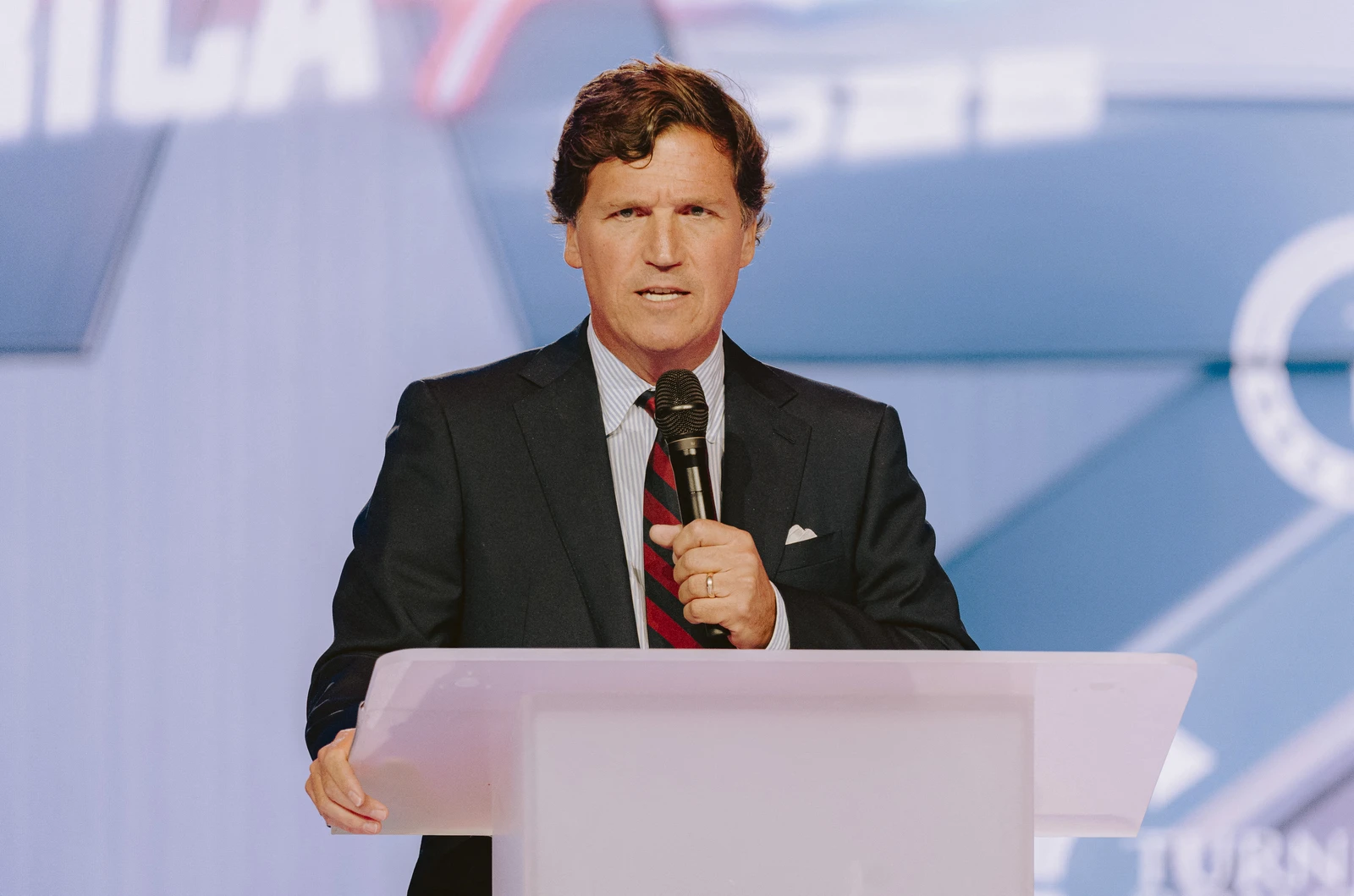

American political commentator Tucker Carlson was traditionally regarded as part of the far right, at least until 2023. More recently, however, he has moved away from his former position during a period of significant ideological and self-interested shifts at the heart of some of America’s major pressure groups.
Today, Carlson, along with several figures who were once part of the far-right camp, stands at the forefront of the critics of the Trump administration, particularly regarding the Middle East and the Arab-Israeli conflict.
Historically, the “Israeli question” in American politics long predates the establishment of the state of Israel in 1948. As previously noted in this column, the vanguard of the European migration to North America emigrated for a number of reasons, including fleeing religious persecution. Most belonged to the various Protestant denominations that arose in protest against the Catholic Church, which had dominated much of Central and Western Europe for centuries. This Protestant longing to return to religious roots helped bring about the idea of a “Judeo-Christian culture.”
There were, however, three fundamental stages through which religious legitimacy came to play an influential political role in the history of the US, particularly after the end of the Cold War.
The first stage was the success of conservative pastors and evangelists in establishing politically oriented movements aimed at settling the struggle for supremacy against the communist giant during the final years of the Cold War. Indeed, under the leadership of the likes of the Rev. Jerry Falwell and Billy Graham, forces such as the Moral Majority established a major political presence as the Soviet Union staggered through its final years. These forces subsequently helped secure Ronald Reagan’s victory and contributed to the end of the Soviet experiment.
The most active figures among the neoconservatives were a group of strategists associated with the Jewish right.
Eyad Abu Shakra
The second stage began with the rise of the neoconservatives, which emerged as a genuine force of political power during the presidency of George W. Bush. Its prominent figures included Bill Kristol, Paul Wolfowitz, Richard Perle, Douglas Feith, Elliott Abrams and David Wurmser.
Whereas the driving forces and instruments of the Moral Majority were Christian, the most active figures among the neoconservatives were a group of strategists associated with the Jewish right. In their advice to the Israeli right, they emphasized rejecting the principle of land for peace and a two-state solution in Palestine.
The influence of the neoconservatives expanded dramatically after the Sept. 11, 2001, attacks. They began reshaping the map of the Middle East through the 2003 invasion of Iraq and by exacerbating Sunni-Shiite tensions.
The third stage emerged following the election of Barack Obama — the first US president of African descent — in November 2008. This event stirred up fears and resentments that had remained concealed since the victory of the civil rights movement in the 1960s.
At the same time, the relatively rapid growth of immigrant populations — especially those from Latin America and the Muslim world — contributed to rising racist resentment against immigration. Some thinkers on the white far right then exploited this sentiment and made it a central element of the “Make America Great Again” movement, which became Donald Trump’s electoral base.
Through these stages, an alliance between the Christian and Jewish right took shape, supported by a class of extremely wealthy individuals, leading figures in future-oriented tech and new media.
But any rise of such scale and momentum was bound to carry internal contradictions and the seeds of fragmentation. Indeed, amid Washington’s overwhelming global dominance, the agendas of the different parties within this powerful alliance began to diverge. Questions previously rarely raised in US started being asked about sensitive issues, including: the Russia-Ukraine war and how the relationship with Russia should be defined; the massacres in Gaza and Israel’s plans for the Middle East; how to deal with China; and how Washington should define its relations with its Atlantic and European allies.
On the Middle Eastern front, one question emerged: Who influences — or dictates to — whom: America or Israel?
Some voices on the American Christian right have always believed that the final word should remain with Washington. But this was not the position of the Israeli right and its supporters in Washington.
As a result, American right-wing voices such as Tucker Carlson, former Rep. Marjorie Taylor Greene and commentators Nick Fuentes and Candace Owens began, for the first time, openly attacking Benjamin Netanyahu and his government.
Still, none went as far as Carlson, who accused Israel not only of dragging Washington into its own wars but also of making the removal of the US from the Middle East a central part of its regional strategy.
Carlson recently said that, after meeting US Ambassador to Israel Mike Huckabee, he became convinced of the following: First, that the war against Iran is aimed not only at ending Iran’s nuclear program but also at eliminating Iran as a regional power capable of challenging Israeli dominance; second, that it seeks to weaken the Gulf states in order to prevent them from becoming prosperous, stable countries attractive to investment; and, third, that it seeks to push the US itself out of the Middle East.
Carlson continued by saying that when he asked President Trump what he thought of this, Trump replied: “Yes, that’s right … but in the end, we’re all going to die anyway.”
Eyad Abu Shakra is managing editor of Asharq Al-Awsat, where this article was originally published.
X: @eyad1949


