

It is not an exaggeration to claim that Lebanon is descending further into the abyss. The departure of President Michel Aoun has left a constitutional void in the country after six years that were characterized by idleness and a lack of achievements on all fronts, despite the recent sea border delimitation with Israel opening up the potential for natural gas exploration.
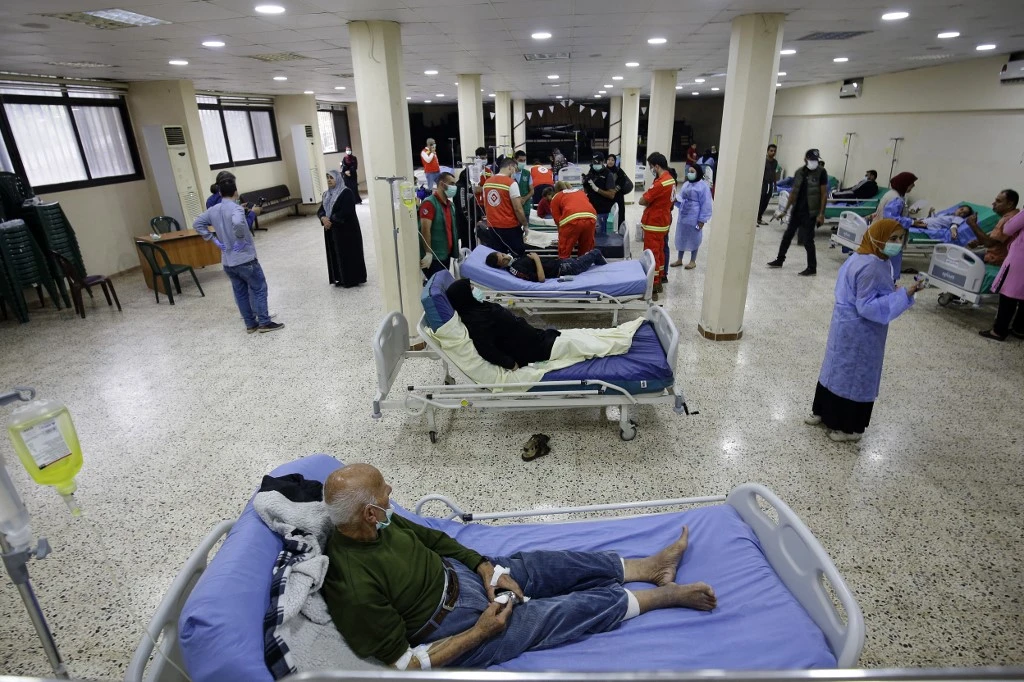
As if the economic crisis and financial meltdown of the state was not enough for this small Mediterranean country, cholera is now hitting the poorest. This adds further woes to a nation already weighed down by a depreciating currency, banks’ capital control preventing people from accessing their cash, ballooning inflation leading to a skyrocketing cost of living, coupled with near nonexistent national grid power and water, the lack of affordable healthcare and medicine — simply a lack of everything.
Lebanon was known among Middle Eastern countries to have been rich in water, as its rainfall is considered to be the highest in the region, despite the effects of climate change, which have led to more extreme weather in recent years. But the dilapidation of basic services, power cuts and the reduced ability of the government to provide the necessary water treatment due to limited financial resources and accountability, mean people have started to rely on buying untreated water from tankers, the owners of which are profiting from the increased needs of this vital commodity.
Last month, Lebanon recorded its first cholera case since 1993 and the World Health Organization has warned that the waterborne disease is spreading “rapidly” in the country. Lebanon continues to struggle with crumbling basic infrastructure, poor sanitation and limited access to clean water due to its enduring three-year-old political and financial crisis.
The crises are getting more serious every day, to the point that many believe the country will soon become unmanageable and unlivable
Mohamed Chebaro
If it is any consolation for the small country that once earned the label “the Switzerland of the Middle East,” Lebanon is not alone. Syria and Iraq have also been badly hit by cholera due to their ongoing wars, turmoil, devastated infrastructure and the housing of large populations displaced by conflict. The bacterial infection has apparently surged globally this year, with other outbreaks in Haiti and across the Horn of Africa, driven as in Lebanon by conflict and poverty, but also turbocharged by climate change.
Lebanon’s cholera and other disease outbreaks are likely to persist, since the country’s institutions will soon grind to a halt unless the dominant and powerful political class manages to come to its senses and agree to elect a president who will, in turn, nominate a prime minister. A proposed Cabinet can then be swiftly endorsed by the country’s fractured legislature. Already, this is asking for a lot of goodwill from a political class that has traditionally put its foreign patrons’ interests above national interests.
Many Lebanese were hopeful that the outgoing president, who ascended to power thanks to a deal with the Iran-affiliated Hezbollah ticket, would at least manage to steady the ship of government, if not improve the country’s outlook, especially as Aoun’s supporters promoted his leadership as “the powerful regime.”
On the eve of his departure, Aoun sounded the alarm, claiming that the country will face “constitutional chaos,” pushing many to believe that the stalemate and power vacuum experienced by Lebanon might be further extended. In September 2020, during a government formation crisis, then-President Aoun also did not shy away when concluding that the country would “go to hell” if Lebanon’s powerful governing elite failed to agree on a government.
Aoun’s career and achievements have always been divisive in Lebanon, especially within his Christian community. But, for once, he has said it as it is: Lebanon before and after his presidency has been descending into a deep constitutional crisis, but this month the country has entered an unprecedented phase, where the president’s seat is vacant, a caretaker government has very limited executive powers and parliament is fragmented. All the while, the crises are multiplying and getting more serious every day, to the point that many believe the country will soon become unmanageable and unlivable.
Lebanon’s permanently fractured sectarian politics mean electing a new head of state or forming a new Cabinet is never straightforward. The presence of Hezbollah, an Iran-backed armed militia, adds a different dimension to the traditionally closely fought process. In the Lebanese system, the 128-member parliament — where seats are evenly divided between Muslim and Christian sects — usually elects the president in a secret ballot. The thresholds needed to secure quorum and victory mean that no single faction or alliance has enough seats to impose their choice, resulting in heavy bargaining for political favors. Forming a government is no easier, with political parties dividing up their shares of ministries based on influence, sect, political blocs and possible rewards dished out in the form of political appointments elsewhere in the state.
What makes the current stalemate more dangerous for the country and its people is the fact that the horse-trading between the dominant political elite has often focused on one or the other vacancy, but never both simultaneously. One would hope that parliament will keep meeting to elect a new president in order to break the stalemate. But in view of the country’s recent history, such an impasse — the Lebanese have been led to believe — would need intervention from regional and international powers to broker a deal or present guarantees that would pave the way to a break in the deadlock.
The problem this time is that countries like the Gulf states have retired from trying to help the conflicting parties reach a compromise, while the influential Iran is trying to secure a renewal of its nuclear deal, which could be derailed by internal anti-veil protests and its sale of drones and long-range missiles to Russia. The Western powers, like France, on the other hand, are busy with the war in Ukraine. Lebanon, therefore, will spend the foreseeable future searching for a president, a prime minister or, even better, a miracle to end the power vacuum.
- Mohamed Chebaro is a British-Lebanese journalist, media consultant and trainer with more than 25 years of experience covering war, terrorism, defense, current affairs and diplomacy.


