


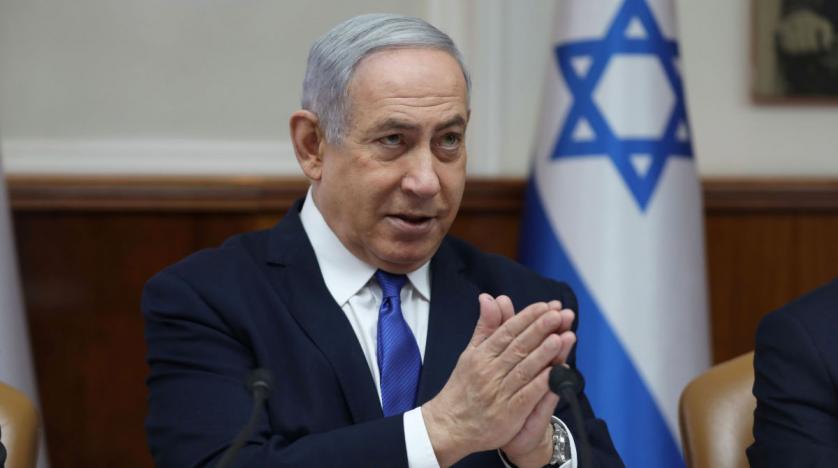
Israeli Prime Minister Benjamin Netanyahu has never had it so good. His one-time foes are lining up behind him like never before, as he inches closer to forming a national emergency government that would extend his premiership for another 18 months. Two weeks ago, and to avoid an unpredictable fourth election, the Likud leader and the head of the Blue and White coalition, Benny Gantz, agreed to a partnership — ostensibly to confront the coronavirus outbreak in the country.
Under that agreement, Netanyahu would remain as prime minister for the next year-and-a-half before handing over that position to his rival and now partner, Gantz. But, most importantly, the deal allows Netanyahu to put to a vote — to the Cabinet and/or to the Knesset — the controversial plan to annex parts of the West Bank and the Jordan Valley, as outlined in US President Donald Trump’s peace plan. That move is expected to take place in July.
Gantz, whose alliance was formed solely to dethrone Netanyahu, lost two key partners as he courted Likud after failing to form a government himself. Moshe Ya’alon of center-right party Telem and Yair Lapid of the centrist party Yesh Atid both walked out of the Blue and White and joined the opposition, which includes members of the Arab Joint List.
In return for his support — Blue and White now has just 17 MKs, down from 33 — Gantz will become defense minister, while his coalition will also take the justice and foreign affairs portfolios. The partnership will cost Netanyahu the backing of some extremist parties that were in his last government. On paper, the new Cabinet will move away from the far right, but the reality could be somewhat different.
Gantz and the new Foreign Affairs Minister Gabi Ashkenazi are no doves. Gantz had resisted joining hands with the Joint List, although he stopped short of demonizing the Arab minority. His Blue and White coalition had failed to attract what little remains of the Israeli left. But, last Friday, Gantz was able to convince the leader of the Labor Party, Amir Peretz, to formally endorse Netanyahu for prime minister, together with his fellow party members. Like Gantz, Peretz, whose party did poorly in March’s elections, broke a key campaign promise not to support Netanyahu.
Under the Blue and White-Labor deal, lawmakers from Peretz’s left-wing party would have to vote with the government on issues considered controversial, including the annexation of parts of the West Bank. His party also agreed to avoid any moves to dissolve the coalition, the government or the parliament.
No one in Israel could have imagined Netanyahu — who, only a few weeks ago, looked vulnerable as he too had failed to form a Likud-led government — would emerge this strong, with such a backing in the Knesset. So assured of himself was he that, on Sunday, Netanyahu told a crowd of US evangelical Christians, through a special online broadcast, that he was confident Trump would honor his vow to recognize “Israeli sovereignty over the Jewish communities there (in the West Bank) and in the Jordan Valley.”
His confidence was boosted by a statement made last week by US Secretary of State Mike Pompeo, who said that it was up to Israel whether to annex parts of the West Bank, adding that Washington would offer its views privately to Israel’s new government. Pompeo left the door open for Netanyahu to go ahead — within the coming few weeks and with the support of his coalition partners — with unilateral annexation.
Under the Netanyahu-Gantz deal, the annexation can go through provided that it does not threaten existing peace treaties between Israel and its Arab neighbors. That puts the onus on Jordan and Egypt, while giving Gantz the room to step aside and let the move go ahead.
Trump, who is under pressure at home over his administration’s handling of the coronavirus crisis, will not hesitate to bless the Israeli annexation in order to placate the core of his voter base — the evangelicals. Netanyahu knows that, which is why he is sure of Trump’s backing. It’s a symbiotic relationship if ever there was one.
No one in Israel could have imagined Netanyahu would emerge this strong, with such a backing in the Knesset.
Osama Al-Sharif
The UK, Germany and France, among other European nations, have stated their opposition to Israel’s plans. The head of EU foreign policy, Josep Borrell, stated last week that “the European Union does not recognize Israeli sovereignty over the occupied West Bank and views any annexation as a serious violation of international law.” Jordan and the Palestinian Authority also made their rejection clear.
But the world is focused on battling the spread of the coronavirus and would give little attention to Netanyahu’s planned move. He will soon lead what is tantamount to a war Cabinet to fulfill what he sees as his lasting legacy. Ironically, the only serious warnings over his annexation plans are coming from ex-military and security officials. But Netanyahu is blind and deaf to such warnings and is bent on putting Israel and the Palestinians on a critical collision course.
- Osama Al-Sharif is a journalist and political commentator based in Amman. Twitter: @plato010


