
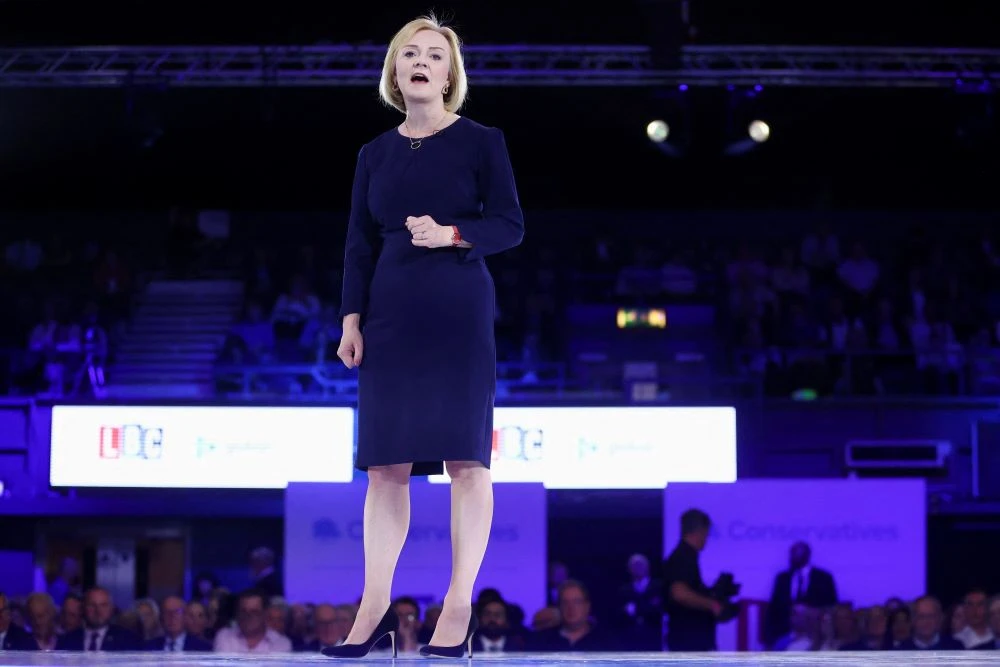

It has been obvious for several weeks that the foreign secretary in Boris Johnson’s UK government, Liz Truss, is likely to succeed him in 10 Downing Street. Some say that Truss has used her political experience to pull ahead of her challenger, the ex-treasury secretary Rishi Sunak. Maybe that is true, but also her loyalty to Johnson, even after 60-plus ministers resigned from his government, has played well among the Conservative Party’s grassroots membership, which is tasked with selecting his replacement.
Truss, 47, has often described her ascent toward the top of British politics as a “journey,” drawing criticism for her opportunistic ambition. She comes from a left-wing family and initially joined the centrist Liberal Democrats, before jumping ship to the right-wing Conservatives. She became an MP in 2010 and served in various ministerial posts prior to taking the high-profile job of foreign secretary last year.
Initially a “Remainer” who quickly turned her coat and became an avid “Brexiteer” when the Leave campaign won the referendum to exit the EU in 2016. Her performance as a minister in charge of negotiating post-Brexit free trade deals and as foreign secretary tasked with remedying differences with Brussels did not yield much in the age of the nationalistic sentiments and populist brand of Johnson. Like her boss, she talked tough on Ukraine, while also trying to emulate Conservative Party icon Margaret Thatcher’s dress sense and her no-nonsense, tough-talking approach.
The leadership contest that many have described as stale and predictable has revealed Truss to be combative, stubborn and sometimes reckless. But one hopes that was all an electioneering show with the sole aim of winning the contest. The televised debates might have given us a glimpse of her so-called “fairy-tale economics,” as she held on to her idea of cutting taxes to stimulate growth in the UK economy. One hopes that, once in the driving seat, she will change her mind.
Her rival, Sunak, has been emphasizing the need to maintain current tax rates, including recent rises, in the short term, while pledging more targeted support for the most needy during the cost-of-living crisis. But that does not seem to have convinced the fewer than 200,000 Conservative Party members, who are older, whiter and more likely to be male than the national averages and are firmly backing Truss in her bid to reside in Downing Street for the remaining two years or less before a general election is held.
When resigning, Johnson signed off by promising to be back. Regardless of what he does next, one might wake up to find that the country has inherited, in Truss, a more dangerous version of Johnsonian politics. The Tories, who came to power in 2010 and brought with them their austerity politics, have caused severe damage to the institutions and workings of the country. The Brexit years and its divisive politics, both domestically and with Europe, compounded by the COVID-19 pandemic, have left the country in a dire economic state (though the Conservatives refuse to even mention Brexit as a source of the UK’s bad economic performance).
Britain has “taken back control,” only to lose control on all fronts. The new PM will not be envied for the challenges and adversities they must deal with. In addition to the war in Ukraine and how to mend the spoiled relations with Europe, Britain needs to find answers to its fast-rising inflation, the cost-of-living crisis and energy security and its affordability for the consumer, which add up to a formidable challenge. The increased prospects of drought, crop failures, labor shortages and strikes by nurses, postal workers, train drivers, barristers and dock workers make for an explosive mix that would likely damage any prime minister, let alone Truss, whose approach to leadership looks at times like she enjoys a fight whenever the opportunity presents itself.
The leadership contest has revealed the likely next prime minister to be combative, stubborn and sometimes reckless.
Mohamed Chebaro
Johnson’s leadership sought to bash the EU in order to rally his euroskeptic MPs. Truss, if she gets the chance to lead the country, is likely to have a handful more opponents, especially if she does not modify her leadership approach, which seems headstrong and willful, making many believe that she is a person who intuitively looks for a fight.
No matter what Truss, Sunak or Johnson say, post-Brexit Britain is not working. Truss’s unfunded tax cuts are likely to stoke more inflation, which will manifest itself in further pressure on business and industries, as well as on staff, who will resort to more strike action to try to protect their earnings and the survival of their families.
Truss seems to have fired up the Tory party activists to believe that she is the new Thatcher. Her leaning toward obduracy might have reminded the party faithful of the Iron Lady, although forgetting that times have changed. Truss will quickly find out that this is only going to add to the general sense of malaise being felt in a nation that is tired of years of Brexit divisions, COVID-19, government scandals, lies and a lack of integrity in politics.
For whoever is at the helm of UK power, the mission is colossal. Britain is showing all the signs of fatigue after 12 years of Conservative rule and, if Truss is elected, she will soon find out that the country is much more difficult to govern compared to Thatcher’s times. If she chooses to rule the country in Johnson’s shadow, Truss will be ignoring the damage that he has inflicted on the UK’s public life, and maybe the ability to heal such damage might not be her strongest trait anyway.
- Mohamed Chebaro is a British-Lebanese journalist, media consultant, and trainer with more than 25 years’ experience covering war, terrorism, defense, current affairs, and diplomacy.


