
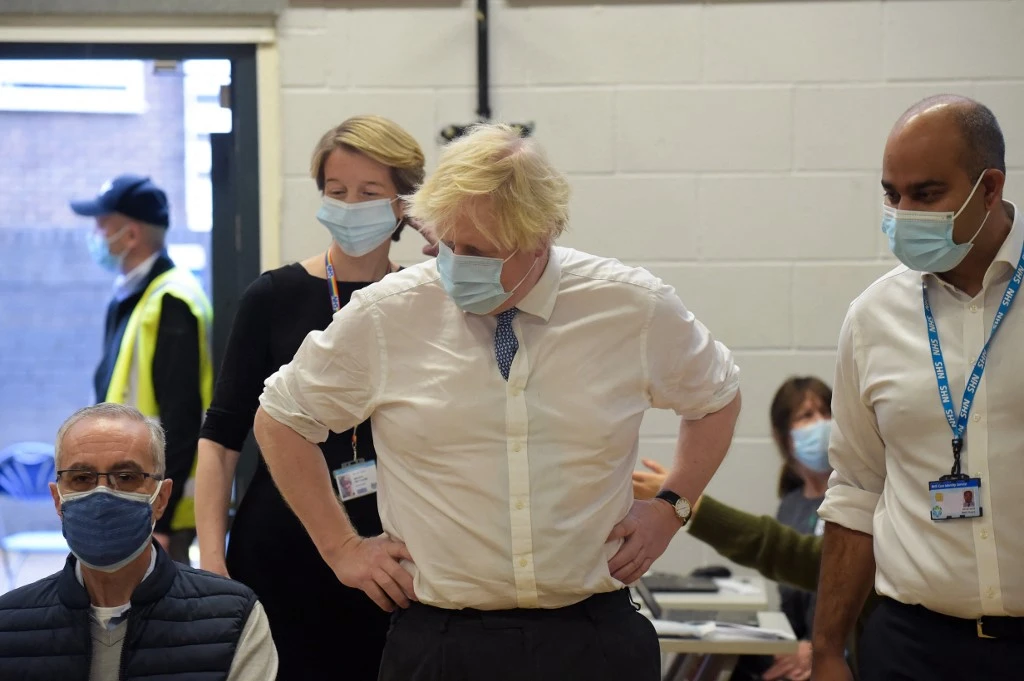

A year after the COVID-19 vaccine rollout in the UK, the emergence of the omicron variant has sparked debate over whether the country can rely on booster jabs and light restrictions to contain the virus.
After weeks of resistance to demands by scientists that the government activate the so-called plan B, which includes limits on social gatherings, as well as the return of social distancing and compulsory face masks, the government has finally admitted that the UK is facing “a tidal wave” of omicron, and that these measures are a vital part of buying time so we can get more booster doses in arms and provide protection.
As has been the case during the past 24 months of managing the pandemic, Boris Johnson and his government seem happy to act late, if at all, and are choosing to bank solely on booster shots as a means to alleviate the mounting pressure on the health sector in view of increased hospital admission of patients with COVID-19, and its delta or omicron variants.
The UK is not unique in its current COVID-19 bottleneck, with countries near and far struggling to stem the rise in infections as new variants threaten to end any advantage nations had in shielding themselves by relying mainly on vaccine protection. Vaccines protect against hospital admission, but do not halt the spread of the virus and its variants, or its continued mutations at home and in the wider world.
Johnson’s government ignored calls to tighten measures in early autumn in the hope of avoiding further disruption to the economy, thereby avoiding the wrath of Conservative MPs who believe that the vaccines and booster shots are sufficient to keep the pressure off hospital beds.
Ten days before Christmas, however, the outlook is alarming, with the first confirmed death from omicron registered in the UK and indications that the variant is already responsible for 40 percent of infections in London alone. Health Secretary Sajid Javid has warned that the variant is spreading at a “phenomenal rate.”
Scientists say they need two more weeks to determine the new variant’s impact on healthcare, as well as the future of the vaccines and the boosters.
In the UK, we are led to believe that booster shots are likely to halt the virus because of improved general immunity. But if omicron proves to be stronger, and capable of evading vaccine and booster-gained immunity, then the nation is facing a grim winter with tougher restrictions in order to contain the variant.
However, neither scenario looks good, according to a study by scientists at the London School of Hygiene and Tropical Medicine which showed that even a “weakened” omicron will still mean more than 175,000 hospital admissions and 24,000 deaths between now and April, 2022. A “stronger” omicron will see an extra half-a-million hospital admissions and more than 75,000 fatalities by April in the UK alone.
If omicron proves to be capable of evading vaccine and booster-gained immunity, then the UK is facing a grim winter with tougher restrictions in order to contain the variant.
Mohamed Chebaro
British MPs have approved further restrictions to prevent the spread of the virus, including mandatory use of COVID-19 passes to access some venues or crowded events. This is despite a rebellion by 100 MPs in Johnson’s own party amid a wider outcry in the country over Christmas parties that were held at Downing Street during the lockdown last year — revelations that have eroded trust in the government, and sparked claims of “one rule for politicians and another for the public.”
While the UK waits for scientists to have a full understanding of omicron’s threat, curbs on public behavior seem the only defense available to reduce the risk of hospitals being overwhelmed. These restrictions might work for the UK for now, but the same rules also must be adhered to in vaccine-poor countries so that new variants do not take hold and spread worldwide.
- Mohamed Chebaro is a British-Lebanese journalist, media consultant and trainer.


