
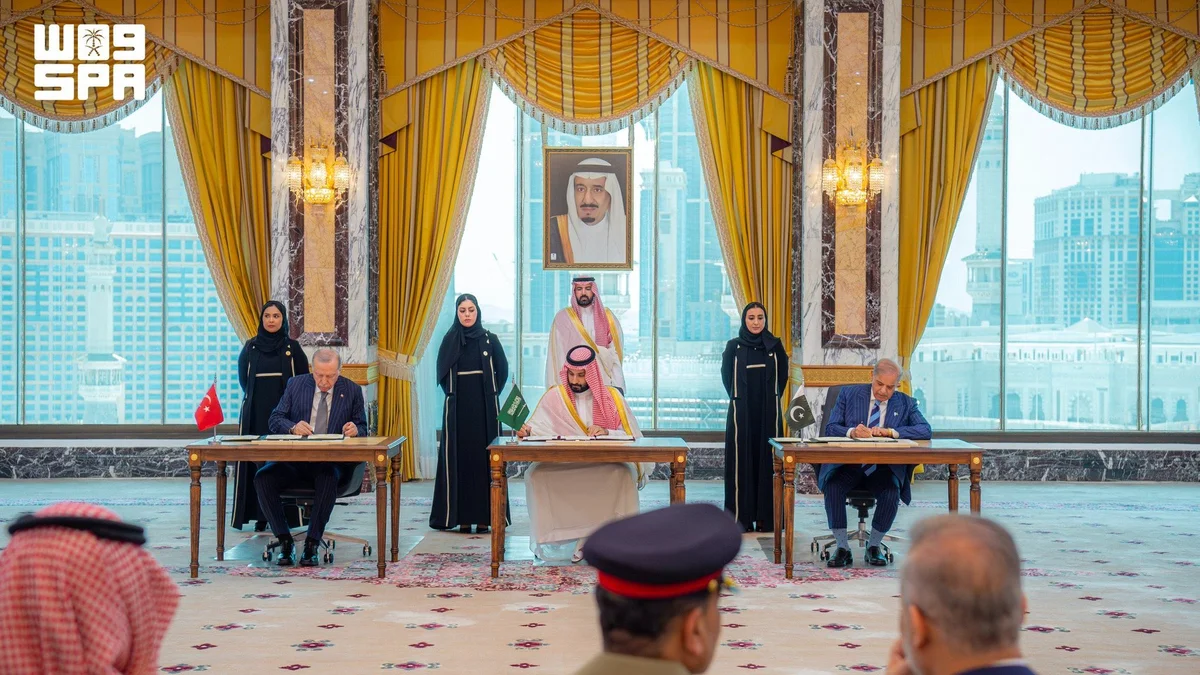

After attending the first institutional meeting of the Makkah Joint Defense Agreement in Istanbul, Pakistani Foreign Minister Ishaq Dar traveled to Bishkek aboard the same plane as Turkish Foreign Minister Hakan Fidan and Defense Minister Yasar Guler to attend a critical summit.
Their destination was a meeting of the Shanghai Cooperation Organisation, in which Pakistan sits as a full member and Turkiye and Saudi Arabia are increasingly signaling that they want a larger role. The symbolism in the photos taken both aboard the plane and at the summit was hard to ignore.
In Istanbul, the Turkish, Saudi and Pakistani foreign ministers agreed to establish a permanent secretariat in Saudi Arabia, with Pakistan initially providing the secretary-general. Setting aside the Makkah Agreement’s defense and political dimensions, what could it offer its member states in terms of deepening their engagement with, and pivot toward, Asian organizations?
As a Makkah pact member, Pakistan can serve as a gateway for Turkiye and Saudi Arabia into Asian multilateralism. Islamabad is a full member of the Shanghai Cooperation Organisation and a participant in Association of Southeast Asian Nations mechanisms, meaning it can use its position to build consensus around greater support for Turkish and Saudi participation.
As a Makkah pact member, Pakistan can serve as a gateway for Turkiye and Saudi Arabia into Asian multilateralism
Dr. Sinem Cengiz
Turkish President Recep Tayyip Erdogan, who attended the Bishkek summit, called the Shanghai Cooperation Organisation a “rising star” and an “indispensable element of a multipolar order.” He said Turkiye wants to deepen its relationship with the grouping and would even consider full membership, while stressing that this does not mean abandoning the West. Turkiye currently holds dialogue partner status.
Turkiye has accelerated its engagement with Asian organizations over the past few years. In July, it also became an ASEAN dialogue partner — the first country from the Middle East to do so. Turkiye’s elevation from sectoral partner to dialogue partner reflects its “Asia Anew Initiative,” a strategy launched in 2019 to deepen and anchor the country in the Asia-Pacific. By increasingly building a network across Asia, Turkiye was able to break ASEAN’s long-standing pause on welcoming new dialogue partners.
While Turkiye is moving deeper into Asian institutions, Saudi Arabia is also looking to diversify and strengthen its strategic partnerships. Over the past few years, the Kingdom has also pivoted toward Asian organizations. Although Riyadh is not yet an ASEAN dialogue partner, it has developed institutional ties with the bloc through the ASEAN-Gulf Cooperation Council relationship and signed its Treaty of Amity and Cooperation in 2023. Saudi Arabia hosted the first ASEAN-GCC summit in 2023, when the two institutions agreed to improve trade and supply chains. The same year, the Kingdom agreed to join the Shanghai Cooperation Organisation as a dialogue partner.
Turkiye, Pakistan and Saudi Arabia are also members of the Asia Cooperation Dialogue, which focuses on six major areas of cooperation, including connectivity. Turkiye has described this dialogue as a bridge between ASEAN and the GCC, making it a potentially important platform.
Both Saudi Arabia and Turkiye see cooperation with Asia as being significant for their connectivity projects
Dr. Sinem Cengiz
Both Saudi Arabia and Turkiye see cooperation with Asia as being significant for their connectivity projects. They, along with Pakistan, are partners in China’s high-profile Belt and Road Initiative. Pakistan plays a strategic role in this initiative, offering Ankara and Riyadh a bridge toward China and Central Asia, with Gwadar Port being the key maritime link. Pakistan and China this year agreed to develop Gwadar as a regional connectivity hub.
Turkiye and Saudi Arabia have the potential to contribute to Asia’s connectivity by helping connect it with the Middle East and beyond. A strong role for these countries in Asian institutions could therefore broaden regional cooperation and create new opportunities for economic integration and connectivity.
Pakistan’s participation in the Makkah pact is significant for Asian states, particularly China. Pakistan is one of China’s closest strategic partners and Beijing has extensive economic and infrastructure interests in the country. It is also one of China’s closest defense partners and a major recipient of Chinese arms.
From this perspective, Pakistan’s close ties with Turkiye and Saudi Arabia could bring another dimension to these countries’ relations with China in the long-term. Islamabad’s membership of the Makkah pact brings a strong South Asian dimension and means it can function as a gateway for Turkiye and Saudi Arabia, bringing other Asian countries more toward cooperation.
The Makkah pact has already changed the geopolitical landscape of the Middle East and South Asia. It brings together three states that are each embedded in different institutions. Turkiye is a key member of NATO, while expanding its engagement with the Shanghai Cooperation Organisation and ASEAN. Saudi Arabia plays a leading role in the GCC and the wider Arab/Gulf system. And Pakistan sits within South Asian and Asian institutions, including the Shanghai Cooperation Organisation, and has a long-standing partnership with ASEAN.
The Makkah Agreement could therefore become a mechanism through which these three countries bring their respective institutional relationships into closer contact with Asian partners.
Dr. Sinem Cengiz is a Turkish political analyst who specializes in Turkiye’s relations with the Middle East. X: @SinemCngz


