


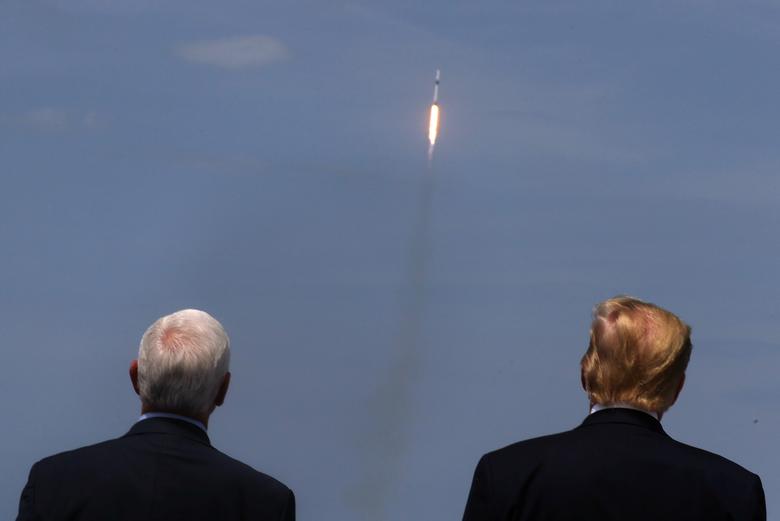
The international media, and with it millions of people worldwide, cheered this week’s successful launch of a manned spacecraft by SpaceX to the International Space Station (ISS). It wasn’t always clear to everyone why this mission was being hailed as “historic.” After all, the ISS is only 400 kilometers above Earth and, over its 20-plus years, there have been countless such trips to it, by both the US (NASA) and Russia (Roscosmos). OK, this time it was by a private company, SpaceX, although partially funded by NASA, but does that make it such a big deal? And why now, while we have a pandemic to contend with? Are there no risks of contaminating the ISS, where disinfection would be very difficult?
Indeed, it was a bit surreal to see the astronauts and mission officials not wearing face masks; it was as if this whole event was happening pre-coronavirus, or was somehow totally disconnected and isolated from the rest of the world. First, one should remember that space missions are always thoroughly disinfected (mainly with radiation) to ensure that no germs are ever carried to space. Secondly, and confirming that the coronavirus wasn’t going to stop important projects around the world, on April 9 Russia launched its Soyuz spacecraft to the ISS, carrying one NASA astronaut and two Russian cosmonauts (the Russians call them “cosmonauts” — riders and explorers of the cosmos).
This leads me to the strategic aspects of the latest mission, which Jim Bridenstine, the current “administrator” (director general) of NASA described as “a high-priority mission for the United States of America.” Why? Because the US could not afford, literally and figuratively, to keep paying Roscosmos $86 million for each American astronaut sent to the ISS. Indeed, since its space shuttle fleet was retired in 2011, NASA has sent 38 astronauts aboard Soyuz, at a total cost of $3.3 billion, with one more to go in November. Moreover, the US wants to be in total control of who, what and when to launch into space.
Most importantly, the US has always encouraged competition within the private sector in all fields. In space technology, as private companies started to emerge and mature (SpaceX, Boeing, Blue Origin, Sierra Nevada, and other upcoming firms), it became logical and strategic to entice them with contracts (NASA has signed multibillion-dollar contracts with SpaceX and Boeing) to push them to innovate and bring the price down.
This brings me to what I consider the most important aspect of this mission and the reason why it can be considered a historic moment and a step up (not quite a quantum leap, to be honest) in the history of spaceflight: SpaceX has made important innovations, most notably its ability to bring the main launch rockets back to land on Earth after successfully sending up a spacecraft. This has not only helped bring the overall price down by more than 30 percent (since rockets can be reused for dozens of flights), it has also allowed for the introduction of new safety measures that protect the astronaut-carrying capsules.
And now that SpaceX has proven itself capable of handling manned missions — another first for this ambitious company — it can guarantee its financial future (through vital contracts with NASA) and safely and confidently pursue its bigger goal: Getting humans to Mars.
Who can believe that, more than 50 years after man first walked on the Moon (there were six Moon landings in total, with 12 astronauts walking on our nearest cosmic neighbor, performing various tasks and bringing back half a ton of rocks), no human has been sent farther than the ISS, 400 kilometers above ground? If you had asked people, specialists and laymen alike, back in the 1970s about when we would walk on Mars, I imagine that most would have said “the early 2000s.”
Granted, Mars is hundreds of times farther and harder to reach than the Moon (seven months each way, with all that this implies in terms of supplies and safety measures), but manned missions to the red planet kept being pushed back decades — that is until Elon Musk (the visionary founder and owner of SpaceX and other innovating companies) stepped up. Musk has always considered Mars his main goal and priority, and he knows that taking people there requires important quantum leaps in space technology. But he is doing it, one development at a time.
SpaceX can now guarantee its financial future and safely and confidently pursue its bigger goal: Getting humans to Mars.
Nidhal Guessoum
This mission has opened up space to the private sector. The heavens are no longer reserved for the big superpowers (the US, Russia and China, with India soon to join); they are all of humanity’s, including private companies and people. This will multiply missions and goals, including trips to space stations, asteroids to mine, the Moon, Mars, and who knows where else.
The success of this new, different and somewhat spectacular mission (rockets separating, one of them landing back on a platform, everything broadcast live and in high resolution) comes at a good time for the US and the world. Much like back in the late 1960s, the US is suffering from deep political and racial divisions, while the world is also struggling to contain and overcome a pandemic that has killed hundreds of thousands and broken economies big and small. In such times, any project that unites people and turns their attention to loftier goals and vistas, where race and nationality do not matter, is very welcome.
- Nidhal Guessoum is a professor of physics and astronomy at the American University of Sharjah, UAE. Twitter: @NidhalGuessoum


