
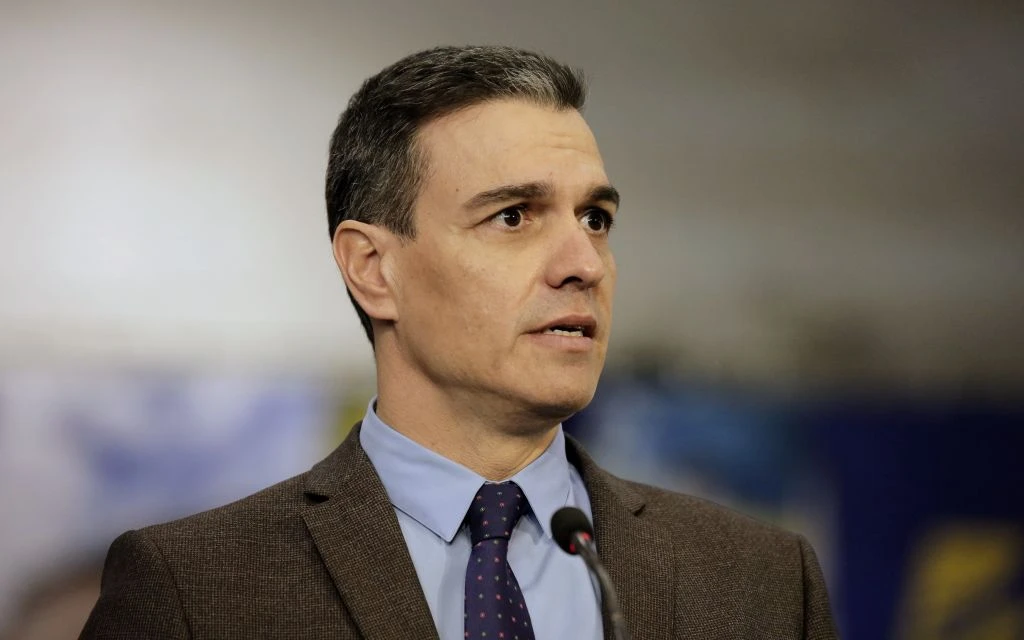

Prime Minister Pedro Sanchez, who leads the Spanish Socialist Workers' Party, has earned a reputation as a supreme political survivor during his eight years in office. However, the election on Sunday is likely to be his strongest ballot test yet with polls showing a potential majority for the right-of-center Popular Party and a possible partner, the populist, pro-Trump Vox.
The poll kicks off a “super election” year in Europe that will set the context for ballots in at least three other major eurozone economies in coming months: France, Poland, and Italy. The outcome of the ballot could be widely felt not only in Europe but also internationally in the US and China, and in South America, a region that has long had strong ties with Spain.
Latest surveys indicate a virtual tie between the Popular Party and the Socialists. If these numbers are correct, PP might narrowly be the largest single party. Together with Vox, a combined right-wing bloc could have a majority.
A stable majority could end Spain’s current political paralysis. The country is currently operating under a 2023 budget, now the longest-lasting fiscal framework since democracy was restored in 1975.
The scale of change under any new PP-led government would depend in part on whether, and to what extent, it relies on Vox for parliamentary support, and whether technocrat leader Alberto Feijoo would moderate Vox’s more extreme ideas, or co-opt some of them.
Until now, the PP and Vox have governed jointly in only four Spanish regions. However, if they work together at the national level, too, much will depend on the balance of power in the legislature.
Spain’s ballot on Sunday will be watched widely internationally. The result could help change the political weather in Europe, and also have implications well beyond from the Americas to Asia.
Andrew Hammond
As much as momentum may be with the political right, it cannot be assumed that Sanchez will fail to retain power. The PP was the largest party after the 2023 election, but Sanchez defied the odds to remain in power through deals with the backing of Catalan and Basque nationalist parties, pro-independence groups, and other left-wing parties.
There is also the possibility of political deadlock, an inconclusive outcome that could result in a repeat election in 2027.
The context for the election is that Spain has been one of the world’s strongest-performing economies in recent years, with unemployment falling to its lowest levels in almost two decades. However, this mini-boom has helped fuel a cost-of-living crisis, with affordability especially challenging in housing.
As much as the ballot could have huge domestic policy ramifications, the polls outside Spain’s borders are also potentially key. If the Spanish Socialist Workers' Party-led government loses power, only Denmark, Lithuania, and Malta would remain with center-left governments in the EU, although Sweden’s Social Democratic Party leader, Magdalena Andersson, is also still trying to form a government following elections in September.
While PP belongs to the moderate, right-of-center European People’s Party bloc in the European Parliament, Vox is in the Patriots for Europe group, a far more Euroskeptic, populist bloc founded by former Hungarian Prime Minister Viktor Orban, who was recently ousted from power. If Vox joins a new Spanish government led by the PP, a coherent, consistent policy toward the EU may be difficult to achieve. One flashpoint is trade, with Vox condemning the EU-Mercosur trade agreement as a sellout of Spanish farmers, and attacking the PP for supporting the deal.
On defense, the PP has expressed commitment to meeting NATO’s 5 percent spending target. This is a clear difference from Sanchez’s position which has resulted in Spain becoming the only member of the military alliance to reject this.
On Ukraine, the PP supports Kyiv. However, when US President Donald Trump clashed with President Volodymyr Zelensky in the White House in February 2025, Vox leader Santiago Abascal criticized the European leaders backing Kyiv, although he claims not to be pro-Russian.
Sanchez has helped lead Europe’s opposition to Trump’s policies, but there would be a change of approach under PP. This especially if pro-MAGA Vox, which has adopted a “Make Spain Great Again” message, also takes power in Madrid.
Sanchez has formed a bond with Brazilian President Luiz Inacio Lula da Silva, but this comes in the context of a growing number of right-of-center governments in South America whose relations with Spain have cooled. Vox’s ties to regional pro-Trump leaders, including Argentina’s President Javier Milei, could help rebuild diplomatic ties with those nations.
Sanchez has deepened ties with China, making four trips to the country in just over three years. His positioning has been to make Madrid perhaps Beijing’s best friend in western Europe. Chinese investment in Spain has grown to around €643 million ($700 million) in 2025 from about €149 million in 2024.
If the PP takes power, Feijoo will try to secure the benwaefits of Chinese investment but look again at potential compromising of Spanish or wider European security. This is a topic that Vox would be particularly vocal about if it also enters power in Madrid.
Taken together, this is why Spain’s ballot on Sunday will be watched widely internationally. The result could help change the political weather in Europe, and also have implications well beyond from the Americas to Asia.
Andrew Hammond is an associate at LSE IDEAS at the London School of Economics.


