
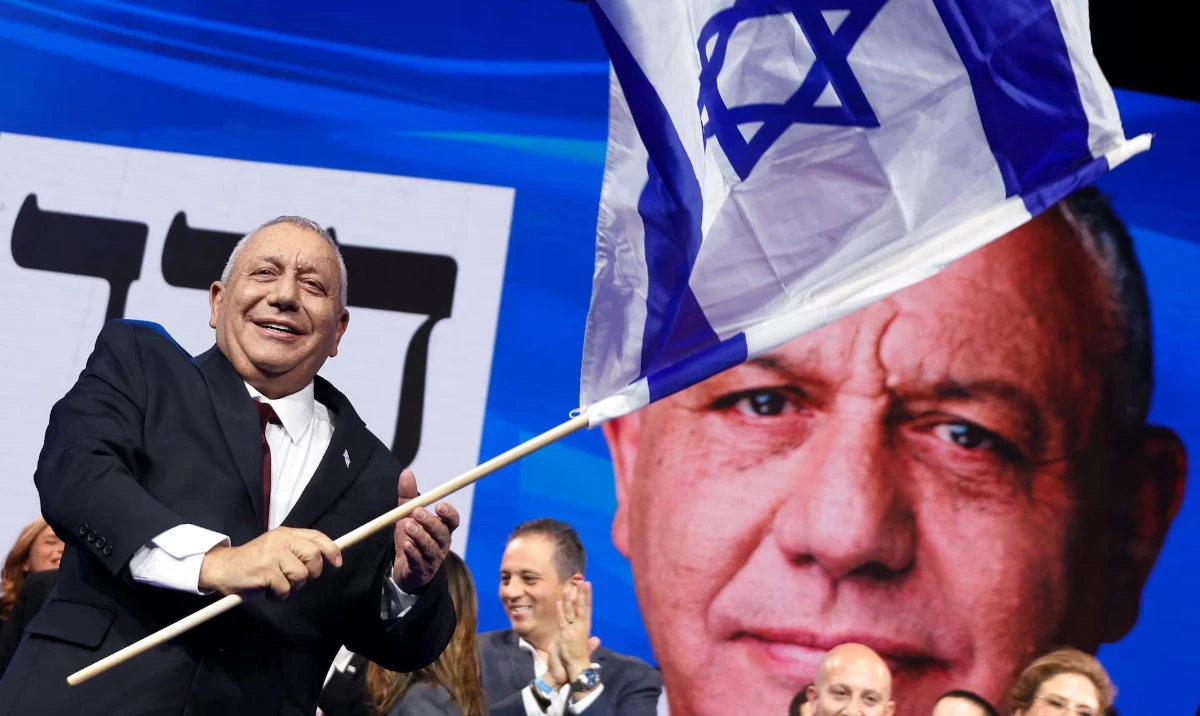

Israel’s Yashar party leader Gadi Eisenkot is edging closer to government as he negotiates with the Haredim and Arab parties. The former Israeli military strategist has announced a deal with Yisrael Beiteinu leader Avigdor Lieberman to form a coalition. Lieberman has repeatedly opposed forming a government supported by Arab parties and rejected concessions to the Haredi parties regarding conscription. Yet a breakthrough was achieved.
Although the outcome is far from certain, the return of Prime Minister Benjamin Netanyahu appears less and less likely — unless he can pull a rabbit out of the hat. The important question is what can the region and, most importantly, Palestinians expect from an Eisenkot-led Israel?
Eisenkot has been described by Aaron Miller, a senior fellow at the Carnegie Endowment for International Peace, as “a hammer in a satin glove.” As the father of the Dahiya military doctrine that was applied to level Gaza, he is unlikely to be more humane or ethical than Netanyahu. The plight of people in Gaza is not even part of public discourse in Israel, and Eisenkot has clearly declared that he rejects Palestinian statehood.
The only advantage that an Eisenkot government brings to the Palestinians is the removal of Netanyahu and his two hard-line ministers Itamar Ben Gvir and Bezalel Smotrich. Overall, there is little hope that Eisenkot will be a better leader, even if he appears more aware of Israel’s growing isolation, and hence is keen on curbing measures that risk turning the country into a “global pariah,” as US special envoy Jared Kushner warned.
Netanyahu’s return appears increasingly unlikely
Dr. Dania Koleilat Khatib
Although a two-state solution is out of the question for this government, Eisenkot has condemned “Jewish terrorism.” He might take some steps to tame settler terrorism, and will be able to convince the Israeli people of any action he takes by telling them that settler actions are tarnishing the image of Israel worldwide.
On Gaza, Netanyahu has been a major hurdle for Trump’s Board of Peace. Kushner recently accused Netanyahu of obstructing the postwar reconstruction and stabilization plan. Eisenkot, however, seems more conscious of the scrutiny facing Israel. In the wake of the International Criminal Court verdict regarding Myanmar’s genocide against the Muslim Rohingya, he will not want to be the prime minister under which Israel faces a similar judgment.
Netanyahu seems more confident of taming the US and worldwide public opinion. Hence, Eisenkot is likely to curb the criminal measures Israel is taking against the people of Gaza. However, it is unlikely that he will reach a comprehensive settlement where the enclave is rebuilt and rehabilitated. He will probably keep the army in Gaza but allow more aid to enter.
The plight of Gaza is not even part of public discourse
Dr. Dania Koleilat Khatib
The million-dollar question is what will happen with Iran given that Netanyahu has been the main driver behind the war with the Islamic republic. Eisenkot is unlikely to pursue the conflict, and seems more concerned with addressing domestic problems and limiting the international ire against Israel. He has said that while Iran is a major threat, it is not an “immediate” one requiring military action before a new government is formed. If Eisenkot succeeds in forming a government, chances are the current tensions will be eased and there will be less pressure on the Trump administration to resume strikes. With Eisenkot there are likely to be improvements in Israel’s relationship with both Turkiye and Egypt.
Eisenkot has also vowed to hold an inquiry into the Oct. 7 attacks. If claims that Netanyahu knew about the attacks beforehand and did nothing to stop them are proved to be true, it will create turmoil inside Israel. The country will most likely undergo internal divisions.
Israel under Eisenkot is unlikely to roll back its presence in Lebanon and Syria. He will not want to appear weaker than Netanyahu on foreign policy. The deployment of Israeli forces in the two neighboring countries comes at almost no cost for Israelis — unlike the attacks on Iran, which drive people into shelters and damage the economy.
Despite Eisenkot’s less-than-encouraging background, he appears a better option than Netanyahu. The most important advantage he will bring is that under his leadership there is a reduced likelihood of a devastating region-wide war.
Dr. Dania Koleilat Khatib is a specialist in US-Arab relations with a focus on lobbying. She is co-founder of the Research Center for Cooperation and Peace Building, a Lebanese nongovernmental organization focused on Track II.


