


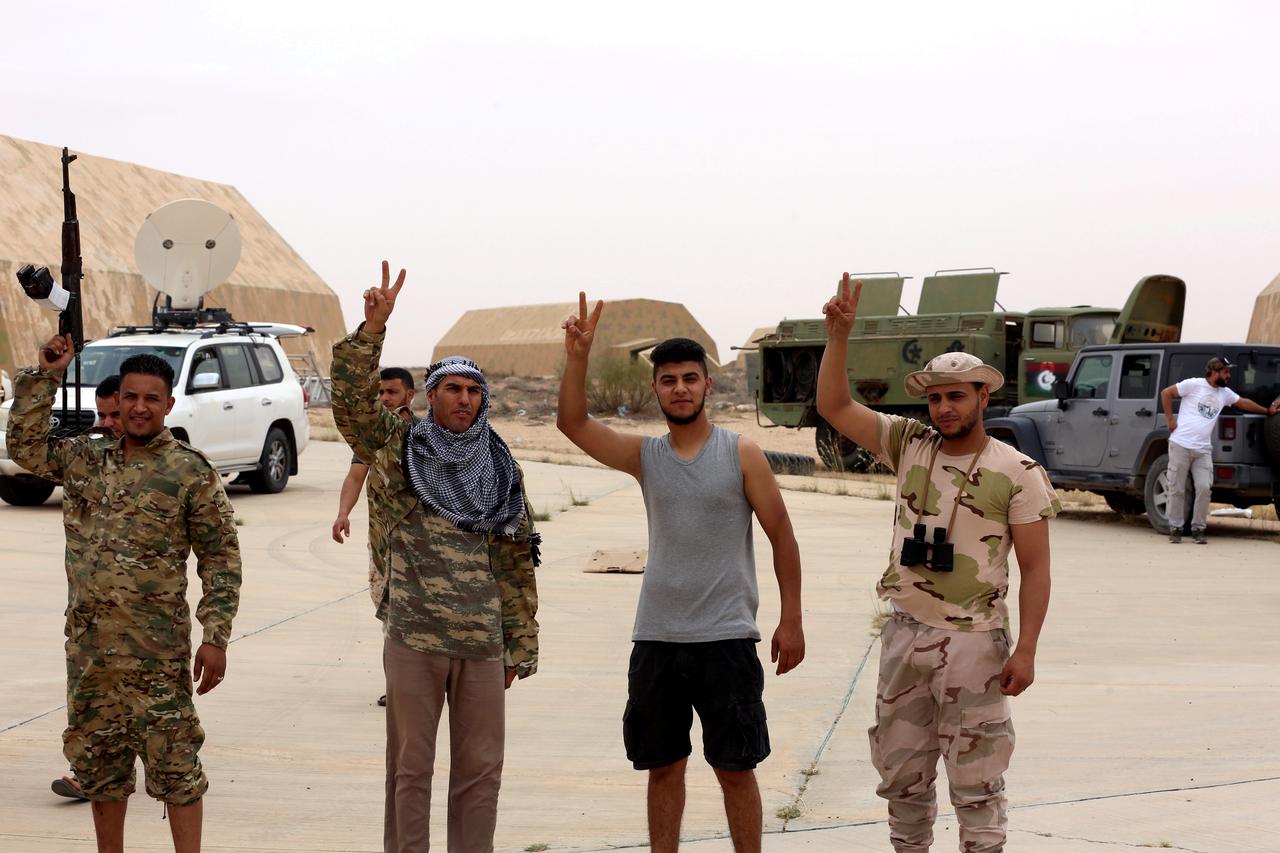
The protracted nine-year-old Libyan conflict is quickly turning into another Syria — ironically with the same two main state actors, Russia and Turkey, holding the balance of power and supporting opposite sides. Turkish-supported fighters of the UN-recognized Government of National Accord (GNA) have scored several gains recently against forces fighting under the banner of the Libyan National Army (LNA) led by Field Marshall Khalifa Haftar. The most important victory was the capture of the strategic Al-Watiya airbase on the outskirts of Tripoli more than two weeks ago.
The fall of the airbase signaled a reversal in the fortunes of Haftar, who a year ago launched a military campaign to “liberate” western Libya from the GNA after talks to implement a political deal had collapsed. Before Turkey’s direct intervention in January, the GNA appeared to be on the brink of defeat, as Haftar’s forces had broken through the southern districts of the capital.
Turkey has dispatched thousands of Syrian mercenaries to Libya, as well as drones and armored vehicles — thus violating UN sanctions. On the other hand, Russia has been backing Haftar through military contractors, and last week Moscow sent 14 MiG-29 and Su-24 fighter jets to the LNA’s Jufra airbase in central Libya. This could be crucial in keeping Haftar in the game, as Turkish drones have been instrumental in destroying the LNA’s air defenses. The Libyan quagmire has seen many foreign players taking sides, with Egypt and the UAE supporting Haftar, and Turkey, with the hesitant backing of Tunisia and Algeria, defending the GNA under Prime Minister Fayez Al-Sarraj.
But Haftar may have undermined his own position years after emerging as the uncontested ruler of eastern Libya. In April, he absolved himself of the Skhirat Agreement of 2015 and declared himself sole ruler of Libya — a move that was condemned by key international players as well as members of the Tobruk-based parliament. Instead, Speaker Aguila Saleh proposed an initiative to reach a political solution to the crisis.
With UN mediation failing to implement the Skhirat Agreement and end the deep rift between Tripoli and Benghazi, Turkey and now Russia have used the vacuum to bolster their own positions in the key North African country. The “Syrianization” of the Libyan crisis is not far-fetched. Recep Tayyip Erdogan and Vladimir Putin previously clashed in Syria before reaching a deal to jointly manage that crisis, at least in the north of the country. Now a similar scenario is unfolding in Libya and it underlines the new geopolitical reality, which is marked by the lack of a US strategy and European divisions.
The possibility of Turkish-Russian collaboration in Libya, where both sides create a foothold and jointly benefit from the country’s riches, is cause for concern, especially for Egypt. Turkey has been challenging Greece, Cyprus and Egypt over the Eastern Mediterranean gas fields and Erdogan has been condemned for signing a maritime demarcation accord with Libya. It is clear that Turkey’s objectives in Libya are long term.
The US, which has expressed concern over Russia’s deployment of fighter jets in Libya, appears to be content with Turkey’s role so far. Last week, a statement by the US Embassy in Tripoli said: “The United States is proud to partner with the legitimate, UN-recognized government of Libya.” It also slammed “forces seeking to impose a new political order by military means or terrorism.” Such a position strengthens Turkey’s mission in Libya.
The scenario unfolding in Libya underlines the new geopolitical reality, which is marked by the lack of a US strategy and European divisions.
Osama Al-Sharif
That leaves the EU, which, as is to be expected, is divided over the Libyan crisis. France, unlike Italy, finds itself in alignment with Russia in backing Haftar, but is unable to embrace a clear policy other than to underline the threat chaos in Libya poses to European interests. The failure of Libyan parties to implement the understandings reached at the Berlin conference in January has, for now, crippled any credible political process. For Washington, backing Ankara is one way of offsetting the rising Russian influence in eastern Libya. On the other hand, Cairo’s qualms about the GNA’s ties to the Muslim Brotherhood will not be eased by Erdogan’s increasing presence in the neighboring country.
For now, the possibility of Turkey and Russia clashing directly in Libya seems remote. The more plausible scenario is that the two powers will find a way to impose a cease-fire, backed by almost all regional and international players, by controlling their proxies while seeking to reach an understanding on reviving political efforts. Saleh’s initiative may provide the basis for renewed political efforts if Haftar reaches the conclusion that his ambition of ruling over all of Libya is no longer plausible. It is Russia and Turkey that appear to be in the driving seat now, and each is able to implement its own self-serving agenda.
- Osama Al-Sharif is a journalist and political commentator based in Amman. Twitter: @plato010


