
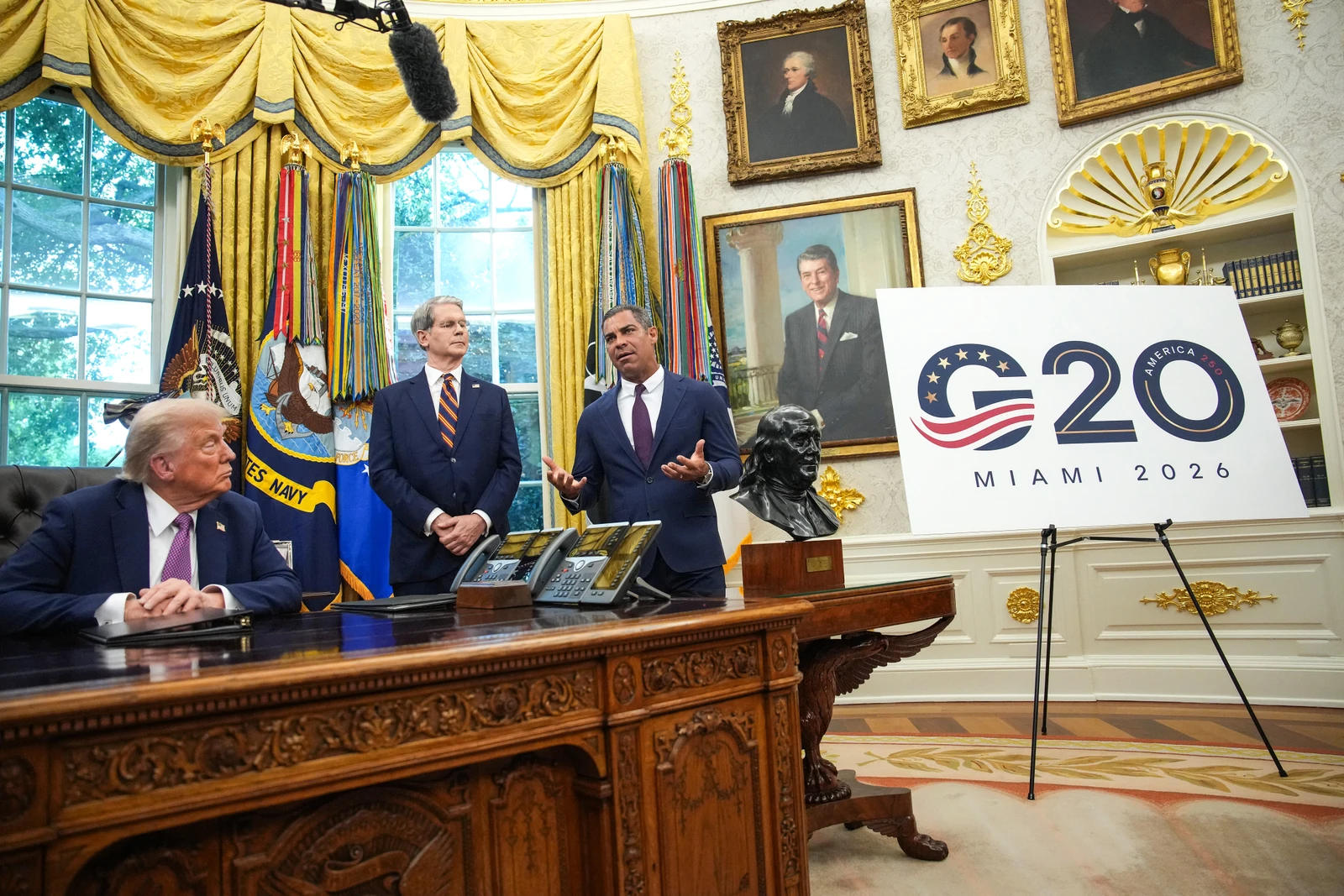

The US’ hosting of this year’s G20 has stepped up a gear, including with last week’s trade ministers’ meeting. However, this intensification of diplomacy comes at a time when there is growing concern that the global body may no longer have the capability to deal with big challenges.
In 1999, the US helped create the G20 in response to a succession of crises, including the 1998 Asian economic crash. However, almost three decades later, the global group of nations is increasingly riven with geopolitical splits, with only fragile support from the Trump team.
While multilateralism is much derided, entities such as the G20 have played key roles in helping defuse major crises like the 2007-09 financial crash. In London in April 2009, in perhaps the most important G20 summit ever, a coordinated $1.1 trillion package was agreed to help stimulate demand and employment after intensive, skillful diplomacy led by then-UK Prime Minister Gordon Brown.
Fast forward to today and US President Donald Trump has rarely shown a keen interest in multilateralism. He has quite often left key summits early. Moreover, in 2020, his team hosted a light-touch G7 year of diplomacy, skipping the final summit during the COVID-19 pandemic and not even holding a short online session with Western leaders.
Last year, moreover, the Trump administration boycotted the South African-hosted G20. This was largely over the widely discredited Trump claim that the emerging market’s white minority population was being subjected to large-scale murders and land appropriations, which the president described as “genocide.”
The disdain of Trump toward Pretoria continues, with the South African government not invited to this year’s US-hosted events and Poland given a seat at the table instead. This diplomatic snub, despite Pretoria continuing to be a full member of the G20, has led to objections from key European nations, including France, which is the current G7 chair.
While multilateralism is much derided, entities such as the G20 have played key roles in helping defuse major crises.
Andrew Hammond
In this context, it has long been expected that the US-hosted G20 would be unconventional. This includes the fact that the leadership summit in Miami in December will be held at the National Doral Golf Club, which was purchased in 2012 by the Trump Organization.
Yet, beyond accusations of presidential commercial self-interest, concerns are growing about the Trump team’s wider administration of this year’s G20. Russia has aired its grievances in public, with Marat Berdyev, ambassador-at-large for G20 and Asia-Pacific economic cooperation affairs, asserting a major failure by the Trump team to fulfill its obligations as host state.
Berdyev’s gripes include the rejection of visas and denial of accreditations, which, it is claimed, prevented Moscow from fully taking part in financial track meetings organized by US Treasury Secretary Scott Bessent. This is one reason why the US-hosted G20 finance minister meeting in April concluded without a joint statement or even the traditional media conference.
Multiple other nations are expressing concerns off-the-record. This includes worries about what US Secretary of State Marco Rubio has called a “new G20” agenda.
This is centered on a slimmer range of topics than normal and focuses on issues that the Trump administration regularly espouses, such as energy security, artificial intelligence, and technology generally, immigration, reducing regulation, and foreign investment. Correspondingly, there is a US push to make fewer references to issues that the president finds less palatable, like climate change and the energy transition. This is reportedly already influencing drafts of December’s joint declaration.
This direction of travel should come as no huge surprise. During last year’s G20 process, Rubio declared on social media that not only is “South Africa doing very bad things. Expropriating private property,” he also flagged his disdain for Pretoria “using (the) G20 to promote solidarity, equality, and sustainability. In other words: DEI (diversity, equity and inclusion) and climate change. My job is to advance America’s national interests, not waste taxpayer money or coddle anti-Americanism.”
The Trump White House’s unusual style of G20 diplomacy is now intensifying the splits within the bloc that have grown since the pandemic and the outbreak of the Ukraine war. This is diminishing the effectiveness of the group as a global actor.
Tensions have been high for some time between China and the West and recent summits have seen significant tensions with Moscow too. G20 ministers have clashed diplomatically, with Russian Foreign Minister Sergei Lavrov walking out of some meetings.
Amid the division and uncertainty, what is at stake is more than US international economic and political leadership in the Trump era. In play too is the very future of the G20 and other multilateral forums, including the G7, which the US will host again next year.
At a time of growing geopolitical division, now is the time for Trump and his fellow world leaders to double down on building multilateral relationships ahead of the next global emergency. As the COVID-19 pandemic and 2007-09 financial crash showed, global cooperation and coordination are increasingly key ingredients in defusing, if not always solving outright, a widening range of global challenges.
Andrew Hammond is an associate at LSE IDEAS at the London School of Economics.


