
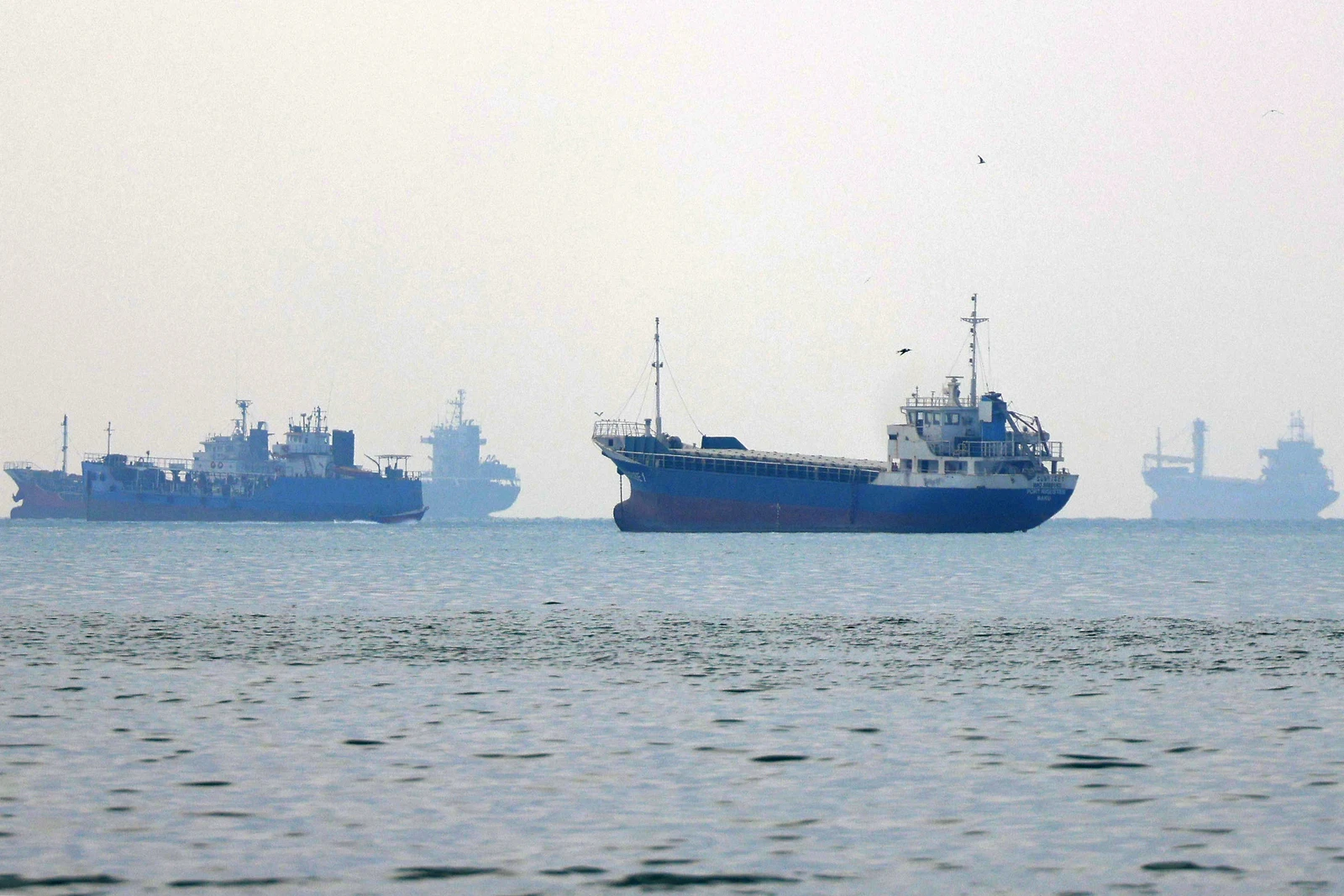

The Houthi militia’s attacks on international trade routes, from Bab Al-Mandab and the Red Sea to the Indian Ocean, have posed a direct threat to the stability of the global economy and international trade. Over the past several years, the militia has targeted more than 100 vessels, damaging 42 and sinking four.
This conduct, which threatens international navigation, has had extremely serious economic repercussions worldwide. Shipping and tanker traffic through the Bab Al-Mandab Strait and the Suez Canal declined by more than 70 percent during certain periods of the crisis, forcing shipping companies to reroute their vessels around the African continent via the Cape of Good Hope. This led to substantial increases in shipping and insurance costs, exceeding 30 percent in some cases.
The threat was not confined to Bab Al-Mandab but also extended to the Indian Ocean, where the Houthis targeted several vessels in 2024, including the MSC Orion, using an Iranian-made Shahed drone. All the while, Yemeni citizens themselves were not spared the economic repercussions of these attacks.
Support for Gaza has been the main justification put forward by the militia for its attacks on international navigation. However, its threats extended to vessels belonging to neighboring countries, most notably Saudi Arabia, while its criteria for targeting vessels have shifted according to political and military circumstances. This raises questions about the real objectives of these operations, beyond the slogans the group promotes regarding the Palestinian cause.
The Houthis rely on Iranian support and assistance in terms of tactics, armaments and intelligence
Noofal Gawad
The Houthis are a nonstate armed militia that does not possess a naval fleet comparable to those of nation-states. Yet, they have managed to threaten one of the world’s most important international trade corridors. How did this happen?
As one of the instruments through which Iran implements its regional policy, the Houthis rely on Iranian support and assistance in terms of tactics, armaments and intelligence. Of particular importance in this regard is the information provided by Iranian reconnaissance and intelligence assets, including the vessel Behshad, which has been linked to reports of providing information on ship movements in the Red Sea. Iran also possesses specialized reconnaissance vessels, such as the Zagros, which perform the same function.
Information suggests that the naval blockade imposed on Saudi vessels at Bab Al-Mandab was carried out under directives from Iran’s Islamic Revolutionary Guard Corps, with the aim of preventing and obstructing Saudi oil exports through the port of Yanbu and pursuing a policy of blackmail targeting not only neighboring countries but the entire world.
This threat complements Iran’s policy in the Strait of Hormuz. Exercising influence over both straits gives Tehran a real ability to exert pressure on the global economy and international trade, turning maritime corridors into a strategic bargaining chip that is no less important in its calculations than other instruments of deterrence.
These practices could prompt other nonstate groups and militias to threaten international shipping routes
Noofal Gawad
Have the Houthis succeeded in blackmailing the world through the Humanitarian Operations Coordination Center and collecting extortion payments in exchange for granting safe passage permits through Bab Al-Mandab? How dangerous is this for the international community? Could other groups and militias pursue the same policy?
The Houthis established the Humanitarian Operations Coordination Center as an administrative front responsible for issuing safe passage permits to vessels, raising questions about the use of this mechanism to extort international shipping companies.
In a 2024 report by the UN Panel of Experts on Yemen, the panel cited estimates from sources indicating that the Houthi militia was collecting about $180 million per month in illegal transit fees in exchange for allowing vessels safe passage through the Red Sea and the Gulf of Aden. The panel noted, however, that it had been unable to independently verify these estimates.
Well-informed diplomatic sources indicate that this step was taken under direct instructions from Tehran to institutionalize the collection of fees and that the cost of a transit permit for a single vessel could reach $4 million.
Ironically, a militia that does not possess a conventional naval fleet has managed to pose a real threat to one of the world’s most important international trade corridors and attempt to turn the security of navigation into a means of economic blackmail, drawing on Iranian support and tactics.
What poses an even greater danger to the world, however, is that these Houthi-Iranian practices could prompt other nonstate groups and militias to threaten international shipping routes and attempt to impose transit fees in exchange for safe passage. Somalia’s Al-Shabab movement may be among the groups most likely to seek to replicate this approach.
Iran is thus exerting a form of economic pressure that extends beyond the confines of conventional military confrontation and whose impact is felt across the entire world. Its policy in the Strait of Hormuz and Bab Al-Mandab has become an instrument for influencing global trade flows and energy security, giving it an additional bargaining chip with which to exert pressure and engage in blackmail in its regional and international conflicts.
Noofal Gawad is a Yemeni diplomat and director of the Office of the Undersecretary for Political Affairs at the Ministry of Foreign Affairs.


