
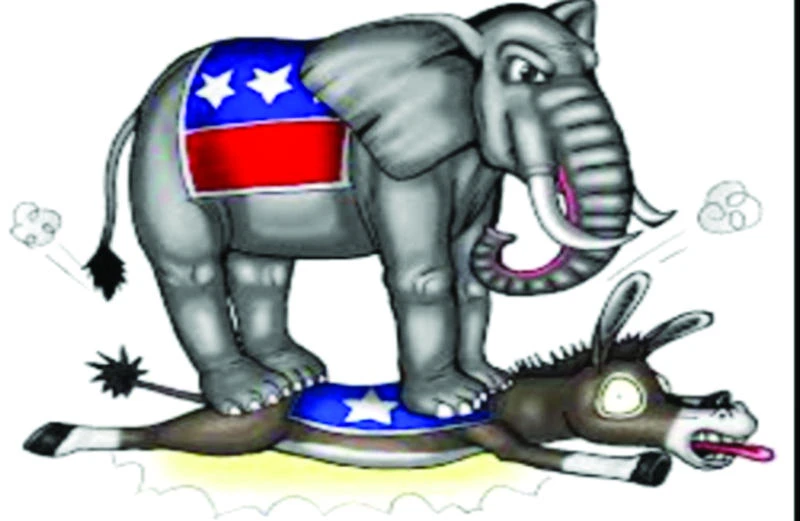

Over the last six years, President Obama’s administration has shown itself to be a dismal failure in its domestic policy as in its foreign policy. That at least appears to be the verdict of voters in the mid-term elections held last Tuesday across the US.
For most Americans, domestic policy translates primarily as how well the economy is managed and President Obama has led a nation during his tenure that suffered a prolonged six-year economic decline.
On the eve of the elections, for example, where democratic candidates were trounced — surrendering a Senate they had handily controlled — roughly 2.2 million Americans were unemployed, comprising individuals who, in the words of the federal government’s monthly report on the economy, “were marginally attached to the labor force” and who had unsuccessfully “looked for a job sometime in the prior twelve months.” A chief executive who presides over, and is ultimately held accountable by the electorate for, that kind of performance is likely to see his party lose in mid-term elections — and potentially in 2016.
Americans, you see, have come to look at prosperity in their lives as an entitlement. Consider, in this regard, America’s wealth creation over the years: As the millennium opened in 2000, according to the Federal Reserve, the increase — the increase, alone — in the net worth of American households was approximately equal to the total annual income of the three billion people of China, India, Russia and Brazil combined. True, this disparity began to narrow recently, but we are still looking at an astonishing economic fact that the average American is not only blaze about but takes for granted.
For decades after World War II, the United States enjoyed an annual average growth rate of 3.3 percent —and still found enough time and enough cash lying around to help rebuild Europe under the Marshall Plan. Over the last six years, however, under Obama’s stewardship, that growth plunged to 2.5 percent in 2010 and 1.9 percent in 2013 — and is still plunging, despite a recent uptick in employment figures.
President Obama has not only failed his constituency at home, but he also has failed his constituency abroad, for he had one there as well. More than six years ago, while campaigning for president, he mesmerized Americans with his sonorous rhetoric. Yes, we can, he hollered. They believed him. And they voted for him. On his overseas trips, he equally mesmerized Germans in 2008 when he addressed 200,000 ecstatic Berliners at the Brandenburg Gate, and a year later, in an effort to “mend a severely damaged relationship” between the US and the Muslim world under George W. Bush, he gave a speech before a large invite-only audience at Cairo University.
Yes, he declaimed there, it’s all about the audacity of hope. He was trusted. And he was applauded. Obama, as we say, talked the talk and walked the walk. He was an African-American, the first to aim for and finally occupy the White House. He knew how to string his words together and make them sing. Lest we forget, the deepest energies of the black soul are always expressed in idiom and music. And who could resist the charms of a man who is able to address a crowd as touchingly as a jazz soloist is able to jam on his sax?
But in his foreign policy, as in his domestic policy, Barack Hussein Obama just didn’t cut it, for he turned out to be a detached president who shunned — almost dreaded — American engagement in our part of the world, especially in Syria and Palestine, where in the former he appeared to be giving a tyrant like Bashar Assad a lot of slack and in the latter he appeared to be letting a brazen expansionist like Benjamin Netanyahu walk all over him.
Middle-class, middle-brow, middle-aged, middle-Americans from, say, Kansas or Ohio may not overly care about, or fully understand, their government’s foreign policy (unless we’re talking about Vietnam in the late 1960s and early 1970s, where America was conducting the war there on credit and where 65,000 Americans were killed), but they do feel that policy’s trickle-down effect on their financial lives. And for the last six years, they have chafed at the erosion of their place in the world.
And the erosion is all too real. In his new and critically acclaimed book, “Losing Our Way: An Intimate Portrait of a Troubled America”, Bob Herbert, former columnist for the New York Times, writes about his country’s sense of aimlessness in recent years, the aimlessness evinced domestically in the anemic recovery (if recovery it was) of the Great Recession and evinced internationally in the morass of America’s wars in Iraq and Afghanistan.
“As I traveled the country,” he tells his readers, “I couldn’t help but notice that something fundamental in the very character of the United States had shifted. There was a sense of powerlessness and resignation among ordinary people that I hadn’t been used to seeing. The country seemed demoralized.”
Now who wouldn’t give a drubbing at the polls to those responsible for this mess?


