- The EU-Jordan Investment Conference, attended by key leaders, aimed to boost investment in strategic sectors like water security, energy, and digital infrastructure.
- The partnership includes a €3 billion financial and investment package for the years 2025-2027 to support economic modernization and job creation in Jordan.
- A separate €63 million financing agreement was signed to enhance economic resilience and support reforms in public administration and the water sector.
- Jordan is the EU’s second-largest trading partner, with two-way trade in goods reaching €6.1 billion in 2025.
- The conference emphasized major projects, including a €1.6 billion initiative for water security and a commitment to improve digital connectivity and green industrial development in Jordan.
JEDDAH: The EU and Jordan signed a €110 million ($121 million) budget-support agreement to advance economic reforms under the Kingdom’s modernization vision, as both sides seek to boost investment and strengthen economic resilience.
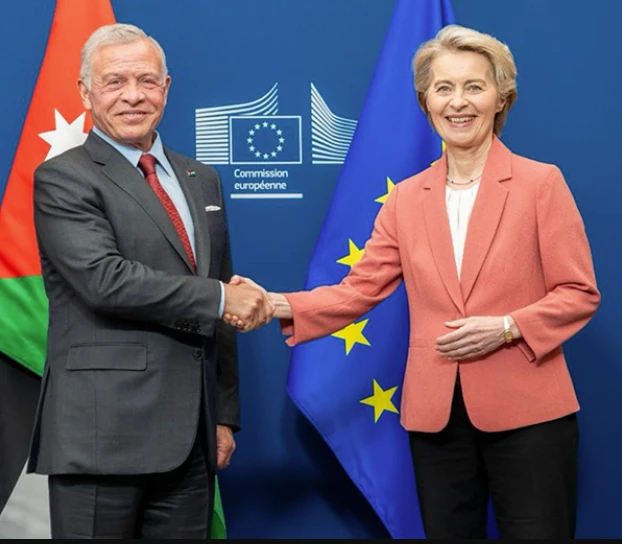
The deal was signed at the EU-Jordan Investment Conference at the Dead Sea, attended by King Abdullah II and European Commission President Ursula von der Leyen, according to a statement.
The conference brought together around 1,000 policymakers, business leaders and representatives of international financial institutions to explore investment opportunities in water security, energy, digital infrastructure, and other strategic sectors.
EU-Jordan partnership
The conference builds on the EU-Jordan Strategic and Comprehensive Partnership, signed in Brussels on Jan. 29, 2025, and backed by a €3 billion EU financial and investment package for 2025-2027.
The partnership aims to translate closer bilateral ties into increased investment, with a focus on attracting private investment, boosting competitiveness, and creating jobs.
Leyen said that Jordan and the EU share a vision to turn regional ambition into real opportunities for people and businesses.
“Together, we are working to build stronger connections, attract investment and create new pathways for the creation of jobs and growth. Our partnership is about delivering results, supporting Jordan's economic modernization, and shaping a more prosperous future,” she added.
The EU pointed out that the partnership reflects its long-term commitment to Jordan's stability, reform agenda and socio-economic resilience and to a shared future of cooperation in the region.
It added that the financial and investment package comprises €640 million in grants, around €1.4 billion in additional investments through the EU's financial instruments, and €1 billion in concessional loans through macro-financial assistance.
The EU is Jordan’s second-largest trading partner, accounting for 15.2 percent of the Kingdom’s goods trade in 2025, while Jordan ranked as the bloc’s 63rd-largest trading partner.
Two-way trade in goods between the two sides reached €6.1 billion that year, with EU exports to Jordan totaling €5.2 billion and imports from Jordan amounting to €900 million.
Trade in services between the two sides reached €1.8 billion in 2024, according to European Commission data.
A separate €63 million financing agreement was also signed to support economic resilience, trade, and investment, alongside reforms in the water sector and public administration, according to the statement.
The EU and Jordan also signed a memorandum of understanding paving the way for up to €500 million in concessional loans under the bloc’s fifth macro-financial assistance program, with disbursements scheduled for 2027 and 2028, subject to agreed conditions.
“Approved by the European Parliament and the Council on 20 January 2026, this is the fifth MFA operation which complements the ongoing fourth, bringing their combined support to €1 billion,” the European Commission said.
The loans are intended to help meet part of Jordan’s external financing needs, while supporting economic stability and long-term resilience. They will also back reforms in public finances, governance and anti-corruption, social protection, and labor market policies, according to the European Commission.
Disbursements will be conditional on Jordan satisfactorily implementing the measures agreed under the memorandum of understanding and maintaining a satisfactory track record under its International Monetary Fund-supported program.
They will also require a positive assessment of Jordan’s commitment to effective democratic mechanisms, including a multi-party parliamentary system, the rule of law and respect for human rights, according to the European Commission.
Water and digital projects
Water security was another major focus of the conference, with the flagship Team Europe project mobilizing €1.6 billion for Jordan’s National Conveyance Project, which will desalinate seawater and supply drinking water to Aqaba and Amman, meeting around 40 percent of the Kingdom’s drinking water needs.
The European Investment Bank will also mobilize €250 million for infrastructure to transport and distribute the desalinated water.
The EU also announced support for digital connectivity, including an €11.3 million grant through the European Investment Bank to extend the Medusa submarine cable to Jordan.
The announcements also included a €7.5 million green and digital transition facility under the EIB, while the EU-backed Aqaba Digital Hub will join the Blue Ribbon program of the European Bank for Reconstruction and Development.
“These initiatives will strengthen digital links between Europe and Jordan and support closer cooperation on research and innovation across the Mediterranean,” the Commission said.
Green industry
A further €18.5 million green industrial development program will help Jordanian industries adapt to the EU’s carbon rules and improve their competitiveness.
European Commissioner for the Mediterranean, Dubravka Suica, said the conference aimed to bring European and Jordanian businesses and investors together to translate the partnership into tangible projects, create jobs and expand economic opportunities.
“I am in Jordan to bring European and Jordanian businesses and investors together and turn our Strategic and Comprehensive Partnership into projects that create jobs and open up opportunities on both sides,” she said.
Energy cooperation with Germany
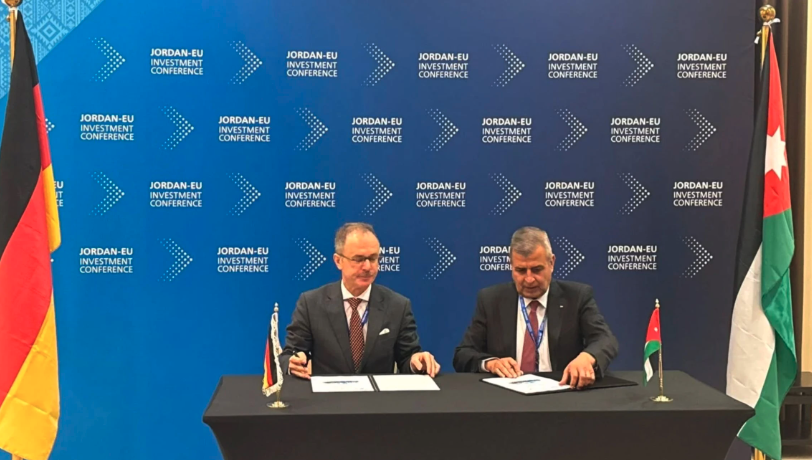
Separately, Jordan and Germany signed a 2027 action plan for their energy partnership on Nov. 18, setting priorities for cooperation in energy efficiency and power grid development.
The plan, signed by Jordanian Minister of Energy and Mineral Resources Saleh Kharabsheh and Thomas Steffen, state secretary at Germany’s Federal Ministry for Economic Affairs and Energy, also covers crisis preparedness, natural gas networks and geothermal energy.
Under the agreement, the two parties will work on policies, regulations, and financing frameworks to improve energy efficiency in industry and buildings, according to Jordan News Agency, or Petra.
The agency added that the two sides will also work to modernize and stabilize power grids, improve the management of distributed energy resources, and strengthen cross-border electricity links.