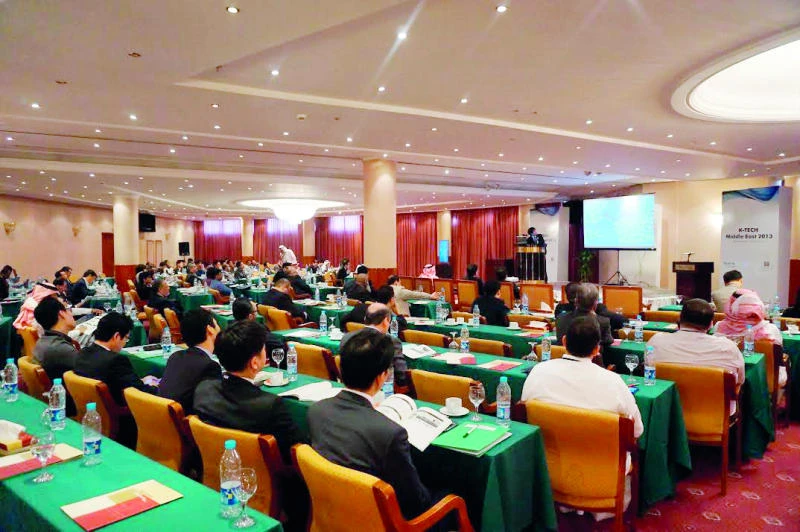
Korean Trade Promotion and Investment Agency (KOTRA) in association with Saudi Arabian General Investment Authority (SAGIA) organized K-Tech Middle East 2013 in Riyadh to bolster bilateral ties in information and communication technology (ICT).
K-Tech will encourage cooperation between the two countries in the ICT industry, Faisal Al-Bafarat, deputy governor of SAGIA, said at the opening ceremony.
Echoing the sentiment, Kim Hyung Wook, director general, Kotra Riyadh, which is also the commercial section of the Embassy of South Korea, said the main objective of the event was to encourage cooperation by bringing the ICT industry players of both the countries on one platform to exchange ideas, new technology and products for mutual benefit.
He added that 22 major Korean companies of the ICT industry are participating in the event that will conclude with a business meeting on Monday.
Kim made a presentation on Korea's national normalization (utilization of information) highlighting it for a paradigm shift in value extension and technology development.
About the significance of national normalization, he stated that it is a key driving force behind social changes such as knowledge-based economy. Best strategy for enhancing a national system entails investment and a principal force seen in the growth of Korea over the last 20 years.
He described ICT as the growth engine of the economy, making Korea a global leader as, according to him, his country is 5th largest ICT exporter globally after China, the United States, Japan and Germany.
He added that ICT alone accounts for18.9 percent in the national economy.
Ahmed Al-Hiary, assistant director general of e-Government program at the Ministry of Communication and Information Technology, in his presentation on National Center for Digital Certification (NCDC) stated that the government has embarked on an ambitious electronic transaction program, recognizing that there is a tremendous opportunity to better utilize information technology to improve the quality of service, lower the cost of operations, and increase customer satisfaction.
To secure efficient transmission and exchange of information electronically, the ministry has created a National Public Key Infrastructure as part of its mandate to develop the ICT sector in the country named as NCDC, he added.
Sultan Al-Malik, CITC director general for PR, said the vision and mission of the Communications, Information and Technology Commission (CITC) is to ensure universally available, high quality and affordable communications and information technology services, and provide a fair, clear and transparent regulatory environment to promote competition, and safeguard public interest and stakeholder rights.
He added that CITC also enables universal availability of advanced ICT services, optimizes utilization of scarce resources and increases ICT awareness and usage to enhance national efficiency and productivity.
Korean ICT giants Samsung SDS and LG CNS also made power point presentations highlighting their expertise in mega projects of smart towns and airports, and other services they render during the networking session.
Samsung SDS is the ICT service provider of Samsung and has partnership with Saudi Aramco, said its director Yeochang Yoon.
Thomas Lee, LG CNS manager, in his presentation highlighted the value of digital world and growing influence of ICT.
sponsored
SAGIA boosts trade ties with S. Korean invesment partners