There was a time in Riyadh when there were only a couple of Indian restaurants and Chinese food was the main alternative to Arab food mainly Lebanese. However, it was clear then that it would only be a matter of years before the food from the Subcontinent became one of the most popular cuisines especially with Saudis who enjoy the spicy curries and the fragrant rice based biryani.
To be more precise, there were a number of open kitchens functioning like restaurants with a few tables but these were not open to families. Those days are very much over and new Indian restaurants are constantly opening throughout the Kingdom. Nowadays, Indian food in the capital has equaled if not surpassed Chinese food in popularity.
I personally love Indian cuisine and I am always ready to try a new restaurant. Most dishes on Spice’s menu hail from North India. Spice has numerous branches conveniently located throughout the capital’s various districts such as Al-Yarmouk , Al-Sulaymaniyyah, Al-Shiffa, Swedi, Salam, Azizia and Al-Rayed, in order to answer the customers’ growing need for home deliveries. All these outlets are ready to undertake all types of catering from an impromptu lunch or dinner to a well-planned event giving us all the pleasure of receiving friends without worrying about cooking, setting up the tables and washing up.
Spice’s menu features one of my favorite snacks “Aloo Tikka” made from mashed potatoes, coriander and onions. “Aloo Tikka” incidentally was greatly enjoyed by the British during the Raj period. Incidentally, potato a staple in India was introduced after 1498 by the Portuguese who also brought chilies, papayas, pineapples, cashews and chili peppers.
Chicken and Lamb Korma, another favorite dish is featured on the menu. This popular Mughal specialty was born from the fusion of Persian and Indian cuisine. The flavor of a korma is based on a mixture of almonds and spices combined with yoghurt or cream kept below curdling temperature until the sauce is rich and thick. This sauce is obtained through a braising technique whereby the meat is first cooked briskly or seared using a high heat and then subjected to a long, slow cooking using moist heat and a minimum of added liquid. A Korma can be mildly spiced or fiery. In the South of India, kormas are made with coconut milk and can be very hot.
“Lamb Do Pyaza” is another tasty dish prepared with a large amount of onions. Onions are added at two stages during cooking; in fact, the name “do pyaza” means literally, “two onions”. To start with, half of the onions are browned in oil before adding the lamb. Just before the meat is cooked, the remaining onions are folded into the stew and this gives the dish a different texture.
According to the legend, this lamb specialty was created when a courtier of the Mughal emperor Akbar Mullah Do Piyaza accidentally added a large quantity of onions to a dish. This dish evolved further in Hyderabad and became a staple of Hyderabad cuisine. The particularity of the Lamb Do Piyaza comes from the addition of raw mangoes or lime juice which gives it a subtle tang.
Another typical North Indian dish is Chicken Karahi noted for its spicy taste. Its name comes from the utensil it is prepared in, namely a “karahi” (wok). Incidentally, “Chicken 65” is one of the few dishes on the menu which is not from North India. This spicy, deep-fried chicken originated in Chennai in 1965 as the name indicates. It was introduced at the famous Buhari Hotel by its founder A. M. Buhari. This hotel was said to be the finest restaurant in Chennai in the 1950s and 1960s.
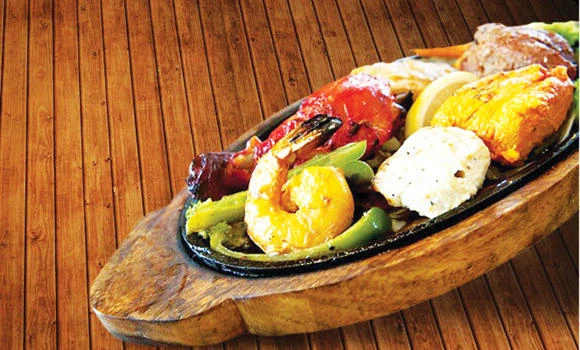
You might be tempted to order tandoori dishes. Besides chicken, fish, and shrimps, I noticed the presence of Tandoori ribs. It is the first Indian restaurant in Riyadh to my knowledge which features ribs. Tandoori cooking is a mainstay in many Indian restaurants and modern day tandoors are powered by electricity or gas instead of charcoal. However, the secret of a good tandoori lies in its marinade. Yogurt is a key ingredient because of its natural acidity which acts as a tenderizer. Incidentally, the green skin of raw papaya is also used as a tenderizer especially with meat. The marinade is made with ginger, garlic, coriander powder, chili powder, and garam masala. The meat is allowed to soak in a marinade for several hours or even overnight. Tandoori dishes are best eaten with tandoori naan. Making a naan in a tandoor requires a deft hand and certainly some tolerance to high temperatures. A naan is flat tear-drop shaped bread similar to the Middle Easter bread, it is flaky on the outside but soft in the center. Marinated meats are lowered into the oven on long metal skewers and the intense heat inside the tandoor cooks meat very quickly and seals in the juices, producing the distinctive and succulent results which characterize tandoori food.
If you are avoiding meat do not miss the Hara Bhara Kabab, a delicious North Indian vegetarian kabab which is light and not heavy. It gets its name and color from the spinach and peas it is made with. Other ingredients include potatoes, gram flour, ginger, green chili and chaat masala powder.
Riyadh is a great place to taste the many facets of Indian cuisine. Spice as I said specializes mainly in North Indian cuisine which is not too overpowering. Yogurt, in particular, imparts a richness and creaminess whereas nuts and fruit lend texture and sweetness to savory dishes. For more information log into: www.spice_sa.com
—
Email: [email protected]
Spice: Sample the richness of North Indian cuisine