RIYADH: They say that laughter is the best medicine, and sometimes, when the state of the world is looking overwhelmingly bleak, seeing the funny side is all that is left to do.
One of the most entertaining and fundamental parts of any newspaper are its caricatures, which provide a welcome relief to some of the tensions through a smile.
Arab News boasts some of the top editorial cartoonists in the region. Always on the nose, carefully toeing the line between the appropriate and the barrier-breaking, they have been speaking about how they got into the business and some of the favorite aspects of their work, while also offering advice to up-and-coming artists.
Mohammed Rayes knew from a young age that he wanted to be a caricature artist. “Most people don’t have a clear idea of what their life goals are during childhood, but gradually, a person finds themselves attracted to a specific field.

Mohammed Rayes
“I found myself drawn to caricature and started drawing for my first publication at the age of 15 when I was still in school,” he said.
Having worked for the Saudi Research and Publishing Co. for nearly 20 years, his work has been featured in a range of publications, including Arab News’ sister paper Asharq Al-Awsat.
Rayes joined Arab News four years ago and was the recipient of last year’s Saudi Media Award in the caricature category.
During his career, he has drawn countless cartoons, some more dark than funny, others more funny than dark, but always thought-provoking.

Arab News cartoonists balance barrier-breaking, appropriate content. (AN)
“Over the years I have drawn many caricatures that express different issues, so I am not able to identify a specific drawing close to me, but some of my works carry cherished memories. Examples are letters of thanks and praise from government officials for drawings that have been published, or thanks from the editorial staff of the newspaper,” he said.
He could not pinpoint a single source of inspiration, saying that he found many things in his daily life inspiring. “The community around me, from my family and friends to the general public, even people in the street are sources of ideas. Even situations or issues I find on social media articles in newspapers.”
Amjad Rasmi discovered his interest in caricature while attending the Jordan Institute of Fine Arts in the mid-1990s, but what began as a simple money earner became a way of life.

Amjad Rasmi
“The strongest motivation in my life to become a cartoonist in the beginning was the job, frankly. It started out that way at first, and now it is my life,” he said.
After getting published in several weekly newspapers, he moved to the local daily press as a full-time artist. Since 2005, his work has been published in Arab News in conjunction with Asharq Al-Awsat.
Known for his unique style and visuals, as well as his signature sense of humor, Rasmi has been recognized internationally for his various published works.
“I am a visual artist before I am a cartoonist. This is reflected in my drawing style in terms of line and perspective, and the importance of color and its connection with the content.
“There are many inspiring things in our lives. The extent to which I feel and get affected by things creates a state of brainstorming. I often try to distinguish between my own reality and true reality by presenting my ideas … there is a big difference between the two that not many people realize,” added Rasmi.
The impact of the artists of the past still resonate in Arab News’ history.
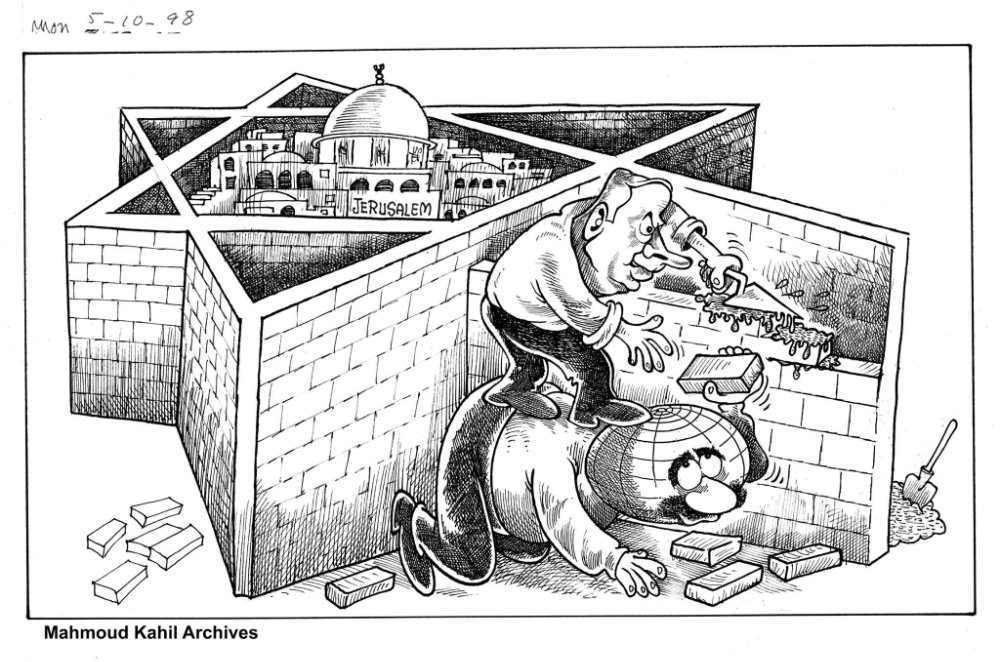
Mahmoud Kahil, the famous Lebanese-born British editorial cartoonist, was one of the greatest artists to be featured in Arab News.

Mahmoud Kahil
When the Lebanese Civil War broke out, he found himself forced to leave when travel between east and west Beirut for work became too much for him, though he expressed his love for his home country for the rest of his life and often longed to return.
Kahil moved to London in 1978, where he began working with Asharq Al-Awsat, Arab News and Al-Majalla magazine. He also became the chief cartoonist for the monthly English-language journal Middle East International.
He used his cartoons as a means of fighting oppression and wrongdoing. A great supporter of the Palestinian people, he once named Yasser Arafat (the late leader of the Palestine Liberation Organization) as his favorite person to draw, saying that “for better or worse, he is an inspiration, due to his mannerisms, the way he looks and the way he dresses.”
Kahil’s most lasting and important legacy as a cartoonist was the way in which his work, with remarkable simplicity, familiarized the world with the Arab reality and highlighted issues vital for the Arab people.
He passed away unexpectedly in 2003 at the age of 66, due to complications during heart surgery, but his legacy has stayed very much alive in the continued recognition of his work. In 2015, the American University of Beirut created the Mahmoud Kahil Award, a region-wide accolade to honor Arabs in the field of cartoons, illustrations and graphic design.
Former Arab News Editor-in-Chief Khaled Almaeena, once said: “He (Kahil) was a man of simple taste. His eyes always had a twinkle, and whatever the situation that twinkle stayed in place. Kahil was at heart a humanist. He cared for the poor, the oppressed and the dispossessed. It did not matter what the ethnic or religious beliefs these people held.”