- From hydrogen technology to soil solutions, Tallinn innovators seek partnerships in the Kingdom
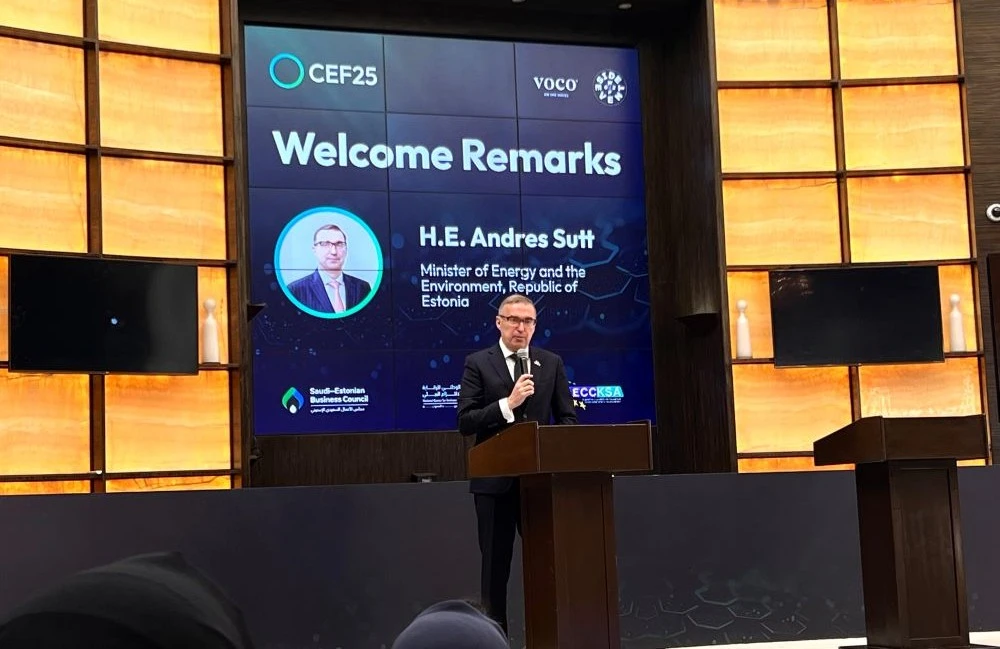
- Estonian Energy and Environment Minister Andres Sutt: Estonian companies like Stargate Hydrogen, who are doing high-efficiency alkaline electrolyzers, are interested to be present here
RIYADH: The Circular Economy Forum has highlighted opportunities for collaboration on sustainable environmental solutions — not only between Estonia and Saudi Arabia, but also with Nordic countries that lead in the field.
Estonian Energy and Environment Minister Andres Sutt told Arab News on Tuesday this was undoubtedly the case after a meeting with the Saudi Investment Recycling Company.
He said the technology he had seen had been world class, noting that there were many areas to connect innovations in the circular economy sector.
Sutt said: “We have certain interests and we have actually (had) very good conversations (at CEF25) about the green hydrogen market. Estonian companies like Stargate Hydrogen, who are doing high-efficiency alkaline electrolyzers, are interested to be present here.”
Stargate Hydrogen, an Estonia-based green hydrogen technology firm, is expanding globally and positioning itself as a key supplier for industrial decarbonization worldwide, including through a new headquarters in Riyadh and a partnership with RDI (Research, Development and Innovation) in Saudi Arabia.
Its advanced electrolyzer systems, including 5 MW stacks and a compact 10 MW module, aim to make clean hydrogen production more efficient and affordable.
The firm’s designs eliminate expensive catalyst metals by using ceramic-based materials, reducing costs while improving reliability and scalability.
Marko Virkebau, CEO of Stargate Hydrogen, told Arab News: “Besides those cost factors, there are also regulative factors that are sometimes bottlenecks to deployment, but I’m happy to say this is also one of the reasons we are in this region, because deregulated relative hurdles are much less here compared to Europe.”
With Estonia’s strong digital infrastructure supporting its environmental solutions, the minister said another area for collaboration with local partners was Saudi Arabia’s focus on artificial intelligence and data centers.
Taavi Madiberk, the CEO of Skeleton Technologies, told Arab News that the Kingdom was now positioned to shift from a technology importer to an innovation hub by building local value chains and adopting advanced energy-efficiency technologies.
Sutt added: “For Skeleton Technologies, the creed stabilization and the efficients of AI training data centers is something that could really add and contribute, and that is where I think there is a shared interest.”
International interest in collaboration extends to other areas as well.
Finnish-based environmental-solutions firm Lamor specializes in oil-spill response, waste management, soil and water remediation, and recycling.
It operates in more than 100 countries, with a focus on boosting local manufacturing and environmental-protection capabilities in Saudi Arabia and the Gulf Cooperation Council.
It opened its main manufacturing center in Dammam two months ago to “make products in Saudi Arabia for Saudi Arabia,” Johan Gron, CEO of Lamor, told Arab News.
Gron said: “I think that our vision — ‘let’s clean the world’ — as a company goes right through our DNA. And it’s very important that we can support Saudi Arabia to meet up to their Vision 2030.”
Tallinn University of Technology, Estonia’s only technical university, founded in 1918, offers around 80 study programs across engineering, business, IT, and natural sciences, emphasizing research, innovation, and sustainable digital development. To help shape a climate-neutral, tech-driven future, the university hopes to collaborate with Saudi Arabia on student exchange programs.
Tiit Land, rector of the university, told Arab News: “We are looking to, hopefully, sign some memorandums of understanding, (and) set up agreements with universities. And, of course, these climate change issues are so global that no single country can achieve this on their own. We have to collaborate.
“What we can provide from the university is our expertise in digitalization, clean NSC production, and circular economy. We are looking for exchange of students and also actually research collaboration because research is really what matters to achieve real changes.”
Also based in Tallinn, the agritech firm Ground Improver offers a soil-conditioning technology called Rescaype that improves soil structure, boosts water retention, reduces fertilizer and water needs, and significantly raises crop yields. The solution is an innovative, sustainable option for agriculture, landscaping, greenhouses, and land reclamation worldwide.
Anti Noor, co-founder of Ground Improver, was present at the forum hoping to connect with local entities. He told Arab News: “For us in Arabic countries, specifically Saudi Arabia, we understand that there is a big problem with desertification as well as desalination.
“So we hope to come to try to seek partners with whom we can help against these problems, reducing the salinity in the soil. This enables them to start putting trees back into the ground, as well as increasing the water retention.”
The minister also expressed an interest in working with the Saudi Ministry of Environment, Water and Agriculture, and has already had conversations with the National Center for Environmental Compliance, and the Saudi Investment Recycling Company about potential collaborations.