

In a book published last year called “If Russia Wins: A scenario,” German academic Carlo Masala presented a gloomy take on European defense and NATO in the Trump era. He speculated on how things could unfold if Vladimir Putin decided to test the alliance by rolling tanks into Narva, an Estonian town of 50,000 mostly Russian-speaking residents, close to the border with Russia.
The hypothetical crisis is described as unfolding in the spring of 2028 after Ukraine is forced to concede territory when its Western support collapses. In the book, Moscow assures Washington that the invasion is limited and merely meant to protect Russian speakers in the region. Masala describes a US president not dissimilar to Donald Trump making one thing clear to his NATO allies: America will not risk a third world war to defend a small town in Estonia.
Many experts consider the scenario nonsensical as, since 2022, NATO has increased the military authority vested in its commanders. But it remains highly plausible that a single politician could pull the plug by defying the alliance’s unity and commitment to Article 5, which considers an attack on one member state to be an attack on all members.
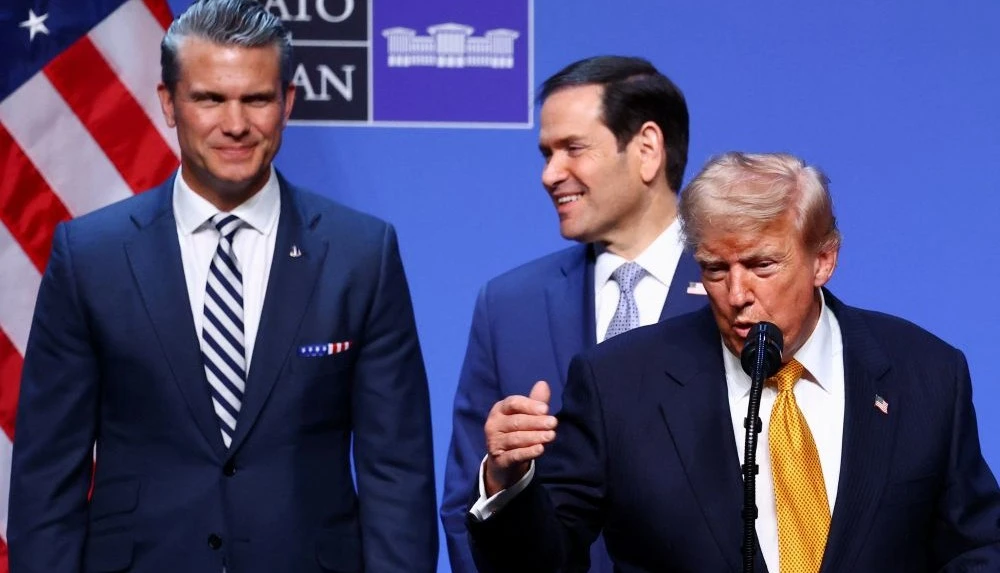
At this week’s NATO summit, this example no doubt animated the thoughts of all the participants, with the exception of Trump. The question for those who met in Ankara was not just what military structure is needed — NATO 3.0, NATO-minus or a European-led NATO — but would the US come to help if the necessity presented itself? And could NATO be anything without the US?
The Europeans are rushing to fire up their planning, their factories and their procurement, digging deep in their budgets for defense funding, amid the changing nature of the threats they face, as demonstrated by the Ukraine and Iran wars. But they cannot be envied due to the hole they find themselves in. They need to build a hybrid, conventional and nonconventional military umbrella with autonomous, uncrewed weaponry, Europe-sourced, that could still be integrated with the existing NATO structure and operability while having the potential to fight without the US.
Since he became NATO secretary-general almost two years ago, Mark Rutte has been tirelessly trying to keep the US anchored to the world’s biggest military alliance, employing outright flattery to dissuade Trump from acting on his threats to abandon it, take Greenland by force and withdraw American troops from the continent.
But the goalposts keep shifting. Despite the European NATO members increasing their defense spending, Trump appeared unmoved, saying he was still disappointed at their refusal to join the Iran war, which he launched alongside Israel without consulting them. He claimed that they had failed his loyalty test. Trump’s demand for loyalty is hard to measure or capture on any defense, procurement or deployment charts. He also repeated his threats on Greenland and a full troop withdrawal, adding that he likely would not have attended the summit if it was not held in Ankara.
In the age of an unreliable and possibly adversarial America, Europe is being forced to reassess and reorganize its security and defense at speed. The tasks ahead are daunting, especially transforming the economic-political EU bloc into a military and defense one. Many doubt Europe’s ability to make NATO work without the US. The task is colossal, including replacing assets on all fronts, from intelligence to reconnaissance, air defense, refueling and the strategic nuclear umbrella.
Policymakers will also have to work with blurred vision: to factor the US both in and out at the same time. They must throw money at a costly defense sector in a scenario where tanks and drones are needed today but might become obsolete tomorrow, as technology and the methods of war are rapidly evolving. The US may or may not come to Europe’s aid if it faced an existential threat.
Planning must also go ahead when trust in America is at an unprecedented low and when domestic problems and election upsets could derail even the best of intentions to build Europe’s defense to the scale needed.
Saving NATO in the age of Trump was on the minds of everyone in Ankara, but of course it was not discussed.
Mohamed Chebaro
Saving NATO in the age of Trump was on the minds of everyone in Ankara, but of course it was not discussed. Europeanizing NATO is maybe the next best option, but that is a complex task that will be made even more difficult by the need for EU-style institutions and consensus-building, even while the enemy is at the door.
The nature of the threats to Europe and world peace in general keep evolving. There is Iran’s hybrid warfare, which has strangled shipping and the world’s economy by threatening and closing key maritime chokepoints. And there is Russia’s potential to test a weighed-down NATO with various deniable actions that look for and then exacerbate holes in the eastern front of the alliance’s security and defense apparatus.
Europe’s leaders must look closely at what they represent and consider whether the continent’s traditional liberal democratic ethos and values are still a platform worth uniting for. And are the rules-based international order and international law viable and worth defending in a world where societies everywhere are in transition?
There is a transatlantic rift, meaning uncertainties that one cannot hide. But those leaders that met in Ankara need to step up their preparations for a NATO with much less American leadership and help — and potentially an urgent need to go back to the drawing board. NATO is an American alliance designed for an outdated set of American priorities. Today’s challenges and the defense of Europe requires European tools, as well as a uniform political philosophy and, above all, a well of trust in a common destiny that is still worth saving.
- Mohamed Chebaro is a British-Lebanese journalist with more than 25 years of experience covering war, terrorism, defense, current affairs and diplomacy.


