
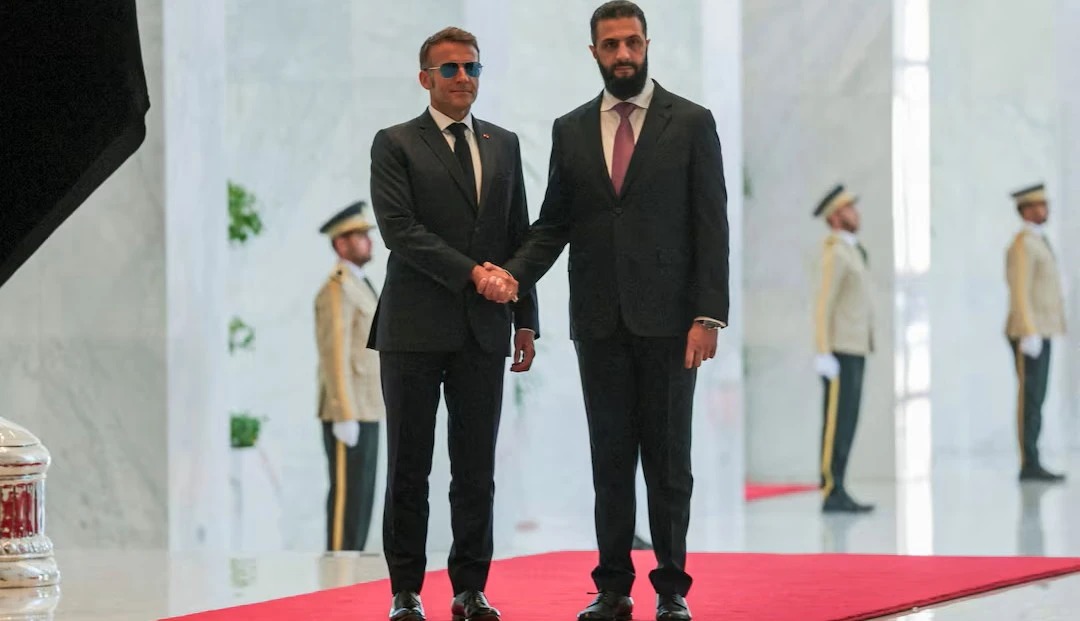

French President Emmanuel Macron’s visit to Syria obviously covered many files, from energy to geopolitical stability. It also had a message regarding Lebanon that has been repeated several times before. Indeed, France is encouraging the new Syrian authorities to fully respect Lebanon’s independence and end all interference in its affairs.
In other words, Macron does not want Syria to play a role in the current back and forth taking place regarding the disarmament of Hezbollah. Through Paris’ lens, the goal is to empower Lebanese sovereignty and avoid new entanglements in the Levant. However, this policy keeps Hezbollah at the center of political decision-making in Lebanon. And this is clearly at odds with the US’ position.
During his discussion with Syrian President Ahmad Al-Sharaa on the sidelines of the NATO Summit in Ankara this week, when it comes to Lebanon, Donald Trump’s message was that the new Syria should play a stabilizing role in the region by helping to reduce Hezbollah’s influence. He has repeatedly stated that he believed Syria could “deal with Hezbollah.” Trump also claimed to have directly asked Al-Sharaa to help contain Hezbollah, while clarifying that this would not involve a Syrian military intervention in Lebanon but rather security and political cooperation aimed at strengthening the authority of the Lebanese state. But this did not seem like a red line.
“Stabilizing” is a recurrent theme in the French and US presidents’ visions for Lebanon. The US and France seek to strengthen security along the Syrian-Lebanese border to combat arms and drugs smuggling, as well as the activities of armed groups, while limiting the influence of nonstate actors that destabilize the region. This includes preventing Syrian territory from serving as a rear base for Hezbollah’s activities. Both approaches also seek to ease the pressure of Syrian refugees on Lebanon by creating the conditions for a gradual and safe return to their homeland.
Both Washington and Paris hope that a rebuilt Syria, reintegrated into its regional environment, will create vast economic opportunities and increase strong exchanges with Lebanon. They also want to reduce the risks of military escalation with Israel. Trump even stated that Israel should exercise restraint in Lebanon to allow Damascus to participate in stabilizing the situation.
We are witnessing various efforts to create a new balance in the Levant, based on sovereign states, secure borders and strengthened regional cooperation. It is thus not surprising that, as these geopolitical shifts are being outlined, Syria has been struck by several attacks.
Last week, a bomb attack in central Damascus killed and wounded several people, while another attack was thwarted in the capital’s suburbs the following day. Two explosions also occurred in Damascus during Macron’s visit, killing one and injuring several people but not disrupting his official schedule. This might be pure speculation on my behalf, but it is undoubtedly not always those who commit these acts who ordered them.
The new Syria is a direct threat to Iran’s goal of continued hegemony in the Levant. For decades, Tehran benefited from access to Syria’s Mediterranean coast, allowing it to blackmail and put pressure on Europe and the US. It is now being cornered. I am not even sure Russia, which is maintaining its military bases in Syria, would be totally unhappy with an Iranian exit.
There are now several questions and scenarios. For Lebanon, one key question is how Syria will deal with the threats to its security. Will it intervene to disarm Hezbollah, which also represents a security threat to Damascus? And if so, how? Could it intervene militarily? The quick answer is that, for now, as it is still bringing together all the pieces required for its own unity and sovereignty, it is unlikely to seek conflict. However, if clear indications were to emerge that Hezbollah was carrying out activities that threaten the stability and security of Syria, then this position could change and a more aggressive posture might take shape.
Another element in this equation that should be considered is what Damascus could gain from such an intervention. What could make it appealing to take this risk? Now, some might be surprised by this but it is an extension of a declaration attributed to former US Secretary of State Henry Kissinger that you cannot make peace in the Middle East without Syria. This concept is what gave the Assad regime power over both Syria and Lebanon.
Through Paris’ lens, the goal is to empower Lebanese sovereignty and avoid new entanglements in the Levant.
Khaled Abou Zahr
Are we now about to face the same situation, with a potentially greater reward for Syria in Lebanon, if it removes Hezbollah and the Islamic Revolutionary Guard Corps from Lebanon like Hafez Assad did with the Palestinians? Is a new mandate for Lebanon being offered once again?
In essence, noninterference is something everyone wishes for — and it is clear that the new leadership in Syria is sticking to this vision for now. So, it is in alignment with Macron’s position. But the issue with France’s view is that it goes a step further and offers Hezbollah a special status. And it is, in fact, indirectly shielding it from pressure. This could also lead to the reverse of its objective being achieved.
Hezbollah’s arsenal has long represented the greatest risk of further destabilizing Lebanon. Today, it prevents Beirut from exercising full sovereignty due to its parallel power structures. Tomorrow, it could invite renewed foreign control of the country. This is why there can be no sustainable future for Lebanon as long as Hezbollah remains. France needs to take note.
- Khaled Abou Zahr is the founder of SpaceQuest Ventures, a space-focused investment platform. He is the CEO of EurabiaMedia and editor of Al-Watan Al-Arabi.


