


Most geopolitical discussions about Central and Eastern Europe are focused on the many security challenges in the region. A timely reminder of these challenges occurred last week, when Ukraine marked the sixth anniversary of Russia’s invasion and annexation of Crimea. The aftermath of this Russian aggression in 2014 refocused the US and its NATO allies on the need to defend and deter further aggression on Europe’s eastern flank.
However, policymakers must take a holistic approach when it comes to Central and Eastern Europe. It is not enough just to say that NATO will protect the countries in the region. Compared to Western Europe, this region is in need of economic development and foreign investment too. These economic issues are arguably just as important in the long term as the security issues.
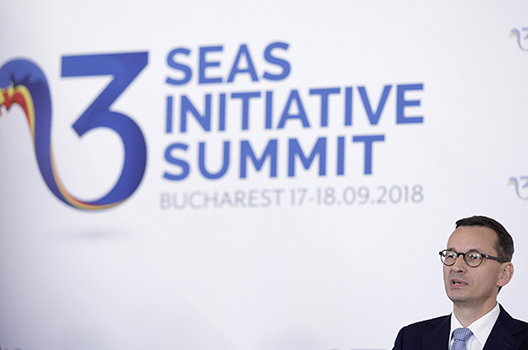
A good example of policymakers thinking beyond security in the region is the Three Seas Initiative (3SI). Launched in 2016, the 3SI’s main purpose is to strengthen trade, infrastructure, energy and political cooperation among EU countries bordering the Adriatic Sea, the Baltic Sea and the Black Sea.
The region between these seas is strategically important. The 12 countries in the 3SI (Austria, Bulgaria, Croatia, Czech Republic, Estonia, Hungary, Latvia, Lithuania, Poland, Romania, Slovakia, and Slovenia) account for 28 percent of EU territory and 22 percent of its population, but only 10 percent of its gross domestic product.
The economic and trade importance of the Danube River and its tributaries has made Eastern Europe (covering today’s 3SI) important for centuries. Eastern Europe has also played a key role in many of Europe’s most significant events. For example, the starting points of both world wars were found in the region of the 3SI. If this region is secure and stable, then the whole of Europe will be secure and stable.
In terms of infrastructure, the region also lags behind Western Europe. A legacy of the Cold War and the Soviet-dominated Warsaw Pact means that most of its infrastructure runs east to west, stymieing greater regional interconnectedness.
This is why the 3SI is focused on developing north-south interconnections, pipelines, roads, railways, and electrical grids. It is hoped that this will spur economic growth, prosperity and security. Under the right circumstances, this north-south corridor in Eastern Europe could one day become the backbone of Europe.
Of course there is always the issue of funding. To encourage private sector interest and investment, Poland, Romania and Estonia have committed some €620 million ($683 million) to the Three Seas Investment Fund, which was created last year. There is an expectation that other Three Seas countries will invest, but also a hope that public investors such as the European Bank for Reconstruction and Development or private investors in Asia and the Middle East will take an interest too. The plan is for private sector managers to run the fund on purely commercial terms, driven by two principal goals: Investment in regional infrastructure projects and returning a profit.
The Trump administration has been a strong backer of the 3SI. In 2017, President Donald Trump became the first US president to attend a 3SI meeting. And, at the recent Munich Security Conference, Secretary of State Mike Pompeo announced an American commitment of $1 billion to the Three Seas Investment Fund.
A successful 3SI will also keep the region less beholden to Russia and give it alternatives to China.
The nations involved in 3SI are largely dependent on Russian energy, but the threat from Russia, especially in the realm of cyberattacks, influence operations and propaganda, is real. The 3SI will help these nations resist Russian pressure, while also developing greater interconnections between the nations themselves. As noted by Trump in Warsaw in 2017: “The Three Seas Initiative will not only empower your people to prosper, but it will ensure that your nations remain sovereign, secure, and free from foreign coercion.”
Of course, in a region of the world that desperately needs improvements and investments in infrastructure, China is never far behind. Back in 2012, China launched the so-called 16+1 Initiative, seeking to make inroads with 16 countries in Central and Eastern Europe. In the past eight years, the 16+1 has lost some steam and it has not yet achieved the impact that Beijing had hoped. However, China remains ambitious, looking to make long-term investments in the region, especially in critical sectors, to garner economic, diplomatic and political influence.
Under the right circumstances, this north-south corridor in Eastern Europe could one day become the backbone of Europe.
Luke Coffey
The next 3SI meeting takes place later this year in Estonia. This will likely prove a pivotal moment for the group — either with tangible outcomes starting to magnify, or with the initiative fading away as a missed opportunity due to a lack of political will.
The 3SI will hopefully strengthen business, energy and geopolitical ties in the region, while also counterbalancing Chinese and Russian efforts to make regional inroads.
A strong, prosperous and secure Eastern Europe is in the world’s interest, and the 3SI can play a role in making this happen. The international community should work with Estonia to advance an agenda that enhances cooperation among the nations of the 3SI.
- Luke Coffey is director of the Douglas and Sarah Allison Center for Foreign Policy at the Heritage Foundation. Twitter: @LukeDCoffey


