
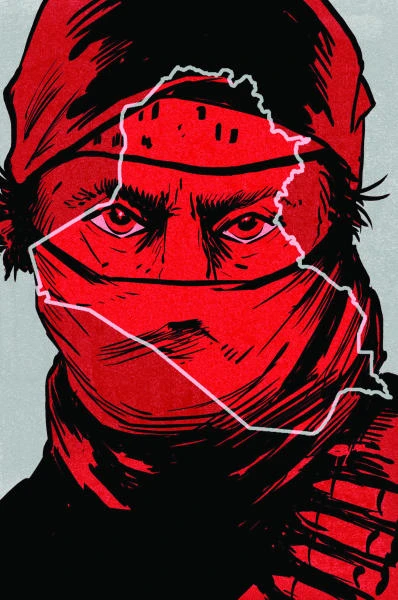

Fallujah, the City of Mosques, whose existence dates from Babylonian times, looms large in the historical consciousness of Iraqis, at least Iraqis in touch with their modern history.
It was there in Fallujah where Lt-Col. Gerard Leachman — the British spy, political officer and colonial enforcer, whose job during Britain’s occupation of Iraq was to ensure that Iraqis remained subservient to the Crown — was murdered by tribal insurgents in August 1920, an event that galvanized the country’s revolt against British rule at the time, a time when Sunni and Shiite communities together evinced unprecedented cooperation in the year-long fight against London’s plans to accede to Iraqi independence — but only under British tutelage and in accordance with a British timetable
Then came the 1980s when Fallujah was transformed from a sleepy town into a heavily industrialized hub after Saddam Hussein, the Iraqi dictator, approved the construction there of several factories, which considerably helped in tripling the town’s population and in earning it the reputation as the heart of what later came to be known as the Sunni Triangle.
Then in April 2004 the Americans came to Fallujah, bearing arms, to mount an assault against Sunni rebels entrenched there, only to pull back days later, ostensibly because of concerns about civilian casualties. But then they returned seven months later, in November, to wage that unforgettable house-to-house battle that cost the lives of 100 Marines and 1,200 insurgents.
And today, as we speak, Fallujah dominates the news and preoccupies our minds again while sundry government forces bear down on a city held by Daesh militias for the last two years and inhabited by roughly 50,000 civilians inside it, a remnant of its original population of 350,000. These sundry forces are enlisted Army soldiers (who work closely with US advisers), Shiite militias (who are trained by and loyal to Iran) and token Sunni tribal fighters, who are expected (perhaps) to hold the city once it is taken over — for no one has forgotten the vengeful mayhem these Iran-backed militias inflicted on Sunni Tikrit when they entered it as “liberators” last year
So do the math: A mostly Shiite force converging on a mostly Sunni city. If this is not going to exacerbate sectarian tensions in a country already fractured by sectarian animus, one is hard put to know what will.
There is a consensus among analysts that what we are looking at here is a catastrophe in the making — and it is hard to disagree. The catastrophe? The fate that may befall the 50,000 civilians trapped inside the city. Lise Grande, the top United Nations humanitarian official in Iraq, told the New York Times last Tuesday: “I’m desperately worried what is happening to civilians in Fallujah.” And well she might. These civilians are facing horrifying conditions, with food, medicine and potable water in extremely short supply. Reportedly, a bag of flour in the city now costs $850. We all want to see Daesh cut down to size, and finally eliminated, but what fate, we wonder, awaits 50,000 innocent Iraqi men, women and children once government forces pounce on the heart of Fallujah? The New York Times correspondent in Baghdad, Tim Arango, filing from “Near Fallujah” last Tuesday, as “units of Shiite fighters rained down mortar shells and rockets on the city and its (Daesh) occupiers,” had this to say about the issue: “United Nations humanitarian officials in Iraq believe they are racing against time to avert what they worry could be a blood bath should Iraqi forces storm the city. Those fears were heightened on Monday morning when Iraq’s United States-backed counterterrorism forces left their bases and advanced from the south to the city.”
All this would not have happened had successive central governments that materialized in Baghdad following the 2003 American invasion, worked hard at earning the trust of their Sunni citizens and at bringing them equitably into the political process. It doesn’t take a rocket scientist to tell us that it was the resentment felt by large sections of the Sunni public that enabled Daesh to take control of population centers like Fallujah and Mosul two years ago.
In short, it was the shortsightedness encoded in sectarianism that brought the country to this dismal point. Had Iraqi leaders, from the outset, recognized sectarianism for what it was — a social sickness whose symptoms are turmoil, conflict and bloodshed — Iraqis would not be where they are today, a people inhabiting a nation at odds with its own sense of selfhood.
Sectarianism is a self-inflicted wound that, in history, has destroyed nations and devastated human souls. It’s a poison without antidote that secretes itself into the body politic and destroys it. As Arnold Toynbee succinctly put it in his monumental 12-volume tome, A Study of History: “Nations die of suicide, not murder.” And one wonders where Iraqis, today, place Fallujah in their historical consciousness.
It was there in Fallujah where Lt-Col. Gerard Leachman — the British spy, political officer and colonial enforcer, whose job during Britain’s occupation of Iraq was to ensure that Iraqis remained subservient to the Crown — was murdered by tribal insurgents in August 1920, an event that galvanized the country’s revolt against British rule at the time, a time when Sunni and Shiite communities together evinced unprecedented cooperation in the year-long fight against London’s plans to accede to Iraqi independence — but only under British tutelage and in accordance with a British timetable
Then came the 1980s when Fallujah was transformed from a sleepy town into a heavily industrialized hub after Saddam Hussein, the Iraqi dictator, approved the construction there of several factories, which considerably helped in tripling the town’s population and in earning it the reputation as the heart of what later came to be known as the Sunni Triangle.
Then in April 2004 the Americans came to Fallujah, bearing arms, to mount an assault against Sunni rebels entrenched there, only to pull back days later, ostensibly because of concerns about civilian casualties. But then they returned seven months later, in November, to wage that unforgettable house-to-house battle that cost the lives of 100 Marines and 1,200 insurgents.
And today, as we speak, Fallujah dominates the news and preoccupies our minds again while sundry government forces bear down on a city held by Daesh militias for the last two years and inhabited by roughly 50,000 civilians inside it, a remnant of its original population of 350,000. These sundry forces are enlisted Army soldiers (who work closely with US advisers), Shiite militias (who are trained by and loyal to Iran) and token Sunni tribal fighters, who are expected (perhaps) to hold the city once it is taken over — for no one has forgotten the vengeful mayhem these Iran-backed militias inflicted on Sunni Tikrit when they entered it as “liberators” last year
So do the math: A mostly Shiite force converging on a mostly Sunni city. If this is not going to exacerbate sectarian tensions in a country already fractured by sectarian animus, one is hard put to know what will.
There is a consensus among analysts that what we are looking at here is a catastrophe in the making — and it is hard to disagree. The catastrophe? The fate that may befall the 50,000 civilians trapped inside the city. Lise Grande, the top United Nations humanitarian official in Iraq, told the New York Times last Tuesday: “I’m desperately worried what is happening to civilians in Fallujah.” And well she might. These civilians are facing horrifying conditions, with food, medicine and potable water in extremely short supply. Reportedly, a bag of flour in the city now costs $850. We all want to see Daesh cut down to size, and finally eliminated, but what fate, we wonder, awaits 50,000 innocent Iraqi men, women and children once government forces pounce on the heart of Fallujah? The New York Times correspondent in Baghdad, Tim Arango, filing from “Near Fallujah” last Tuesday, as “units of Shiite fighters rained down mortar shells and rockets on the city and its (Daesh) occupiers,” had this to say about the issue: “United Nations humanitarian officials in Iraq believe they are racing against time to avert what they worry could be a blood bath should Iraqi forces storm the city. Those fears were heightened on Monday morning when Iraq’s United States-backed counterterrorism forces left their bases and advanced from the south to the city.”
All this would not have happened had successive central governments that materialized in Baghdad following the 2003 American invasion, worked hard at earning the trust of their Sunni citizens and at bringing them equitably into the political process. It doesn’t take a rocket scientist to tell us that it was the resentment felt by large sections of the Sunni public that enabled Daesh to take control of population centers like Fallujah and Mosul two years ago.
In short, it was the shortsightedness encoded in sectarianism that brought the country to this dismal point. Had Iraqi leaders, from the outset, recognized sectarianism for what it was — a social sickness whose symptoms are turmoil, conflict and bloodshed — Iraqis would not be where they are today, a people inhabiting a nation at odds with its own sense of selfhood.
Sectarianism is a self-inflicted wound that, in history, has destroyed nations and devastated human souls. It’s a poison without antidote that secretes itself into the body politic and destroys it. As Arnold Toynbee succinctly put it in his monumental 12-volume tome, A Study of History: “Nations die of suicide, not murder.” And one wonders where Iraqis, today, place Fallujah in their historical consciousness.


