
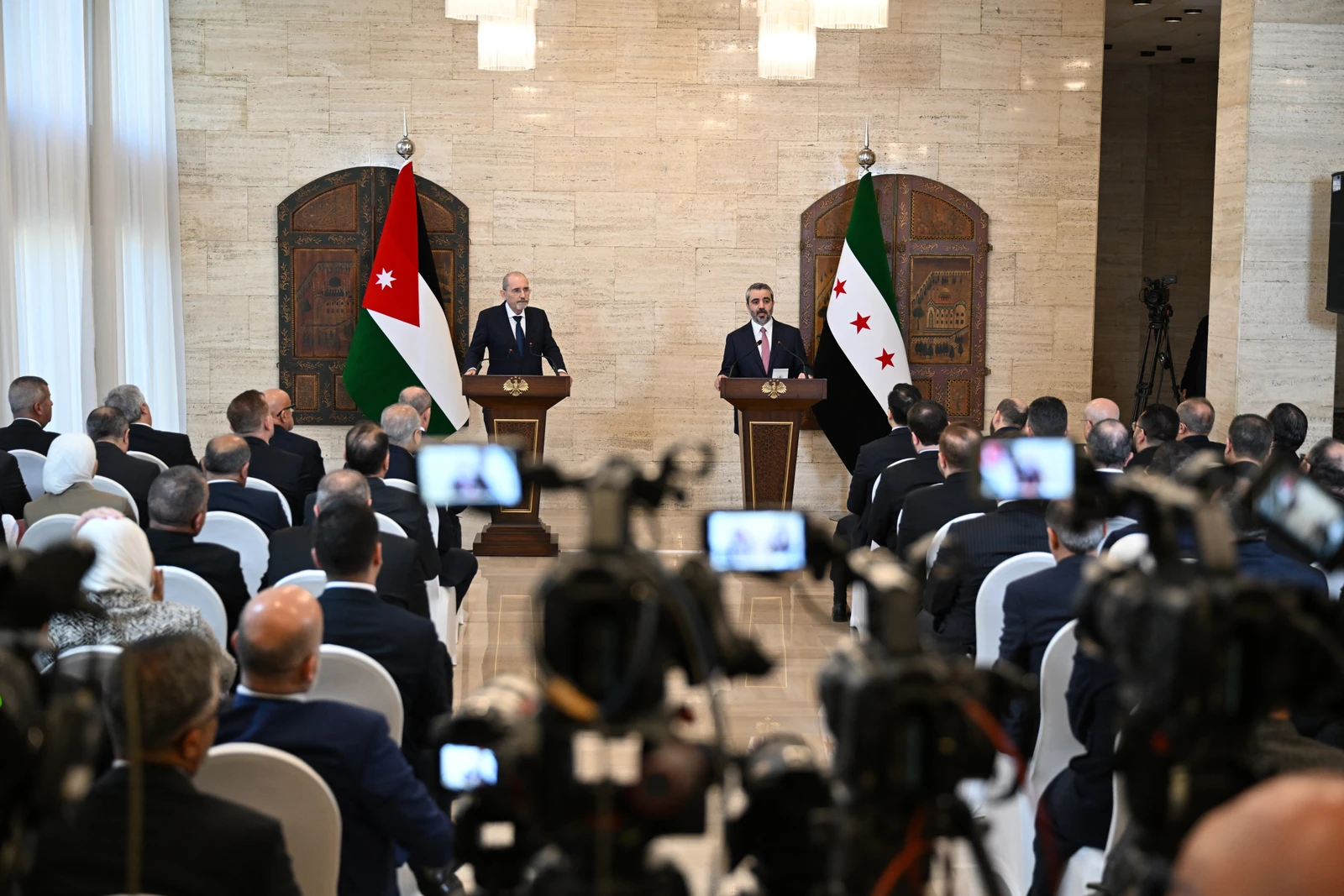

When Jordanian Foreign Minister Ayman Safadi met with Syrian President Ahmad Al-Sharaa in Damascus last week, he was accompanied by the kingdom’s army chief and intelligence director. The makeup of the high-level delegation was in itself a message of how keen Amman is to mend fences with Damascus. The visit came weeks after Jordanian jets struck targets in Deraa following the terrorist attack on a church in Hamoud, Karak governorate — an operation Amman said hit Daesh sites and Damascus said killed civilians. The ensuing crisis between the two neighbors had to be contained quickly. For Jordan, southern Syria is not a foreign policy file but a national security one.
Historically, since both countries gained independence, bilateral ties have ebbed and flowed. But when the civil war erupted in Syria in 2011, Jordan saw itself being challenged by the crisis across its northern border. The Syrian civil war sent more than a million refugees to a small, resource-poor Jordan.
The war closed the overland route to Syria, leaving Jordan’s exports to Turkiye, Lebanon and Europe badly constrained. It also gave extremist groups a base on Jordan’s doorstep. Daesh spread through western Deraa near the Yarmouk basin and across the eastern desert, so Jordan joined the international coalition against it.
And then there are the captagon smuggling rings. What began as a criminal trade under Bashar Assad’s patronage to generate income to finance the war became, in effect, a major drug manufacturing and smuggling network. Jordan’s army reported 536 smuggling and infiltration attempts in 2025 and 231 in the first half of 2026, with drones and balloons increasingly used to bypass border defenses.
Amman quickly welcomed the new government in Damascus while pushing to institutionalize relations
Osama Al-Sharif
The fall of the Assad regime in December 2024 dethroned the drug networks’ state sponsor but it did not shut down their activities. These networks fragmented into decentralized groups that became harder to deter and locate.
This is why Amman quickly welcomed the new government in Damascus while pushing to institutionalize relations. A joint coordination council, frequent high-level visits and a series of cooperation agreements reflect Amman’s determination to cement its ties with the new leadership. For Amman, the logic was simple: a Syrian state with real authority over its territory can safeguard the 375-km border Jordan shares with it, while a weak or fragmented Syria cannot. Jordan needs to see Syrian soldiers back in Deraa, in Quneitra and along the border.
Israeli incursions into Syrian territory have complicated Jordan’s efforts to bolster the Syrian presence in the south. Since Assad’s fall, Israeli forces have crossed into the 1974 buffer zone and operated across Quneitra, Mount Hermon and the Yarmouk basin, with repeated incursions into Deraa close to Jordan’s border. Amman has condemned these violations of Syrian sovereignty and Safadi has argued that instability in southern Syria is a threat to Jordan, adding that Israel is the only party that wants to see Syria divided. Jordan hosted a US-mediated Syrian-Israeli meeting in August, yet Israeli incursions continued afterward — a sign of how limited Amman’s leverage could be.
But events in Sweida then complicated Jordan’s efforts and heightened its concern. After the deadly violence there in July 2025, Jordan joined Syria and the US in a road map built on Syria’s unity and the rights of Sweida’s people as Syrian citizens. Sheikh Hikmat Al-Hijri’s camp rejected the road map, with supporters claiming a right to autonomy or even secession. Other Druze leaders have insisted that Sweida remains an integral part of Syria.
Israeli incursions into Syrian territory have complicated Jordan’s efforts to bolster the Syrian presence in the south
Osama Al-Sharif
The crisis in Sweida has become a major security concern for Jordan, which fears that Israel’s support for a separatist faction in southern Syria could deliver a Tel Aviv-backed enclave beside its border. Such an enclave would be open to outside manipulation in an already troubled and divided country. For Jordan, which has spent 15 years managing the spillover from Syria, an Israeli-backed territory so close to its borders is a nightmare scenario that cannot be allowed.
Water security is another key dossier topping Amman’s discussions with Damascus. Jordan is among the most water-scarce countries on Earth and the Yarmouk basin is vital to its national water strategy. Israeli positions near that basin and the Al-Wahda Dam threaten this valuable resource, while also posing a military challenge. Again, Jordan’s interest lies in a strong Syrian state that can manage and protect these shared resources and fulfill its obligations under bilateral agreements.
But Amman has interacted with the new government in Syria long enough to know its limits. Jordan may have reservations about the pace of the reforms promised by Damascus, about hard-line elements close to the government and about the fate of foreign fighters. Jordan’s mediation in Sweida aims to maintain traditional ties with the Druze community and keep Israel away from that point of contact.
Critics will question engaging with a government whose forces were implicated in violence against minorities, while others will claim that the Deraa strikes may have damaged trust with ordinary Syrians. These concerns are real but, for now, preserving Syria’s territorial integrity and foiling what Amman sees as an Israeli effort to divide the country are its top priorities.
There is no better alternative for safeguarding Jordan’s key objectives. Keeping its distance from Damascus would only leave Amman with less leverage over key issues such as borders, refugees and shared resources. On the other hand, diplomatic engagement gives Amman access to issues such as border security, Sweida and the long-discussed projects to connect the two economies. These include transport links, energy pipelines and future reconstruction. The reality is that Syria needs Jordan too, since its frontiers with Lebanon, Iraq and Turkiye demand attention and securing the Jordanian border would free up resources elsewhere.
While policies and attitudes change over time, geographic reality is constant. Jordan understands that it must adapt to geopolitical changes in line with its national interests. It cannot choose its neighbors or move its frontiers away from external threats. But it can adopt a pragmatic approach that influences developments inside Syria.
Jordan’s support for Damascus is not ideological and Amman has no illusions about the challenges facing Syria’s transition. The challenge is geopolitical: a divided Syria is a serious national security problem, while a unified one is the best available solution.
Osama Al-Sharif is a journalist and a political commentator based in Amman. X: @plato010


